Uzusakhe Mbebe’s deep connection to agriculture began in Komani (Queenstown) in the Eastern Cape where he learned the fundamentals of farming from his grandfather, his earliest role model.
This early passion led him to Winterberg Agricultural High School in Fort Beaufort, where his commitment to a career in the sector was firmly established.
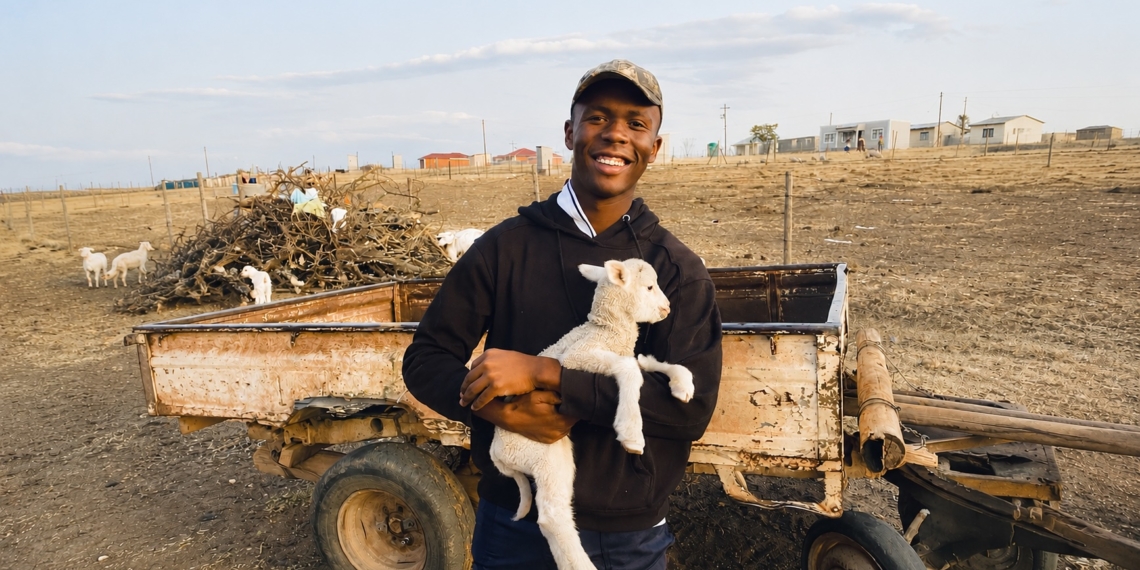
Today, as a third-year student at Fort Cox Agricultural College pursuing a diploma in agricultural business and majoring in animal production, Mbebe is already putting his classroom knowledge into practice.
Back home in Mceula village, just outside Whittlesea, he works side by side with his family to manage and grow their livestock and mohair enterprise.
Honouring a family farming legacy
Mbebe first developed his love for the land on his family’s property in Bloukrans, situated just outside Komani. Watching his late maternal grandfather, Tristan November, care for the soil and livestock left a lasting impression on him that only grew stronger over time.
“The true turning point came in 2018 when I looked at my father’s cattle,” Mbebe says. “In that moment, childhood admiration transformed into a clear decision, and I knew my future belonged to the land.”
In 2019, Mbebe officially launched his farming business, trading under the name Ummagrico (Pty) Ltd. He began working alongside his father, Zolani Mbebe, and his uncles, Fudukile Ndlovu, Samnkelo Ndlovu, Lukhaya Ndlovu, and Zithulele Ndlovu, who all trade under the business entity.
When he first started that year, his father gave him a foundational number of livestock to kickstart his independent venture.

Through disciplined management and strategic growth, Mbebe has built upon that initial gift and today manages a substantial herd of over 120 livestock under his own name.
To turn this lifelong passion into a viable commercial career, Mbebe focused on building a strong educational foundation. Before heading to tertiary school, he sought out practical industry experience by working at Number 2 Piggeries under the Fort Hare Piggery Trust.
His dedication to his studies has also brought him into the fold of the Mohair Empowerment Trust, expanding his practical knowledge of premium animal fibres.
The student stockman
While away at college, Mbebe employs a full-time herder on the farm and returns home for major husbandry operations such as dipping, shearing, and classing. His responsibilities span daily flock management, animal health checks, and strategic planning.
“With our Dohne Merinos, I handle routine vaccinations, parasite drenching, and monitoring nutritional needs during the critical lambing period,” Mbebe says.
He adds that working with the Mohair Empowerment Trust has given him invaluable, hands-on experience in specialised animal fibre production.
“These responsibilities have taught me that successful livestock management is about proactive prevention rather than reaction. Animal productivity is directly tied to daily details, like managing grazing pressure on communal land and monitoring environmental stressors.”
Uzusakhe Mbebe
Balancing demanding academic studies with a growing agricultural business requires strict time management and a reliable support network.
“Because I cannot be in two places at once during the academic term, I rely heavily on my father and uncles to manage the daily physical labour,” Mbebe explains. “I contribute strategically, coordinate logistics, and step in fully during weekends and academic holidays.”
Mbebe has already successfully applied his college coursework to the farm, particularly regarding parasite control on communal grazing land, where roundworms pose a constant threat to livestock health.

Photo: Supplied/Food For Mzansi
“In my animal production and agricultural business modules, we emphasised targeted herd health programmes and tracking input costs,” says Mbebe.
He replaced the traditional method of blanket-treating the entire flock of over 400 Dohne Merinos with a structured monitoring approach. This strategic pivot prevents expensive veterinary remedies from causing parasite resistance and draining the business finances.
“We started evaluating animal condition scores and checking for signs of anaemia before dosing. Applying this class-learned principle directly reduced our medicine expenses, protected flock health, and showed my family the immediate financial benefit of marrying modern science with traditional farming methods.”
Commercialising communal farming
Mbebe explains that choosing the Dohne Merino breed was a strategic decision based on the animal’s dual-purpose versatility and rugged adaptability.
While many farmers choose between meat or premium fibre, the Dohne Merino produces high-quality, fine apparel wool alongside fast-growing mutton carcasses.
“More importantly for our specific setup, they are hardy, resilient animals with an outstanding foraging ability,” Mbebe says.
On communal land, where grazing resources are shared and environmental conditions can be unpredictable, the breed thrives, maintaining high fertility rates and low maintenance requirements.
“Choosing the Dohne Merino was a strategic business decision to maximise our profit margins from both meat and wool on a single, highly adaptable animal.”
Looking forward, Mbebe explains that his ultimate vision is to transition the family operations from smallholder farming into a highly structured, commercialised enterprise.
“I want to establish our setups as models of how communal land can be utilised efficiently to produce premium quality wool, mohair, and beef,” he says.

“I want to implement digital herd management tools to track individual animal performance, pedigree, and health histories, which is vital for commercial growth,” Mbebe adds.
Furthermore, he wants to introduce advanced veld management techniques to improve grazing efficiency on communal land, ensuring their flock and cattle have optimal nutrition year-round without degrading the soil.
Marrying these modern techniques with his mohair insights will allow the family to maximise profit margins and sustainably scale the business.


ALSO READ: HR graduate ditches desk for piggery: Zintle builds thriving farm