Researchers Dr Blessings Masuku and Dr Colletta Gandidzanwa explore how urban farming is helping Johannesburg’s poorest households put food on the table while creating greener, more climate-resilient communities. They argue that greater investment, training and support are urgently needed if these community-led food systems are to withstand growing climate and food security challenges.
Urban agriculture, where plants and livestock are farmed within city limits, is increasingly recognised and promoted as a solution to food insecurity and a way to green cities so that they adapt to climate change.
It includes farming plants upwards (vertical systems), on roofs (green roofs), in the garden and in communal areas.
As interdisciplinary scholars, our research interests span the boundaries of agriculture, economics, geography, and urban studies. Most of our projects look at the point where climate, health, food systems, water, energy and Indigenous knowledge systems overlap.
In a recent paper we examined how home and community gardening can strengthen household food security while promoting urban greening as a pathway to climate resilience.
We interviewed 40 gardeners from Alexandra township, in Johannesburg, South Africa. (In South Africa, townships are places on the outskirts of cities that the apartheid government set aside for Black, so-called Coloured, and Indian populations during the 19th and 20th centuries, that were kept undeveloped.)
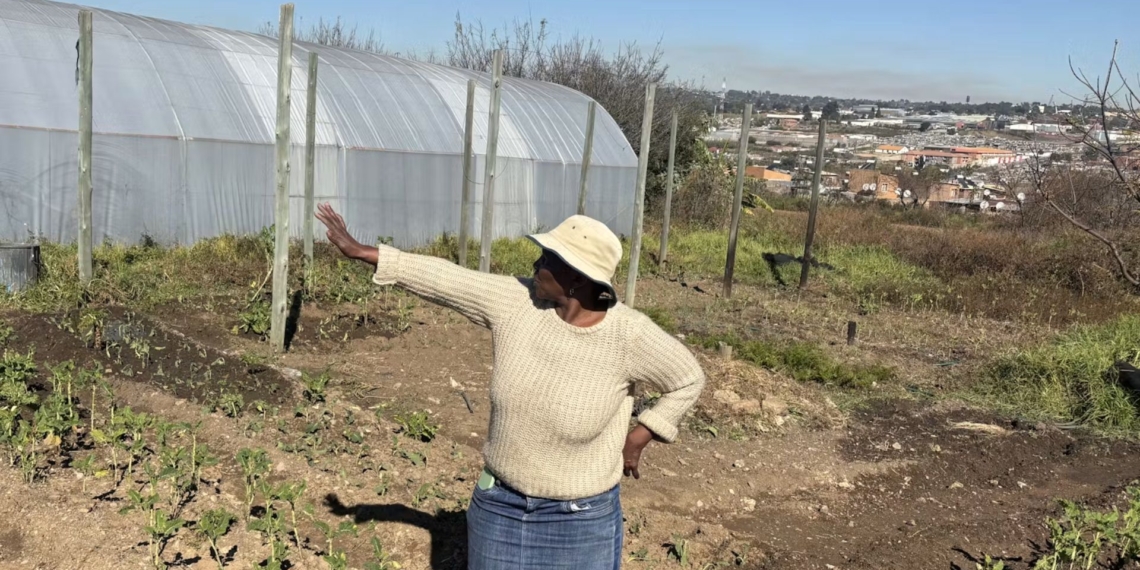
The 40 gardeners in Alexandra township farm household and kitchen plots, school and clinic gardens, and in community cooperatives of up to 20 people. The farmers also cultivate gardens on abandoned land and roadsides.
We found that most of the urban farmers were women from diverse nationalities and ethnic backgrounds who’d been farming for at least 10 years.
Community gardens were substantially larger than other garden types. Smaller gardens produced more modest returns, often confined to vegetables and herbs grown in compact raised beds and containers.
These communities use food gardens, and plant trees and flowers in public spaces, as a way to cope with climate and environmental change. But they lack the support needed to respond to growing climate shocks.
These households and farmers need greater support to adapt to climate change, including access to funding, training and basic services.
Governments can also strengthen urban agriculture by promoting technologies such as smart irrigation and online marketplaces, alongside organic farming and composting, to improve food production, sustainability and market access.

Food, income and community benefits
The urban farmers grew leafy fresh vegetables such as spinach, kale, lettuce, pumpkin leaves, sweet potato leaves and okra leaves. They also grew herbs, sweet potatoes and pumpkin.
Our research found that gardening practices in Alex benefit the community. As one farmer from the Lenin Drive community garden explained:
“Look, we are a small co-operative, and we do not grow enough food to feed the community. Most of what we grow are herbs and vegetables used for community kitchens to feed the homeless and the orphans, and for home consumption to feed our families as well. Sometimes, when we have higher yields, we sell some of it in the market.”
Related stories
- Urban farming reform key focus at hunger summit in Gauteng
- Sustainable farming hub at UJ pioneering urban agriculture
- Market knowledge is the new superpower for SA farmers
- Climate-smart farming offers path to long-term resilience
Most households were not gardening with climate change in mind. But many of their practices still helped them cope with environmental pressures by making use of natural, low-cost solutions.
For example, residents also described using art and culture as practical tools for responding to environmental and climate-related challenges.
The major river running through the area (the Jukskei) frequently floods, partly because rubbish blocks drains and waterways.
In response, local residents, working with NGOs and researchers, created projects such as litter-trapping nets and turned illegal dumping sites into green spaces, art installations and community gathering places.
In this way, spaces affected by climate change were reimagined as living galleries that showcase cultural pride, identity, and the collective capacity to endure.
Another way of adapting to climate change, one female farmer said, was by growing flowers, herbs such as mint, African sage, Bambara groundnuts, beans, sweet potatoes and carrots on a public space that was once an illegal dump site. These crops greened the area and could withstand heatwaves:
“For me, growing these plants is more than just for the stomach. It is about conserving our environment and educating the public about the importance of green spaces that inherently connect us as humans to nature. Most of the plants I grow are drought-resistant and do not need a lot of rain.”
“The funny part of it is considered weeds by many city dwellers who are not familiar with our indigenous food plants.”
The farmers said the leafy vegetables grown were not enough on their own to make up an entire food supply. But they are a healthy supplement to the staple maize meal eaten by most families, and also can be used as medicine.
As another gardener said:
“A kitchen garden is like having a pharmacy in your backyard. I grew up in the village where my grandmother was a farmer and grew all kinds of plants including herbs that were used for medicinal purposes. I learnt that from her.”
|Now I do have a small garden at the back of my yard where I grow fresh herbs (wormwood, aloe vera and mint) and vegetables. This connects me to nature and helps me remember my roots in farming.”
The gardeners said they were limited by not owning the land they cultivated. They mainly farmed in co-operatives on land leased from the municipality.
Most of the farmers we interviewed also had plots that were smaller than a football pitch for the whole collective. This limited the amount they could grow to leafy vegetables, tubers and herbs.
The farmers were keen to cultivate a more varied range of crops. These included maize, rice and indigenous staples such as millet and sorghum. However, the size of available land made this impossible.
Pest and insect infestations were other problems. Rainwater was scarce. The farmers could not afford to irrigate. Fencing was expensive and vegetables were often stolen from unfenced plots.
Next steps
A major challenge is that many low-income communities and small-scale farmers lack the funding, training and support they need to cope with climate-related shocks. Governments and other stakeholders need to invest in helping them build the skills and resources needed to adapt over the long term.
Our study also found that more research is needed into how urban agriculture isn’t just about growing vegetables in cities. It has a role in delivering vital services ranging from food provision to climate-change mitigation to social co-benefits.
For example, our findings suggest that urban farming helps people learn new skills, become more involved in their communities and take greater ownership of local spaces. In doing so, it can strengthen community ties and help address problems linked to hunger and exclusion.
To take city farming forward, it’s important that city residents are made aware of all the different types of urban agriculture, from traditional and Indigenous farming to more modern, technology-enabled systems.
- Dr Blessings Masuku is a postdoctoral researcher at the University of Pretoria, with research focused on sustainable food systems, urban agriculture and climate resilience. Dr Colletta Gandidzanwa is a mentor and researcher at the African German Centre for Sustainable and Resilient Food Systems and Applied Agricultural and Food Data Science (UKUDLA), where her work explores the intersection of food security, sustainability and community development.
- This story was first published on The Conversation. The views and opinions expressed in this article are those of the authors and do not necessarily reflect the views or positions of Food For Mzansi.
READ NEXT: Northern Cape youth lead the fight against water scarcity