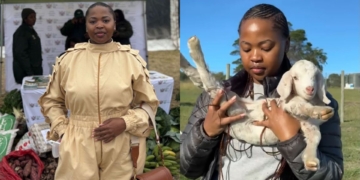
For many, career choices are guided by financial security, with passion often dismissed as impractical. However, for Aviwe Sangcozi from Busila village in Gatyane, Eastern Cape, purpose and service to others shaped her journey in food safety.
She began studying environmental health before transitioning to a B.Tech in food safety at the Cape Peninsula University of Technology.
Leaving a higher-paying career as an environmental health practitioner for a role as a meat inspector with little financial reward may seem unconventional, but Sangcozi embraces it fully, driven by curiosity, dedication, and a commitment to food safety.
Sangcozi was raised under the care of her grandmother, uMandlangisa, a devoted Christian who also deeply believed in herbs and natural healing.
Growing up in such a household, she was immersed in a way of life rooted in natural eating, traditional healing, and indigenous living. She was born in Cacadu but found her true sense of home in Gatyane, a place that continues to shape who she is today.

She recalls that even people from Busila village still remember how, as a child, she once saved a baby goat, a sign of the love and care for animals she carried from an early age.
“From what I remember, I have always had a special bond with livestock,” she says.
Falling in love with public health
Growing up in a home surrounded by almost every kind of domestic animal shaped her way of life and strengthened her connection to farming.
“As I got older, I noticed that farming was no longer taken seriously. The traditional homestead was seen as old-fashioned and primitive. I fell into the same mindset and drifted away from farming,” she admits.
After matric, unsure of what to study, Sangcozi says she simply chose at random. “I did eenie meenie miney mo, and my finger landed on environmental health,” she recalls with a smile. She did not fully understand the course at first, but was determined to study, pass, and find work.
Related stories
- Seed analyst: The unsung hero of your food supply
- From an apricot tree, a career in agronomy blooms
- READ NEXT: Meat Safety Act: What farmers need to know
After three years of study from 2011 to 2013, she felt she needed more and pursued a BTech in 2014, specialising in food safety and epidemiology. “I honestly chose those two modules because during my diploma, I fell in love with public health and environmental sustainability,” she explains.
She tells Food For Mzansi that through her studies, she gained knowledge she believes can benefit not only her village but also communities at large.
What feeds the soul
Sangcozi explains that the transition to BTech was not easy. Students had to buy their own personal protective equipment for practicals, cover travelling costs, and manage files for research.
“Most of my former classmates find it strange that I quit my job as an environmental health practitioner, which offered better pay and benefits, to become a meat inspector earning next to nothing,” she says.
However, she adds, “I love this job. I don’t need inspiration or influence; it keeps choosing me.”
After completing her B.Tech, Sangcozi started her professional journey with community service, followed by six months working in an abattoir. She then spent three years employed by the government.

Despite the stability and benefits, she realised her true calling lay elsewhere and chose to return to meat inspection, a role that aligned with both her passion and purpose.
Ensuring safe meat
As a meat inspector, some of her responsibilities include:
- Ante-mortem inspection: During this inspection, Sangcozi checks the paperwork from the farms the livestock are coming from. The farmer must provide a health declaration certificate detailing vaccinations and hormones administered at the farm. She then examines the livestock to ensure they are fit for slaughter by looking for signs of disease, abnormalities, and injuries.
- Pre-slaughter inspection: At this stage, she ensures the plant complies with food safety and occupational standards for the slaughter process.
She checks the cleanliness of the premises, the availability of hot, warm, and cold water, proper PPE for staff, and conducts daily medical checks to confirm no one has diarrhoea, fever, or skin and eye infections.
Hygiene is also assessed, including nails, jewellery, make-up, and proper protective clothing such as hair and beard nets, aprons, and boots.
“During slaughter, I make sure animals are handled humanely, there is no contamination of meat, and I monitor the speed of slaughter while conducting primary meat inspection.”
She explains that during primary inspection, she observes the sex, age, colour, nutritional state, abnormalities, injuries, and odour of the meat. “Through multiple incisions, I check for pathogens and parasites, such as cysts and worms.”
Some diseases or conditions are condemned for aesthetic reasons, such as jaundice, wet carcass syndrome, and others. Contagious diseases include TB, brucellosis, foot-and-mouth disease, which is currently on the rise in the country, and anthrax, which is rare but highly dangerous.
READ NEXT: Prepare like a pro for livestock auctions and reap big rewards
How meat inspectors and farmers work together
For Sangcozi, her passion and curiosity about how the food safety chain works led her to this career.
Growing up as a curious young girl in the villages, being part of this journey means a great deal to her, and she hopes it is something other farmers can learn from.

Another major challenge, she notes, is farmers who are unwilling to adhere to legislation, particularly regarding animal welfare. She explains that there is a small gap between meat inspectors and farmers, and if these relationships can work collaboratively, many of the issues on farms could be resolved.
She notes that by detecting and removing unsafe meat, meat inspectors protect communities from foodborne illnesses and help maintain trust in the food system.
Sangcozi emphasises that anyone who wishes to study food safety has many opportunities in the meat industry, but dedication and hard work need to be at the centre of their focus for those pursuing this career.
READ NEXT: Poultry farmers: A guide to selling to abattoirs