Thursday, July 16, 2026
SUBSCRIBE
22 GLOBAL MEDIA AWARDS
Food For Mzansi
  • News
  • Changemakers
  • Lifestyle
  • Farmer’s Inside Track
  • Food for Thought
No Result
View All Result
  • News
  • Changemakers
  • Lifestyle
  • Farmer’s Inside Track
  • Food for Thought
No Result
View All Result
Food For Mzansi
No Result
View All Result
in AgriCareers

From an apricot tree, a career in agronomy blooms

Inspired by his great-grandfather’s stories and a curious question about a single apricot tree, Kwanele Dlamini chose a path less travelled: agronomy. Now an intern at Dole SA, he's dedicated to improving crop yields and tackling food insecurity

by Vateka Halile
4th September 2025
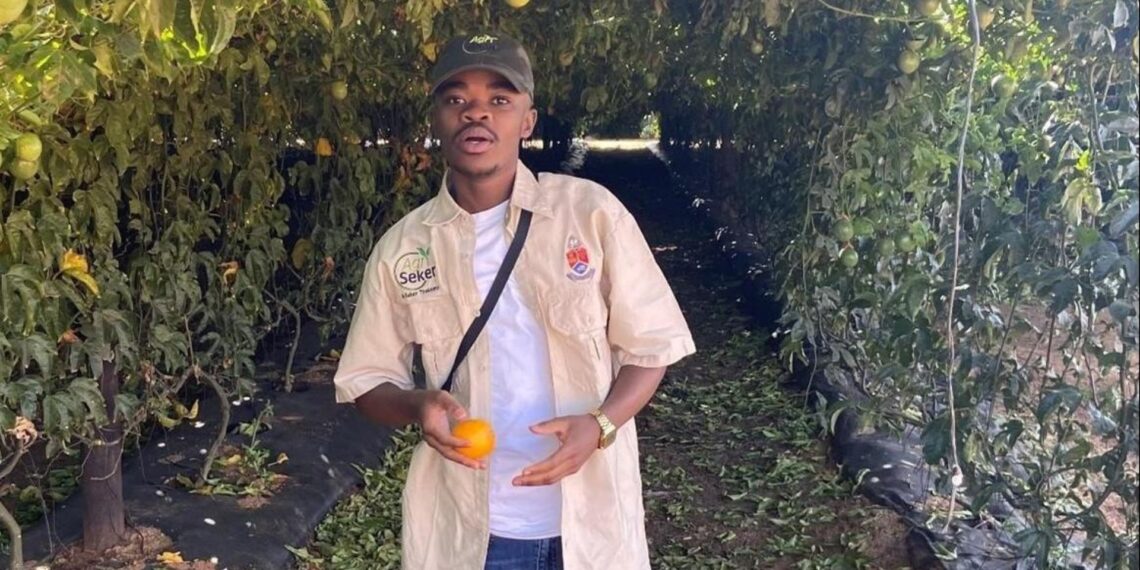
Kwanele Dlamini’s journey began when his great-grandfather noticed a sick tree, a moment that later led him to agronomy.
Photo: Supplied/Food For Mzansi

Kwanele Dlamini’s journey began when his great-grandfather noticed a sick tree, a moment that later led him to agronomy. Photo: Supplied/Food For Mzansi

Share on FacebookShare on TwitterShare on WhatsApp

It was one of those cultural and traditional events at his home in Soweto when Kwanele Dlamini first noticed a struggling apricot tree. “Do you see that apricot tree? Do you know it’s alive and can talk?” his great-grandfather asked, while enjoying some umqombothi with his friends. 

The tree was barely producing fruit, yet that question stayed with him, making him wonder how plants actually grow and respond. Years later, that same curiosity shaped Dlamini’s path into agronomy, turning a childhood question into a career.

His great-grandfather, Themba Dlamini, was a foreman on a citrus farm in Groblersdal, Limpopo. After every harvest season, he would visit the family, often bringing bags of fresh produce.

“Sometimes, if the farm did well, over supper, he would share the ups and downs that happened on the farm. It always sounded hectic but fun at the same time,” Dlamini recalls.

Discovering plant and soil sciences

By grade nine, Dlamini was already helping his grandmother grow and sell vegetables from their home garden. Inspired by his great-grandfather’s stories, he began to see farming as more than just survival. When he noticed how pests damaged even small plots, his curiosity deepened.

Still, he admits it felt unusual at the time.  “I won’t lie, it felt out of line because my peers were going for the commonly known careers like chartered accounting, engineering, and so on. No one in my neighbourhood had ever done this degree or even knew about it.”

Kwanele Dlamini is driven by a purpose: to show the crucial role of agronomy in sustainable food production and economic growth. Photo: Supplied/Food For Mzansi

Guided by his high school teacher, Dlamini first pursued plant breeding before switching to genetics at the University of Pretoria in 2019. But a plant physiology trip in his second year changed everything.

“My crop physiology professor stole me from genetics. That’s when I discovered plant and soil sciences. I realised I enjoyed the field more than the lab, and it’s the best decision I’ve ever made.”


Related stories
  • Sibongile’s plant passion: Healing crops and feeding Mzansi
  • Seed analyst: The unsung hero of your food supply

With a degree in agronomy, Dlamini explains that anyone in science can agree that practical work is often far more beneficial than theory. “Practical work gives you the visual explanation and experience, the challenges, and the solutions.”

He adds that, in simple terms, plant breeding involves improving plants either by genetic modification or by breeding them with other plants to produce desired characteristics such as pest resistance or higher yields.

NW soil scientist-turned-farmer: Plants speak, he listens

A purpose and passion for plants

Currently, he is working as an intern at Dole South Africa, focusing on irrigation, quality control, and harvest estimation in vineyards. “I must say I am enjoying it to the fullest,” he notes.

“Before the week starts, I analyse the weather for the weekend, which helps me figure out the rate of evapotranspiration and determine how many millimetres of water are needed for the week.”

During the post-flowering stage, he counts bunches to estimate yield, and in pack season, he monitors grape quality, assessing colour, size, and bunch weight.

“I have a purpose in this industry, and one of my goals is to make sure agronomy is recognised for its impact and efforts in tackling food insecurity and addressing the challenges of producing more on limited land.”

He also tells Food For Mzansi that agronomy plays a crucial role in driving and improving economic growth, helping farmers adapt to changes such as weather variations, identifying potential phytosanitary pests, and improving crop yields; an essential contribution to reducing food insecurity.

“I am now pursuing my career with Dole SA at Rekopane Estates under Jannier Visser and Charl Niewoudt, and I would also like to express my heartfelt gratitude to Dole for this opportunity,” Dlamini says.

Kwanele Dlamini combines traditional knowledge with modern agronomy to improve crop yields. Photo: Supplied/Food For Mzansi

“We are responsible for about 60+ hectares of table grapes, and my role is ensuring adequate soil moisture by scheduling irrigation, analysing quality, and estimating harvests.”

With his sights set on advancing agronomy’s role in food security, he is excited about continuing his work in nurturing crops.

READ NEXT: The farmer’s guide to supplying fresh produce to markets

Sign-up for the latest agricultural news delivered straight to your inbox every day with Mzansi Today!

Vateka Halile

Vateka Halile grew up in rural areas of Cofimvaba in the Eastern Cape. She was raised in a traditional family setting and found writing to be a source of comfort and escape. Vateka participated in an online citizen journalism course through Food For Mzansi, and her passion for health and medicine-related stories was born. Her dedication to community work and love for social justice and solidarity spaces is evident in her quality time with the community when she isn't working.

Tags: AgriCareersAgronomistInspire me
Rooibos industry targets global growth while protecting local roots
News

Rooibos industry targets global growth while protecting local roots

by Staff Reporter
14th July 2026

With China lifting tariffs on South African exports, the rooibos industry is poised for global expansion. Industry leaders are ramping...

Read moreDetails
KZN declares FMD disaster as SA launches local vaccine

Traceability key as SA opens up FMD vaccine markets

13th July 2026
Maria Makhabane, chief growth officer at Discovery Health. Photo: Supplied/Food For Mzansi

Flexicare helps farms grow through healthier teams

13th July 2026
Feathered Fields: Young farmer defies odds with poultry production

Feathered Fields: Young farmer defies odds with poultry production

13th July 2026
High equipment costs and rising economic uncertainties have driven a nearly 15% drop in South African tractor sales. Photo: Stefan Thiesen/Wikimedia Commons

Farmers turn to second-hand machinery as new sales stall

13th July 2026

Feathered Fields: Young farmer defies odds with poultry production

Fort Cox student is proving communal farming can thrive

Farmers turn to second-hand machinery as new sales stall

Rooibos industry targets global growth while protecting local roots

How Voermol drives Mbatha’s weaning and finishing success

Join Food For Mzansi's WhatsApp channel for the latest updates!

JOIN NOW!
Next Post
Why modular infrastructure is a fast, flexible solution for your farm

Why modular infrastructure is a fast, flexible solution for your farm

THE NEW FACE OF SOUTH AFRICAN AGRICULTURE

With 21 global awards in the first six years of its existence, Food For Mzansi is much more than an agriculture publication. It is a movement, unashamedly saluting the unsung heroes of South African agriculture. We believe in the power of agriculture to promote nation building and social cohesion by telling stories that are often overlooked by broader society.

How this KZN agricultural advisor is bringing tech to rural fields

Weekly stock theft reports pile pressure on farmers

Grain SA defends farmers against blame for rising food prices

Dune spinach: A climate-hardy green transforming coastal farming

The Karoo’s quiet lesson on trust and truth

Unused KZN school transformed into a thriving 16-hectare farm

  • Awards & Global Impact
  • Our Story
  • Contact Us
  • Cookie Policy
  • Privacy Policy
  • Copyright

Contact us
Office: +27 21 879 1824
News: info@foodformzansi.co.za
Advertising: sales@foodformzansi.co.za

Contact us
Office: +27 21 879 1824
News: info@foodformzansi.co.za
Advertising: sales@foodformzansi.co.za

  • Awards & Global Impact
  • Our Story
  • Contact Us
  • Cookie Policy
  • Privacy Policy
  • Copyright

Chat Options

I'm Lerato, your AI assistant!
No Result
View All Result
  • News
  • Changemakers
  • Lifestyle
  • Farmer’s Inside Track
  • Food for Thought

Copyright © 2024 Food for Mzansi

This website uses cookies. By continuing to use this website you are giving consent to cookies being used. Visit our Privacy and Cookie Policy.