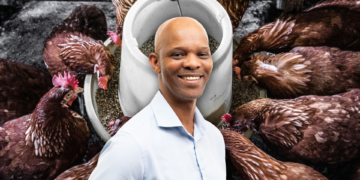
For many poultry farmers, selling live birds directly to consumers may seem like the easiest route. However, industry expert Jeremiah Jothams argues that supplying abattoirs offers greater profitability, sustainability, and security for farmers looking to grow their businesses.
With 15 years as an abattoir manager, meat inspector, and director of Basadi Agribusiness, Jothams has seen first-hand the difference structured supply chains make in successful farming operations.
Jothams notes that supplying abattoirs can promote both profitability and sustainability.
Abattoirs work on agreements or contracts, ensuring farmers a consistent market. “If I can sign a form of contract or an offtake agreement with the abattoir, I know that every week or so, my chickens are going to this abattoir. So then there is that sense of security, there is that guarantee,” he explains.
Unlike informal trading, where farmers risk losses and biosecurity issues from unsold birds, abattoir supply creates a bankable business. “I believe you are able to become something that is bankable and fundable, because then at least you’ve got the records to say you’ve got somebody that you have an offtake agreement with.”
Related stories
- Chicken farming for beginners: Your poultry path starts here
- Solar success: Poultry farmer turns setback into comeback
- How to compile a winning agribusiness plan
- Marketing tips for poultry agribusinesses
Abattoir document requirements
Working with abattoirs requires compliance with the Meat Safety Act 40 of 2000 and several documents:
Environmental impact assessment (EIA): This document is only required for farmers producing above 5 000 birds. “Once you are a farmer willing to go beyond 5 000, one of the things you need to consider having in place is to get a company that can do an environmental impact assessment for you.”
Water rights: Landowners are required to have these by the department of water and sanitation (DWS) before using any water sources on the property. To acquire a licence, farmers must apply through the DWS. The application for a water use licence is submitted to the regional office. A processing fee of R115 is charged, and the application is assessed at the regional office or by the catchment management agency. Once the assessment is completed, the licence application is finalised and a decision is communicated.
Health declaration: Submitted with every batch delivered. It confirms how healthy the chickens were while being raised and notes if any antibiotics were used.
Costs vary. “The EIA can range from anything from fifty thousand to even half a million, it just depends on what you’re looking at,” Jothams notes. By contrast, water rights are fixed at about R200.

Categories of poultry abattoirs
Abattoirs in South Africa are categorised by daily throughput:
- Rural abattoir: 50 birds and below per day.
- Low throughput: Up to 2 000 birds per day.
- High throughput: 2 000 birds and above per day.
Jothams explains, “If you want a small operation, you’re looking at a rural abattoir licence. If you’re doing anything under 2 000 birds, that becomes your low throughput. Anything that does 2 000 birds and above becomes your high throughput.”
Each category carries different requirements, but all are clearly outlined in the Meat Safety Act.
Choosing the right abattoir
When selecting an abattoir, Jothams advises farmers to:
- Research the company’s history and payment reliability.
- Consider location and transport costs.
- Match farm capacity to abattoir throughput.
- Carefully review contracts for penalties, service fees, and payment terms.
“I suggest approaching three different abattoirs within the same category and just ask for letters of intent. Once you are happy with one company, then you go beyond the letter of intent to the offtake agreement.”
Biosecurity: Protecting your birds and your business
Supplying abattoirs also requires strict biosecurity compliance. “[Biosecurity] becomes very critical and important when you’re running a business. You can imagine you have maybe 50 000 birds, but with poor biosecurity practices, you can easily lose half a million just like that,” Jothams says.
Farmers must implement access control, personal protective equipment (PPE), disinfection, and clear biosecurity systems. Jothams also recommends free training resources like C.O.B. Academy. “They cover diseases, vaccination and how to make a programme and monitor it, the disease diagnostics, animal welfare, biosecurity, etc. I would highly recommend it.”
Poor biosecurity practices in poultry farming can have devastating consequences. Farmers who neglect simple measures such as controlling access and maintaining hygiene risk attracting pests.
“You start inviting cockroaches, rats, rodents, flies, and things like that, and these can easily affect your poultry,” Jothams warns.
He stresses that poultry must be treated as a serious business: “It’s not a hobby, it’s not a side hustle. It’s a standalone business that requires maximum attention.”

Transporting birds: Animal welfare and meat quality
Transportation is another area governed by both the Meat Safety Act and the Animal Welfare Act. Jothams highlights key requirements:
- Feed must be withdrawn 9–12 hours before transport, while water should be available until catching.
- Health declarations must be presented: on arrival for low throughput, and 72 hours before delivery for high throughput abattoirs.
- Transport must not exceed 24 hours.
- Trucks must provide ventilation, shade, and correct exhaust placement to avoid harming birds.
Failure to comply has financial consequences. For example, if feed is not withdrawn, crops can rupture during processing, contaminating carcasses. “That means the entire bird is to be condemned, and that cost then goes to the farmer,” he says.
READ NEXT: A guide to sustainable dry bean farming