Thursday, October 22, 2026
SUBSCRIBE
22 GLOBAL MEDIA AWARDS
Food For Mzansi
  • News
  • Changemakers
  • Lifestyle
  • Farmer’s Inside Track
  • Food for Thought
No Result
View All Result
  • News
  • Changemakers
  • Lifestyle
  • Farmer’s Inside Track
  • Food for Thought
No Result
View All Result
Food For Mzansi
No Result
View All Result
in Changemakers, Inspiration

Meet the women working to bring a whole market home

by Funiwe Ngwenya
26th August 2021
Visions for a local market.

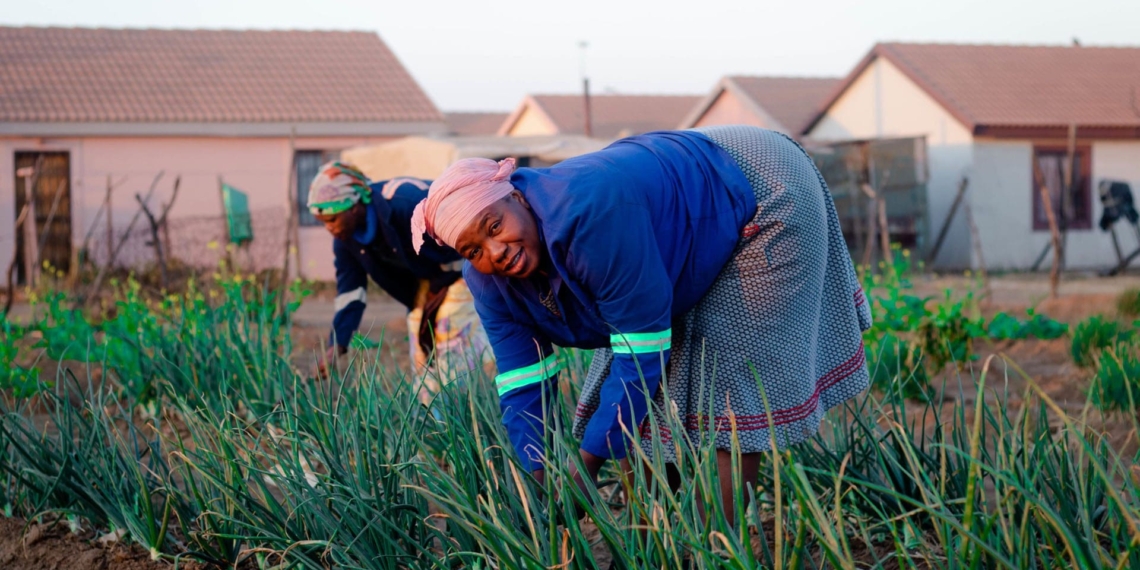
Ntombikayise Zulu with Nthabiseng Mokoena (in the background) cleaning their farm on an open space provided by the council in Katlehong. Photo: Funiwe Ngwenya

Share on FacebookShare on TwitterShare on WhatsApp

A group of women in Katlehong is working hard to create a fresh produce market in the area. They want to make the fruit and vegetables grown by local farmers more easily accessible to residents and local businesses.

Ntombikayise Zulu and Nthabiseng Mokoena, along with a few others, have already secured a piece of land where they envision building a local equivalent of the Joburg Market.

Based in Tsietsi Phase 4, Katlehong, east of Johannesburg, Zulu and Mokoena started farming in 2015 in a local area provided by the government. Since then they have been working hard to have fresh vegetables and livestock for their community. 

Over the years the public area provided to them became fuller as other women were motivated to join them. This let them decide to create a better local market where farmers from around Katlehong could sell their products to businesses and locals.

Vision for a local market: Ntombikayise Zulu feeding her free range chickens. Zulu started as a security guard before going into farming in 2012.
Ntombikayise Zulu feeding her free range chickens. Zulu started as a security guard before going into farming in 2012. Photo: Funiwe Ngwenya

Searching for a better life

Zulu moved to Johannesburg in 1998 from Ndongwe close to Ermelo in Mpumalanga. She wanted to pursue better career opportunities. In 2011, Zulu acquired a security certificate and started working in that industry.

“I have always been a person who loves business and during this period I still wanted to pursue something in business,” she recalls. 

In 2012, while the Palmridge court building in Gauteng was being built, Zulu took her saved salary and bought a food container. She hired people to sell food for her opposite the construction site. 

Not satisfied with the returns, she decided to take another route. She obtained a practice certificate as a caretaker and started working in this field later that same year. “I have always loved taking care of children, and since the area was new with no crèches, I decided to take the opportunity”.

Then she received a reconstruction and development plan (RDP) stand, which was the opportunity she had been waiting for. “Now I had my land, now I had the freedom I had been waiting for. People thought I was crazy because the yard was full of vegetables,” she says, giggling.

The journey into farming

Zulu is a go-getter and doesn’t stop at any cost. She found a way to start selling vegetables to the community.

Initially it was cabbage and spinach. The plot did not have running water; she had to fetch it by wheelbarrow and 20-litre bottles. However, this still felt like heaven to her as she was doing what she loved. “In the morning it’s the crèche, in the afternoon its agriculture; my heart was fulfilled,” she states. Zulu now has 38 free-range chickens and 15 pigs and continues to plant various vegetables.

ALSO READ: Businessman-turned-farmer is building generational wealth

Meeting kindred spirits

Doing this is how she met other women like her. Mokoena loved farming and was also new in the neighbourhood. Mokoena joined Zulu and other local women who farmed in the area with her own big dreams to pursue.

She approached the nearest primary school, Pheasant Fall Primary, to use their open area for farming. The principal agreed and Mokoena gave vegetables to specific learners and community members. 

Vision for a local market: Nthabiseng Mokeona is one of the women who were sponsored by Rand Water as part of the Letlotlo le Mobung co-operative.
Nthabiseng Mokeona is one of the women who were sponsored by Rand Water as part of the Letlotlo le Mobung co-operative. Photo: Funiwe Ngwenya

Both women were full of ambition and drive in agriculture and they got sponsored by Rand Water with farming tools, irrigation and training. This led them to form a co-operation, “Letlotlo le Mobung” (treasure within the soil), that would express their vision and let them work towards the opportunities they saw in farming. 

The mission of the co-operation is to build a Katlehong Agriculture Market similar to Joburg Market. This market will be a platform for all surrounding farmers to sell their products to their nearest businesses. The goal is to bridge transportation challenges that local businesses have by making the produce of local farmers conveniently available to them.

A journey of ups and downs

The journey towards this vision has its ups and downs. The women approached their local council with the proposal. The council gave them an open space to implement the plan, but they are currently unable to get funding from the department of agriculture because they do not have documentation that states them as the owners of the land. They requested this from the mayor, but haven’t yet received a response.

“I have sent multiple emails to the Ekurhuleni office and went to other departments that also turn us back, [requiring] the paper of proof,” says Zulu.

The women are not deterred by this hurdle, though. They are working hard for their vision to become a reality. Zulu, Mokoena and some other women took their children’s social grant money to build a gate around the area and hired a bulldozer to clean the erf. They firmly believe that one day their dream to have a Katlehong Market will be a reality. 

ALSO READ: How to turn that R350 social grant into a side hustle

Get Stories of Change: Inspirational stories from the people that feed Mzansi.

Funiwe Ngwenya

Funiwe Ngwenya is a female photographer who values visual storytelling. She studied BA Film and Television at University of Johannesburg. She is currently a fulltime photographer and documentary maker. She fell in love with agriculture when she joined the Slow Food movement. Her work has appeared at the University of Gastronomic Science and the campaign Total Shutdown. Funiwe believes the world wouldn’t exist if it was not visual and every photograph is a certificate of presence.

Tags: Fresh ProduceKatlehongLivestocklocal market
Becoming bankable: How to get your farm ready for finance
Farmer's Inside Track

Becoming bankable: How to get your farm ready for finance

by Patricia Tembo
20th October 2026

Incomplete applications, mixed personal expenses, and poor record-keeping frequently block farmers from securing capital. Experts share practical, essential steps every...

Read moreDetails

Fixing SA’s agricultural visa system to protect seasonal harvests

20th October 2026
‘Beware the dangers of illegal foot-and-mouth vaccines’

SA and Namibia reevaluate livestock trade after FMD outbreak

20th October 2026
Agda conference to tackle finance, market access and agri growth

Agda conference to tackle finance, market access and agri growth

19th October 2026

Reluctant farmer scales EC cabbage enterprise to supply Spar

19th October 2026

Reclaiming the kraal: Cultural heritage sparks a farming dream

Reality check: What SA agri interns really experience on the farm

Becoming bankable: How to get your farm ready for finance

Land Bank must step up support for farmers, says Aucamp

Promising early conditions predicted for 2027 SA wine harvest

Join Food For Mzansi's WhatsApp channel for the latest updates!

JOIN NOW!
Next Post
House brands are gaining traction.

How food safety can play to the agripreneur's advantage

THE NEW FACE OF SOUTH AFRICAN AGRICULTURE

With 21 global awards in the first six years of its existence, Food For Mzansi is much more than an agriculture publication. It is a movement, unashamedly saluting the unsung heroes of South African agriculture. We believe in the power of agriculture to promote nation building and social cohesion by telling stories that are often overlooked by broader society.

Why simple farm records beat complex systems

Crowdfunding breathes new life into neglected Limpopo citrus farm

Mogogelo farmers receive packhouse and cold storage facilities

Godongwana unveils fuel relief and R10 billion El Niño buffer

Smart irrigation: Precision tools boost crop yields while cutting costs

By-laws vs. livelihoods: Barriers facing WC smallholder farmers

  • Awards & Global Impact
  • Our Story
  • Contact Us
  • Cookie Policy
  • Privacy Policy
  • Copyright

Contact us
Office: +27 21 879 1824
News: info@foodformzansi.co.za
Advertising: sales@foodformzansi.co.za

Contact us
Office: +27 21 879 1824
News: info@foodformzansi.co.za
Advertising: sales@foodformzansi.co.za

  • Awards & Global Impact
  • Our Story
  • Contact Us
  • Cookie Policy
  • Privacy Policy
  • Copyright

Chat Options

About this assistant

This feature generates automated answers summarised from Food For Mzansi articles. By using it, you are interacting with an AI system (provided by Google), not a human. AI can make mistakes. Please refer to the source articles for verification and citation purposes.

Our staff do not check or moderate Lerato’s answers in advance, but may review some later. Our journalists continue to write and edit all the articles Lerato uses as sources.

To estimate unique and returning web users, we store a random browser ID in this browser. WhatsApp users are counted by phone number. The same person using both channels may be counted twice.

I'm Lerato, your AI assistant!
No Result
View All Result
  • News
  • Changemakers
  • Lifestyle
  • Farmer’s Inside Track
  • Food for Thought

Copyright © 2026 Food for Mzansi