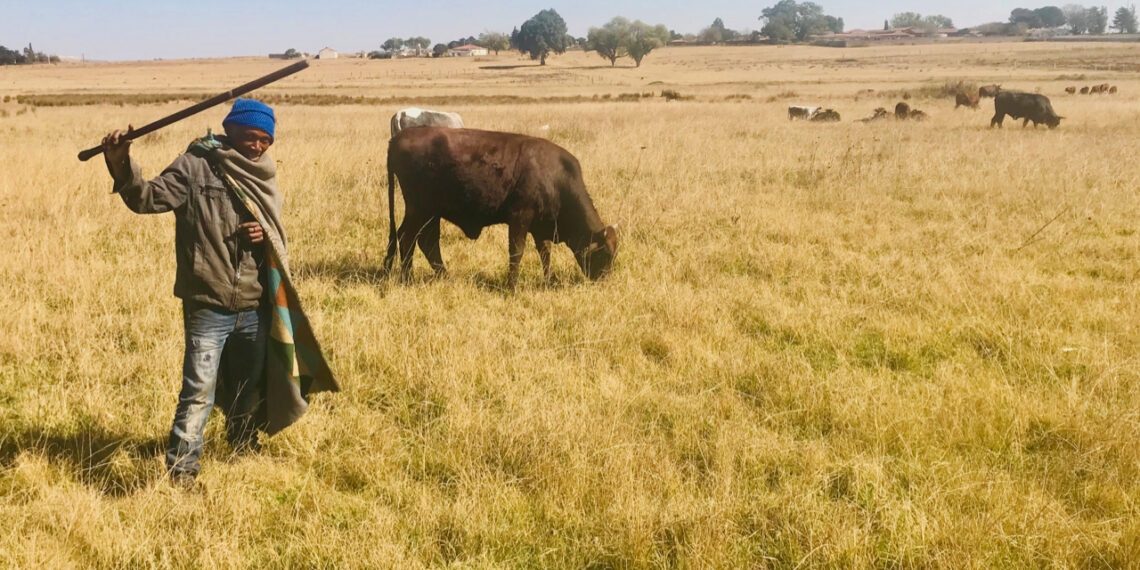
The Constitutional Court has unanimously agreed to a broader interpretation of the Extension of Security and Tenure Act (Esta), ruling that three brothers occupying land under Esta also have the right to graze their livestock.
The court ruled that if Esta occupiers have the right to use land, that right can only be terminated following the Act. This would have to involve a court application.
In November 2022, the Land Claims Court ruled in favour of three brothers in the North West Province – Magalone, Topies and Dikhotos Mereki – who were grazing their cattle on land owned by the Moladoro Trust.
The Mereki brothers, whose mother used to work on the farm, have rights to the land under Esta. But the Trust had wanted to stop the brothers from grazing their cattle on the land, arguing they only had rights to live on the land and had never sought approval to graze their cattle.
Judge Susannah Cowen ruled that a “generous construction” of Esta was preferred over a purely textual or legalistic one. Bearing in mind the history of colonial dispossession, Cowen ruled that stopping Esta occupiers from letting their cattle graze amounted to eviction.
The brothers had tacit consent to graze their cattle on the land, Cowen ruled.
But Cowen’s ruling was overturned by the Supreme Court of Appeal, which said that the brothers did not have the owner’s express consent and that their mother’s grazing rights had not been automatically passed on to them.
Taking it to the Constitutional Court
The brothers appealed the SCA’s ruling in the Constitutional Court. They argued that the SCA had erred – that it should not have interfered with the Land Claims Court’s discretion and that it was wrong in finding that the brothers did not have “tacit consent” to graze their cattle.
The brothers also suggested that the Esta be amended to clarify that occupiers have the right to graze cattle.
Related stories
- Land reform is justice, not just policy, says Ngcukaitobi
- Land reform failure: Ideas not the issue, delivery is
- Court orders Daybreak to halt inhumane bird culling
The Trust, however, pointed to the fact that the brothers had not put up any papers in the Land Claims Court and that “in the absence of evidence, there was no basis for a finding of tacit consent”. The Land Claims Court, the Trust contended, had made findings on issues that were not raised and which made serious inroads into its property rights.
On Friday, the Constitutional Court ruled in favour of the brothers.
Do Esta rights include grazing and cultivation?
Justice Owen Rogers, writing for the court, said the issue was of great importance to Esta occupiers and those who own farms.
He said the Merekis’ primary case was that people who have consent in terms of Esta to reside on a farm automatically have certain ancillary rights, such as cultivation and grazing.
But, Rogers said, the court would not deal with this primary case because neither the Land Claims Court nor the SCA have dealt with this argument. “We thus leave the primary argument open,” Rogers said.
The Merekis’ alternative argument, which the court did rule on, raised two issues: whether the consent of an Esta occupier to graze cattle was protected by Esta and could only be terminated per its provisions, and if so, whether the Merekis had consent to graze cattle.
Rogers said the word “tenure” included associated uses and Esta must, to the extent reasonably possible, be interpreted in a way which protects those uses.
But, he said, an analysis of the Act as it stands does not have a coherent scheme that would explain why “use of land” was sometimes included and sometimes omitted.
The most inexplicable omission, he said, was in Section 8 of the Act, which deals with the processes that need to be followed to terminate an occupier’s right of residence. This section makes no mention of the right to use the land, only the right to reside on land.
“One is driven to conclude that the right of residence cannot have been intended by the lawmaker to be confined to residence in the strict sense, but to include such rights of use as Esta elsewhere envisages, including the right to use land for cultivation and livestock.”
Termination of grazing rights
He said that unless section 8 is understood to include land use rights, not only residence rights, “Esta would be internally inconsistent and the ostensible legislative intent would not have been achieved.”
“The inconsistency must be resolved in favour of an interpretation that enlarges rather than diminishes the security of tenure afforded to occupiers.”
The Trust’s termination of the Merakis’ rights to use the land for grazing must therefore comply with section 8.
Rogers disagreed with the SCA’s view that it was not open to the Land Claims Court to consider tacit consent.
He said it must be presumed the Merakis had tacit consent to graze cattle, unless the Trust put up evidence to prove otherwise.
He said the Land Claims Court was entitled to find that such evidence was lacking and that the Trust had not established that the provisions of ESTA were inapplicable.
The court upheld the appeal and ordered the Trust to pay the costs.
- This article was first published by GroundUp and written by Tania Broughton.
READ NEXT: Rural Limpopo gains from public-private push, but gaps remain