In South Africa’s deciduous fruit industry, producers face a complex mix of global market volatility, adverse weather patterns, and ongoing port disruptions.
While long-term fundamentals like cultivar renewal and expanding market access remain strong, key sub-sectors like stone fruit are recovering from one of the most difficult seasons in history.
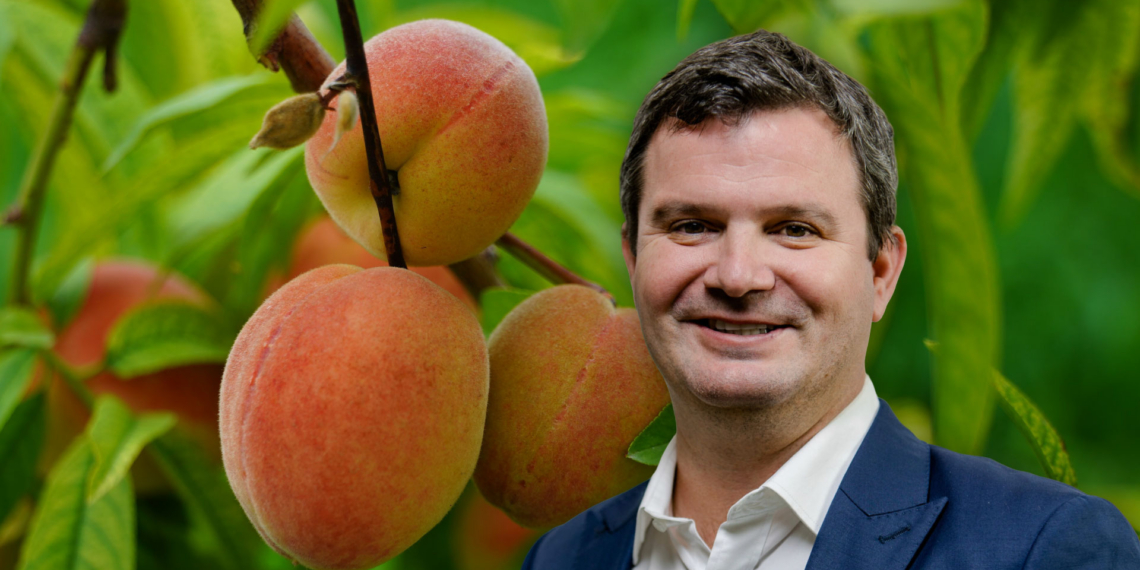
Food For Mzansi sat down with Hortgro’s new chief executive officer, Jacques du Preez, to discuss his vision for the industry body representing South Africa’s pome and stone fruit producers and how he plans to steer the organisation through a down cycle toward sustainable growth.
Lisakanya Venna: As Hortgro’s new CEO, what are you most excited about as you start this new role?
Jacques du Preez: I think we are in challenging times globally as well as locally, but heading towards a greater future. There are a couple of challenges and risks that we need to mitigate, but we’re very optimistic about the future. If you look at our cultivar composition, the age of our orchards, the new markets that are opening up for us, and the market access that is being gained, I believe there’s a great future for the deciduous fruit industry.
The 2025/2026 season has probably been the worst for stone fruit in history, so our growers… are bleeding. We are still struggling with logistics, specifically at the Port of Cape Town and the container terminal, so there are a couple of things that just need to click, and then we will have an upcycle, I believe.
Related stories
- Tru-Cape cherries target China amid bumper 2025 crop
- SA secures landmark stone fruit deal with China
- SA secures landmark stone fruit deal with China
- China opens doors to five South African stone fruits
What is your vision for Hortgro and the fruit industry as a whole, and what would you like to achieve in your first five years?
I’ve got some big shoes to fill figuratively and literally. My predecessor was here for or involved in the industry for more than 37 years, so my short-term goal is just to make the transition as smooth as possible. Luckily, we’ve inherited a stable foundation that we can work from, and I believe in evolution rather than revolution, but you have to keep up with technology, with the changing world, with changing markets.
Some stability! Logistics is our main problem at the moment; it’s costing us billions of rands, so we need to stabilise the ports and logistics. We have to navigate those things within our control. When it comes to research and development, combating adverse weather effects on the production side, and then also opening up a couple of new markets and distributing our exposure.
How would you describe the current state of South Africa’s fruit industry, and what are the most urgent operational issues?
It differs between fruit types. If you talk stone fruits, we’re in dire straits. I don’t think there are many growers that will make money this year. Mainly due to logistics again. It’s been our Achilles heel. We can produce the best fruits… if you can’t get it to market in the right condition and be the preferred supplier on time, then that is your biggest risk at the moment. So that is something we need to address urgently.
And then the weather also – we need to adapt, especially our production techniques, to make room for extreme weather events.
How can the fruit industry become more climate-resilient, particularly regarding water resources?
We invest a lot of money of our gross levy in research and development and tech transfer, looking at new production techniques, the use of netting – which enables you to use less water – and precision agriculture, to produce more on less land with less resources. But there’s definitely pressure on water resources.
We as growers are custodians of the environment, our farms, the biodiversity and the water. So we don’t waste water, but we will need to learn to farm with less water in the future. Specifically in the Western Cape, the competition between cities, specifically Cape Town, and some of the production regions is becoming more intense, and we see that as a big risk for the future.
Which international markets offer the biggest opportunities for South African fruit, and what is required to access them?
Again, it differs between fruit types. If you take stone fruit, we are very reliant on the UK, the EU and the Middle East. With the conflict in the Middle East, it poses a big problem for us at the moment. There’s still strong demand in the Middle East; the problem is getting the fruit there, and the cost of getting the fruit there eats into your margin.
But if you take, for instance, apples, on the other hand, we’ve diversified significantly over the last 10 years. Africa is our biggest market, followed by the Far East in Asia. India has been growing at a tremendous rate for both apples and pears. We’ve recently gained access for stone fruit in China.
For the coming season, which starts in a couple of weeks, we will be able to ship from the start of the season. And then, of course, the hot topic at the moment is cherries that gained access to China a week ago.
READ NEXT: New initiative aims to tackle fertiliser costs via wastewater recycling