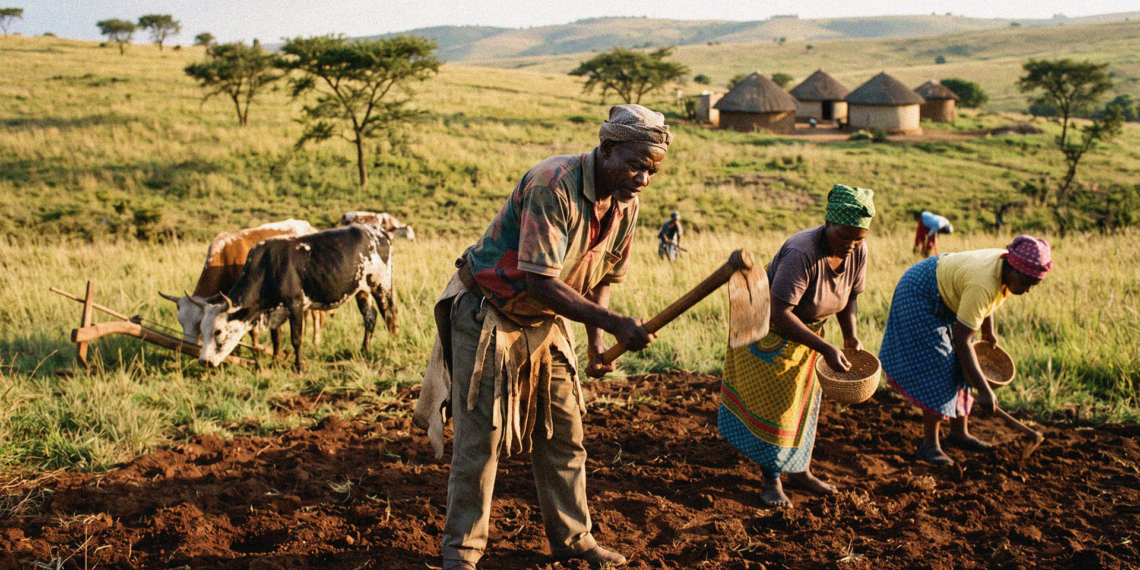
Traditional farming in Mzansi is more than a way of producing food; it is a living connection to culture, family, and community. As millions of South Africans celebrate Heritage Day today, experts and community activists look at how traditional farming can help food security.
While indigenous knowledge is still a big part of many people’s livelihoods, farmers face barriers such as drought, climate change, limited access to land, water, finance, and modern markets.
Preserving traditional farming therefore requires supporting local farmers, valuing indigenous knowledge, and combining traditional practices with appropriate agricultural technologies to strengthen food security and rural livelihoods.
How traditional farming can feed South Africa
Nonhlanhla Moroenyane, a cookbook author, food activist and founder of Noni’s Home Dish, said the greatest barrier is the disconnect that has built up and has taken away the knowledge and wisdom the land provided.
“Commercial farming, degenerate ways of being with ourselves and the land, make it impossible to win. Traditional farming is definitely becoming less common because we are made to believe that indigenous ways are outdated when it is the opposite. We are becoming dependent instead of the opposite,” she said.
Moroenyane explained that modernity has turned communities into non-thinkers. “It has disconnected us from tradition and culture where land is concerned; modernity has literally turned us into consumers and takers and nothing to give back.”
Related stories
- How indigenous knowledge can help farmers survive water scarcity
- Reviving indigenous crops in Mngeni: Smallholders grow food and hope
- Harvesting heritage: Grandparents’ dream is Yonela’s mission
- Know your water and soil: Practical tips for smarter drip irrigation
Structural hurdles threatening SA’s heritage crops
Ashraf Sirkoth, Urban Greening and Landscape Stewardship service project manager at Greenpop, said preserving traditional farming systems faces interconnected structural, economic, and environmental challenges.
“Traditional agricultural knowledge is largely oral and intergenerational. Rural-to-urban migration, ageing farmer populations, and the lack of formal documentation mean that knowledge of seed saving, intercropping, natural pest management, soil conservation, and seasonal forecasting is being lost.
“Agricultural policies, extension services, research funding, and subsidies are historically skewed toward industrial, monoculture, and export-oriented agriculture,” Sirkoth said.
He noted that changing rainfall patterns, increased frequency of droughts and floods, and degraded soils directly threaten traditional systems that are finely tuned to local microclimates.
“While traditional systems are often more resilient, their adaptive capacity is being exceeded, and also traditional farming often depends on access to communal resources beyond the farm plot: communal grazing lands, forests for manure and mulch, water sources, and sacred groves,” Sirkoth said.
Strategies to preserve indigenous farming systems
For moving forward, Sirkoth added, the government must develop niche markets, geographical indications (GI), and fair-trade certification for traditional crops and products.
“Redirect agricultural subsidies to support agro-ecological and traditional practices. Support farmer cooperatives for processing, storage, and collective marketing to increase bargaining power.
“Establish community seed banks and livestock gene banks to conserve traditional varieties and breeds. Document traditional knowledge with the full participation and consent of communities, and integrate it into formal agricultural curricula,” he advised.
Sirkoth added that the preservation of traditional farming is not about romanticising the past. “It is a strategic imperative for food security, climate resilience, and biodiversity conservation. It can only be achieved when farmers have secure rights to land, when their knowledge is valued, and when their products are economically viable.”
Meanwhile, retired deputy director Elijah Ramafoko, who spent decades training farmers for the Northern Cape department of agriculture, land reform, and rural development, said traditional farming needs to be preserved by communities and government.
“This cannot only be left to government; as community, we need to go back to our roots, doing things the basic way.
“But also the young farmers need to be taught by older generations that traditional farming is possible even in the age of artificial intelligence and the ever-changing mechanisation. Importantly, our colleges need to teach traditional farming; this does not mean not moving forward but also remembering where we come from,” he said.
READ NEXT: Orange prices plunge 60% amid huge supply surge in SA