 When she was a little girl, Yolandi Joubert’s mother used to collect mushrooms in the veld with her grandmother on their family farm in Gauteng, where she was born and raised. Little did she know that one day her daughter would be farming with these hearty, meat-like fungi.
Joubert recalls how much she loved to plant and sow seeds on Damplaas, near Modderfontein in Johannesburg, where her father, Adriaan Kirsten, farmed with corn, sunflowers, sheep and cattle. When she was six years old her family decided to move away from the farm to settle in Johannesburg.

Years later, in 2013, Joubert’s mother, Rachael, gifted her with an oyster mushroom growing kit. In that same year Racheal decided to retire in the West Coast town of Langebaan, and Joubert and her 11-year-old son Damian chose to move with her.
“I watched this kit growing and found it so fascinating that I decided to start doing research on mushrooms. Back then there was very little information in South Africa about growing them, and the few people who did grow mushrooms never gave away their secrets.”
She persevered and learned through trial and error. To gear herself with more knowledge she completed a two-day mushroom advanced course. Joubert spent most of her life working as an administrator or receptionist, but in 2017 she put all her time and energy into her mushrooms and registered her own business, Dayora Oyster Mushrooms.
With no customers to buy her products, Joubert says, she literally knocked on every single door she could find in the retail business. “There were so many times that I just wanted to give up, but I kept going. In 2018, I suddenly got a lot of calls from people wanting to know more about how to start a mushroom business,” says Joubert.
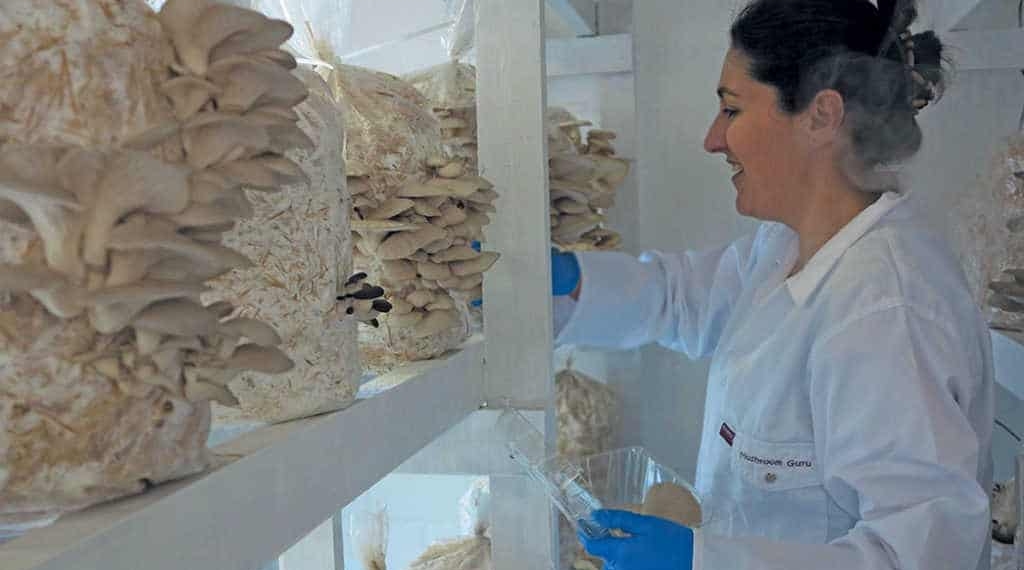
Joubert’s business operates from her home in Langebaan. She had an extra garage and storeroom which she converted into a facility where she grows the mushrooms.
“There were so many times that I just wanted to give up, but I kept going.” – Yolandi Joubert
Dayora Oyster Mushrooms cultivates all six varieties of oyster mushrooms (pink, grey, yellow, white, king & blue oyster), as well as lion’s mane and chicken of wood.
“Lion’s mane tastes like seafood. It is a white ball and looks almost hairy or fluffy. Chicken of wood, on the other hand, tastes like chicken and has a yellow/orange fan shaped look.”
Joubert distributed her yield to any retailer who was interested in buying. She previously provided the local Spar supermarket with mushrooms as well as clients who pre-ordered, but soon she started to advise other people on how to cultivate their own produce.

Today Joubert supplies anyone interested in growing mushrooms with a variety of mushroom kits, from basic ones to a hobby training kit. She also helps those who are serious about going into the production of mushrooms to earn an extra income.
“As soon as they [her clients] are ready and we get queries from a buyer wanting fresh mushrooms, we put them in contact. This enables us to keep making and supplying spawn to farmers and keep focusing on the training part of the business to enable new farmers to learn and expand.”
Spawn is any material (sawdust, grain, woodchip or a similar substance) that has been fertilized with the vegetative part of fungus known as mycelium. The fertilized material acts as the “seed” from which the mushrooms grow.
While Joubert says marketing and awareness has been her biggest challenge in establishing her business, nothing comes close to the health issues she has to face daily. For most of her life, she has been suffering with a rare stomach problem. Joubert lives in constant pain, having to endure regular stomach ulcers.

“It has just escalated over the years; I do not take up iron and I’ve been anaemic for over 2 years, the severity just differs every year depending on what treatment I get. It causes constant tiredness, shortness of breath, constant weakness and even heart problems,” Joubert explains.
Throughout her entire farming venture her mother has been her constant motivation. “My mom has given me so much support. Every time she saw I was down she would pick me up again, it has all been worth it.”
Due to her fluctuating health, Joubert employs two people on a permanent basis to assist her. Within the next five years she hopes to employ more people and to empower future mushroom farmers through workshops.
“I would love to grow more and have three to five more people working with me. I would like to know that I have made a contribution to self-sustainability to many more families in need. Next year we would also like to travel to communities to run workshops to empower more people.”
* Featured photo provided by Farmer’s Weekly