Wednesday, October 21, 2026
SUBSCRIBE
22 GLOBAL MEDIA AWARDS
Food For Mzansi
  • News
  • Changemakers
  • Lifestyle
  • Farmer’s Inside Track
  • Food for Thought
No Result
View All Result
  • News
  • Changemakers
  • Lifestyle
  • Farmer’s Inside Track
  • Food for Thought
No Result
View All Result
Food For Mzansi
No Result
View All Result
in Lifestyle, Weird & Wonderful

Weird mushroom facts we bet you didn’t know

by Elana van der Watt
23rd January 2019
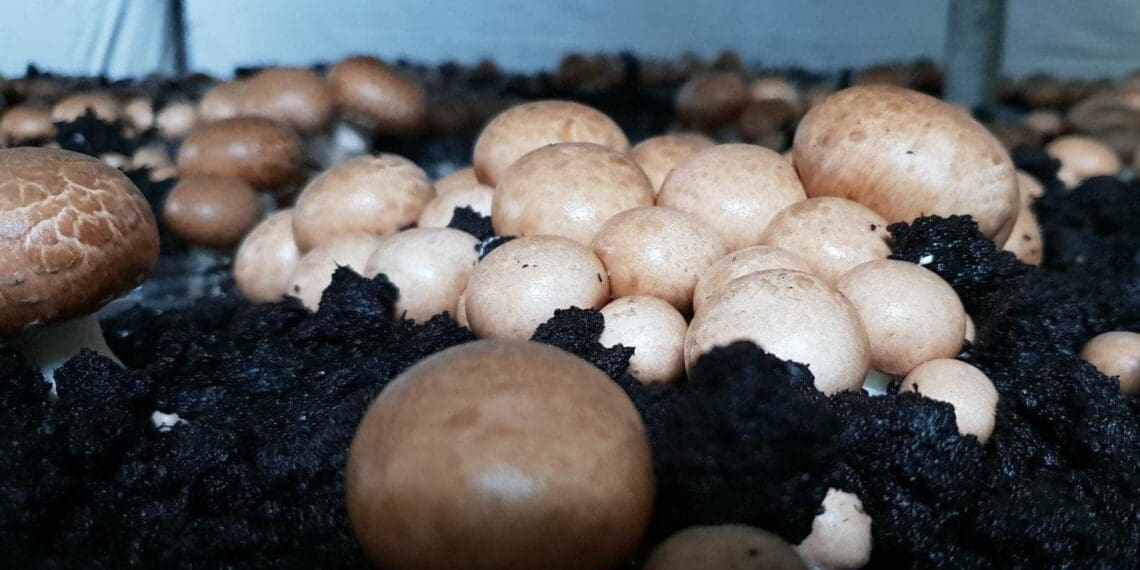
The very dark top layer of peat moss is crucial for mushroom growth and imported from Ireland

The very dark top layer of peat moss is crucial for mushroom growth and is imported from Ireland. Photo: Supplied/Food For Mzansi

Share on FacebookShare on TwitterShare on WhatsApp

One of the great things about mushrooms is that they’re in season all year long. They’re also a great source of vitamins D and B and, above all, an awesome meal stretcher and side dish.

A mushroom is a fungus, which means it grows optimally in warm, damp and dark conditions from a compost-like substrate. Wilmaré Lotz, the owner of Boland Mushrooms in the Western Cape, says the quality of compost is directly related to the quality of the mushrooms, as they feed off the proteins in the substrate. She makes her own compost on her farm.

  • Waste materials from wheat farms (straw) and chicken farms (manure) is used in the compost making process. “If the wheat farmers have a bad harvest, we have a bad year as well,” says Lotz. Compost is pasteurised before it is spawned with mushroom spores.
Mushroom spawn, produced and supplied by a laboratory in Gauteng
  • Because mushrooms are classified as fungi and not plants, their “seeds” are called spawn. All mushroom spawn in South Africa is supplied by a laboratory in Irene in Gauteng.
  • Boland Mushrooms is a bag far, meaning a large bag is used for growing plants. Bigger farms can grow mushrooms on trays or flatbeds. Growing chambers don’t receive fresh air during the first growth stages.
  • After the compost is spawned, they undergo a two-week spawn run. A top layer of peat moss, imported from Ireland, is used as casing soil on each bag to stimulate the growth of thousands of threads, or mycelium. All this happens at a warm 25 °C.
Mushroom farming is done indoors
  • When the grower suddenly set cooling units to temperatures below 20 °C, and introduce fresh air for the first time, the mycelium start to lump together and form mushrooms.
  • Mushrooms can double their size in 24 hours and one bag of compost produces three flushes of mushrooms for harvest. The Boland Mushrooms farm yields 25kg of mushrooms per square metre.
  • After they had been harvested, mushrooms are kept at 2 to 4 °C.

Find out more about Wilmaré Lotz, owner and manager of Boland Mushrooms, a well-established mushroom concern in the Western Cape.

Elana van der Watt

Elana van der Watt is a freelance reporter with extensive experience in community journalism. She started her career as intern at the Worcester Standard and moved through the ranks to the editor’s position and digital editor of the Boland Media group. She has since gone solo.

Tags: boland mushroomsmushroomsWilmaré Lotz
This week’s agri events: 19 – 23 October
News

This week’s agri events: 19 – 23 October

by Tiisetso Manoko
19th October 2026

There is a lot happening in the final months of 2026! Get all the information on the Villiersdorp Show, livestock...

Read moreDetails

Stop the rot: Four steps to slash post-harvest losses

18th October 2026
A standing ovation for agriculture’s incredible talent! The Agri’s Got Talent 2026 top three celebrate their achievements: winner Honey Katoo of Endulini Fruit in Patensie, alongside runner-up Clareece Vlotman of Wolfpack in Wolseley and finalist Lwandile Nantsi of Laastedrift in Ceres. Photo: Supplied/Food For Mzansi

Patensie claims Agri’s Got Talent crown for second year running

17th October 2026
The panellists at FNB Business’s “Farming together” discussion at the Royal Show explored how market access, mentorship, financial discipline and strong commercial relationships can help farmers build sustainable businesses. Featured from the left are Bertram July (FNB’s distribution sales lead), commercial farmer Shakes Shabalala; Sandy Gumede (co-founder of Zulu Girl Wines), and Janis Robson (FNB’s head of development and SME business development). Photo: Food For Mzansi

FNB puts relationships at the heart of commercial farming

17th October 2026
Agri Skills Transfer students gain hands-on experience at the institution’s Cullinan Farm Training Centre, where agricultural theory meets the realities of commercial production. Photo: Supplied/Food For Mzansi

Build your future in agriculture with Agri Skills Transfer

17th October 2026

Land Bank must step up support for farmers, says Aucamp

Fixing SA’s agricultural visa system to protect seasonal harvests

Reclaiming the kraal: Cultural heritage sparks a farming dream

Build your future in agriculture with Agri Skills Transfer

Farmers urged to tap into recycled human waste as fertiliser

Join Food For Mzansi's WhatsApp channel for the latest updates!

JOIN NOW!
Next Post
Nonkululeko Britton-Masekela, running the farm Kula, has an agricultural passion

'Impact far beyond the balance sheets'

THE NEW FACE OF SOUTH AFRICAN AGRICULTURE

With 21 global awards in the first six years of its existence, Food For Mzansi is much more than an agriculture publication. It is a movement, unashamedly saluting the unsung heroes of South African agriculture. We believe in the power of agriculture to promote nation building and social cohesion by telling stories that are often overlooked by broader society.

CPAs urged to register for free governance support toolkits

Potatoes and tomatoes plunge while avocado prices soar

Becoming bankable: How to get your farm ready for finance

Fixing SA’s agricultural visa system to protect seasonal harvests

SA and Namibia reevaluate livestock trade after FMD outbreak

Agda conference to tackle finance, market access and agri growth

  • Awards & Global Impact
  • Our Story
  • Contact Us
  • Cookie Policy
  • Privacy Policy
  • Copyright

Contact us
Office: +27 21 879 1824
News: info@foodformzansi.co.za
Advertising: sales@foodformzansi.co.za

Contact us
Office: +27 21 879 1824
News: info@foodformzansi.co.za
Advertising: sales@foodformzansi.co.za

  • Awards & Global Impact
  • Our Story
  • Contact Us
  • Cookie Policy
  • Privacy Policy
  • Copyright

Chat Options

About this assistant

This feature generates automated answers summarised from Food For Mzansi articles. By using it, you are interacting with an AI system (provided by Google), not a human. AI can make mistakes. Please refer to the source articles for verification and citation purposes.

Our staff do not check or moderate Lerato’s answers in advance, but may review some later. Our journalists continue to write and edit all the articles Lerato uses as sources.

To estimate unique and returning web users, we store a random browser ID in this browser. WhatsApp users are counted by phone number. The same person using both channels may be counted twice.

I'm Lerato, your AI assistant!
No Result
View All Result
  • News
  • Changemakers
  • Lifestyle
  • Farmer’s Inside Track
  • Food for Thought

Copyright © 2026 Food for Mzansi