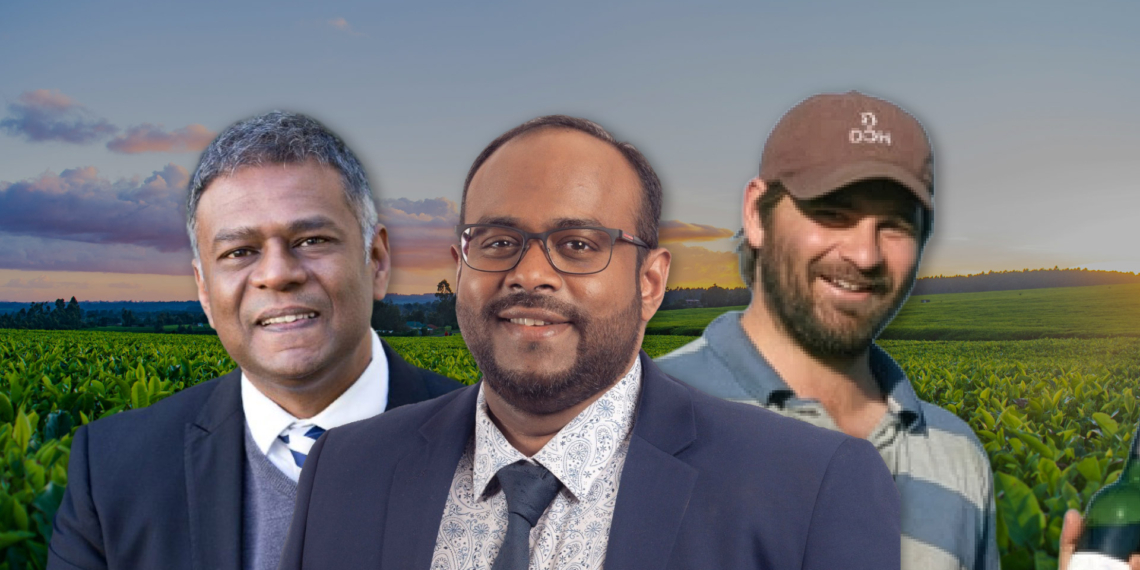
Prof. Kosheek Sewchurran, Bertie Coetzee and Quinton Naidoo explore what it will take to develop a new kind of farmer for a changing world. They argue that the future of agriculture depends not only on new methods but on how people learn to see, think, and steward living systems.
Every major economic transition in history has required societies to reinvent how people work, learn and organise.
The Industrial Revolution did not succeed simply because steam engines and factories were invented. It succeeded because societies developed entirely new ways of organising human capability. Frederick Taylor’s scientific management taught workers to perform standardised tasks with precision and discipline. Factories became schools for industrial society.
Several decades later, another challenge emerged. The Manhattan Project, large infrastructure programmes and modern engineering confronted problems that disciplined workers alone could not solve.
Thousands of specialists had to coordinate under conditions of uncertainty. Project management emerged. Gantt charts, milestones, work breakdown structures and critical paths became the technologies through which complexity could be managed.
Post-war Japan introduced another shift. Faced with scarcity and international competition, Japanese manufacturers discovered that the people closest to the work often possessed the deepest understanding of how to improve it. Continuous improvement and Kaizen became part of everyday production.
Each period faced a different problem.
Each developed new tools.
Each produced new human capabilities.

From industrial to regenerative thinking
South African agriculture now faces another such moment.
For much of the twentieth century, farming operated according to industrial assumptions. Productivity, efficiency and standardisation became the dominant measures of success. Agricultural education mirrored this logic. Experts generated knowledge. Farmers implemented it.
This model delivered extraordinary gains.
But the conditions surrounding agriculture have changed.
Climate instability is increasing. Soil health is declining. Water systems are under pressure. Biodiversity is diminishing. Rural communities are weakening. Young people are leaving agriculture.
Farmers are now being asked not only to produce food, but also to restore soils, regenerate ecosystems, strengthen communities and improve resilience.
This introduces a peculiar challenge.
Regenerative agriculture depends upon living systems. Unlike machines, living systems behave differently everywhere.
- Rainfall differs.
- Soil biology differs.
- Animal behaviour differs.
- Communities differ.
There is no universal recipe.
Related stories
- Carbon credits 101: A guide to regenerative farming & income
- Regenerative farming: Healthy soil, healthy food, healthy profits
- Cattle and cover crops power vineyard regenerative study
- Soil health at the heart of regenerative agriculture
Agriculture at a turning point
The challenge therefore becomes profoundly human.
What kind of people are capable of stewarding living systems?
At Rustlers Valley in the eastern Free State, this question has increasingly become central to our work. Initially, we believed we were teaching people to farm.
Increasingly, we suspect we are learning how people become stewards. We have become increasingly unsettled by a very simple question.
If the industrial revolution produced scientific management, and the project age produced project management, what are the management technologies of a regenerative age?
Rethinking the tools of management
Frederick Taylor gave the industrial world the stopwatch, the time study and standardised work. Project management gave the twentieth century the Gantt chart, milestones, critical paths and network analysis.
What are the equivalent tools required to grow people capable of working with living systems?
The answer, we believe, begins with understanding how capability itself develops.
The first stage is learning to work IN an enterprise.
People feed chickens. Move cattle. Plant trees. Repair fences. Clean equipment.

At first glance, this appears to be simple labour. But something deeper is occurring. People begin paying attention. They notice moisture. Animal behaviour. Grass recovery. Soil conditions. Timing. Observation develops. The work teaches attention.
The second stage is learning to work ON the enterprise.
People begin asking different questions. How do we improve feed conversion? How do we reduce mortality? How do we organise the week? How do we make the enterprise more reliable? People begin designing conditions rather than simply carrying out tasks.
The third stage is learning to work WITH the enterprise.
At this point, people begin recognising relationships. The pigs affect the chickens. The cattle affect the soil. The grazing affects the trees. The community affects the enterprise.
Nothing stands alone. The learner begins to think systemically.
Finally, people learn to work FOR the enterprise. The question changes once again. Who comes after me? What future are we building?
How do I develop others? The individual becomes a mentor, steward and teacher. This progression is not merely technical. It is developmental.
People move from doing to thinking, to being.
| Development Stage | Question | Human Development | Orientation |
| Working IN | Can I do the work? | Doing | Competence and attention |
| Working ON | Can I improve the work? | Thinking | Judgment and improvement |
| Working WITH | How does the system work? | Thinking and Being | Integration and relationship |
| Working FOR | What future am I serving? | Being | Stewardship and contribution |
Seeing differently: the human shift
What changes across these stages is not merely skill. It is perception. People begin to see differently.
One participant interviewed at Lowerland reflected: “Before, being a good farmer meant neat lands, straight lines and high yields. Now, sometimes it looks messy. You have to learn to see differently.”
Another said simply: “I had to empty my mind.”
This may be the deepest challenge of regenerative agriculture. The problem is not simply that we need different farming methods.
We need different ways of seeing.

The research emerging from the study of Lowerland’s regenerative transformation suggests that purpose does not simply descend from leaders or experts. People become sensitive to what matters, develop shared judgments concerning responsibility and organise themselves around these commitments. Ethical direction emerges through participation itself.
This process can be understood through three forms of moral work.
Grounding involves becoming sensitive to ecological, organisational and relational realities through direct experience.
Clarifying involves developing shared judgments about what matters and why.
Organising involves embedding these commitments in routines, relationships and institutions that allow them to endure.
Leadership therefore becomes something different. It is no longer simply about directing people. It becomes the stewardship of conditions through which people can learn, judge and grow.
This brings us back to the original question. What are the tools of a regenerative age?
Perhaps they are not machines at all.
| Development Stage | Primary Tools |
| Working IN | Daily routines, task lists, observation practices, operational standards |
| Working ON | Weekly plans, KPIs, records, enterprise goals, production measures |
| Working WITH | Reflection meetings, systems maps, cross-enterprise projects, collaborative problem-solving |
| Working FOR | Mentoring, succession planning, capability pathways, learning communities |
Every enterprise requires a visible planning horizon. Quarterly plans. Seasonal maps. Annual cycles. Enterprise leaders require weekly planning.
Operations managers must continuously improve routines and coordinate priorities. Teams need regular reflection. Records make learning visible. Conversations create shared judgment.
Capability must be intentionally cultivated. Learning cannot be left to chance. Perhaps these are the management technologies of the regenerative age.

Previous generations built railways, dams, ports and power stations because they understood that economic development required infrastructure.
Perhaps the infrastructure challenge of our generation is different.
Industrial society built workers. The project age built coordinators. The knowledge economy built learners. The regenerative age may need to build stewards.
Because ultimately, we cannot regenerate landscapes without regenerating the people capable of seeing, judging, organising and caring for them.
The future of farming may therefore depend less upon discovering new technologies than upon cultivating the human capabilities required to steward living systems.
That may be the missing infrastructure of regeneration.
- Prof. Kosheek Sewchurran is a scholar working in leadership, systems thinking and organisational learning and also director of Rustlers Valley Foundation NPC. Bertie Coetzee is a regenerative farmer from Prieska in the Northern Cape. Quinton Naidoo is the head of socio-economic development at Kagiso Trust.
- Regenerative Futures SA 2026, hosted by Kagiso Trust and Food For Mzansi, will take place on Wednesday 24 to Thursday 25 June. You can follow the livestream via this link: Facebook livestream
- The views and opinions expressed in this article are those of the author and do not necessarily reflect the views or positions of Food For Mzansi.
READ NEXT: Advisory programme helps black wine farmers adapt and grow