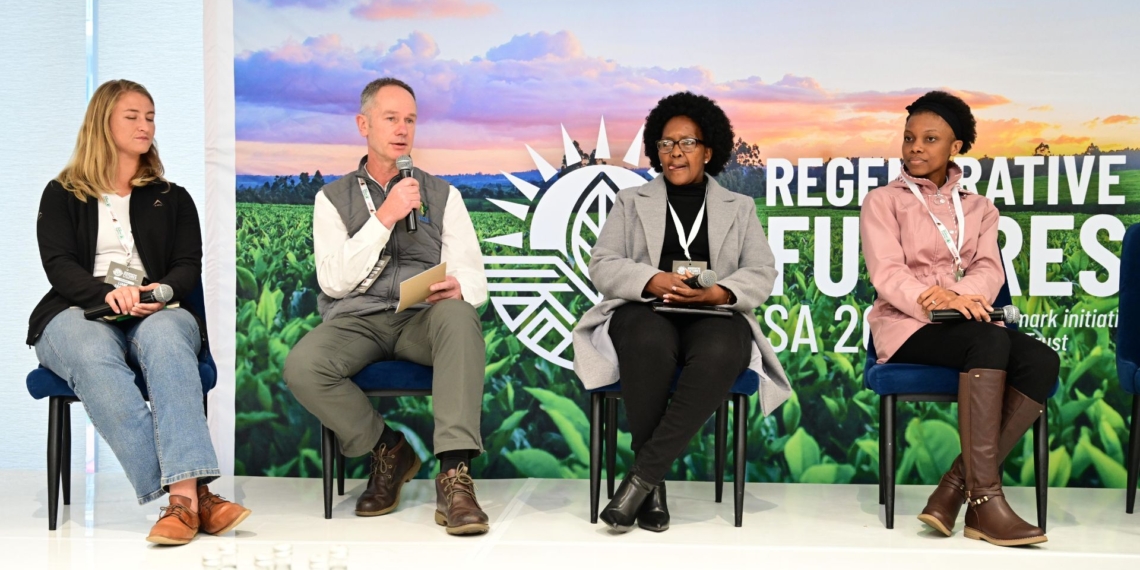
Collaboration between farmers, researchers and communities is essential if regenerative agriculture is to deliver meaningful results on the ground. This was highlighted during a panel discussion at the Regenerative Futures SA conference in Johannesburg yesterday.
The discussion explored how different forms of knowledge, from scientific research and academic study to indigenous wisdom and practical farming experience, can contribute to building more resilient farming systems.
Moderated by Dr Nicole van Rheede, chief researcher at the Human Sciences Research Council, the session highlighted the importance of recognising that learning in agriculture happens through multiple pathways, including experimentation, observation, adaptation and collaboration.
For young regenerative farmer Liane Erasmus from Magaliesberg, Gauteng, much of her most valuable education came from practical farming experience.
While grateful for the foundation provided by her studies at the University of the Free State, Erasmus said her greatest lessons were learned on the farm itself.
Related stories
- Organic certification: A gateway to premium markets
- Carbon credits 101: A guide to regenerative farming & income
- Regenerative Futures: How outdated banking stalls SA farmers
- Beyond land: Leaders call for full package support
“I think most of my learning experience happened on the farm,” she said.
She explained that further studies had broadened her perspective and exposed her to different approaches to agriculture, while reinforcing the importance of practical experience. Erasmus shared that spending time away from the farm and returning with new knowledge allowed her to view her farming operation differently and explore new ways of implementing practices on the ground.
According to Erasmus, successful farming requires continuous testing and adaptation.
“It gives you a new perspective on how to implement things differently and to start testing through trial and error to see what works and what doesn’t work.”

Farmers bring essential knowledge
Agronomist and soil scientist Dr Hendrik Smith said his journey through agricultural research reinforced the value of working directly with farmers.
Having grown up on a farm before pursuing a research career, Smith said he learned to view the land through the eyes of farmers while simultaneously applying scientific measurement and monitoring.
“The quantification, measuring and monitoring happen in a participatory manner with farmers. That makes a huge difference,” he said.
He said the joint learning process creates immediate benefits for both farmers and researchers.
Smith said collaborative learning between farmers and researchers creates a meaningful impact because it combines practical experience with scientific understanding. He emphasised that regenerative agriculture requires urgent action to restore and regenerate the land, but stressed that this cannot be achieved without farmers playing a central role.
One of the most important lessons he has learned is that every farmer operates within a unique context shaped not only by soil and climate, but also by financial realities, objectives, values, culture and traditions.
“Every farmer’s context is different. It’s not only soil and climate, but also finance, objectives, values, norms, culture, traditions and mindset,” Smith said.
The value of indigenous knowledge
Organic agroecology farmer Rosah Ramaipadi said her agricultural knowledge was shaped largely by her grandparents and the farming practices she observed growing up.
She recalled how previous generations relied on close observation of natural systems to guide farming decisions.
“Just by looking at the moon or the stars, they would tell you that tomorrow it will rain. That is the indigenous knowledge they had. That knowledge is really important to me. That’s what I am practising now.”
She also highlighted the importance of community-based learning networks, particularly among women farmers in Limpopo, where producers regularly share experiences and indigenous knowledge.
Stronger partnerships between farmers and researchers key
For Dr Jama Mashele Mohale, a postdoctoral research fellow at the Centre for Ecological Intelligence at the University of Johannesburg, a desire to address hunger and food insecurity ultimately drew her into agriculture.
Through her research journey, Mohale spent time with organic and regenerative farmers across South Africa and East Africa, gaining a deeper appreciation for farming realities.
She said many farmers demonstrated a remarkable commitment to caring for the land despite facing financial and climatic challenges.
Mohale also reflected on the mistrust that can exist between farming communities and researchers. “Some communities told us, ‘You researchers come here, you take information, go present it and forget about us.’”
She believes research must be translated into practical outcomes that benefit farming communities.
“Sometimes I think we write for people we’re not connected to and publish in places that the people we’re talking about will never access,” Mohale said.
A recurring theme throughout the discussion was the need for stronger partnerships between farmers and researchers. Erasmus emphasised that both groups need to recognise their different strengths and perspectives.
“Researchers and farmers have to make peace with the fact that they are going to walk a long journey together,” Erasmus said.
READ NEXT: Extension services must bridge the gap from harvest to market