Monday, June 29, 2026
SUBSCRIBE
22 GLOBAL MEDIA AWARDS
Food For Mzansi
  • News
  • Changemakers
  • Lifestyle
  • Farmer’s Inside Track
  • Food for Thought
No Result
View All Result
  • News
  • Changemakers
  • Lifestyle
  • Farmer’s Inside Track
  • Food for Thought
No Result
View All Result
Food For Mzansi
No Result
View All Result
in News

Regenerative Futures: How outdated banking stalls SA farmers

At the inaugural Regenerative Futures SA conference, farmers shared the harsh reality of trying to fix broken soil. They revealed how old banking models and a lack of institutional trust penalise forward-thinking farmers trying to build resilient, drought-proof operations

by Vateka Halile
24th June 2026
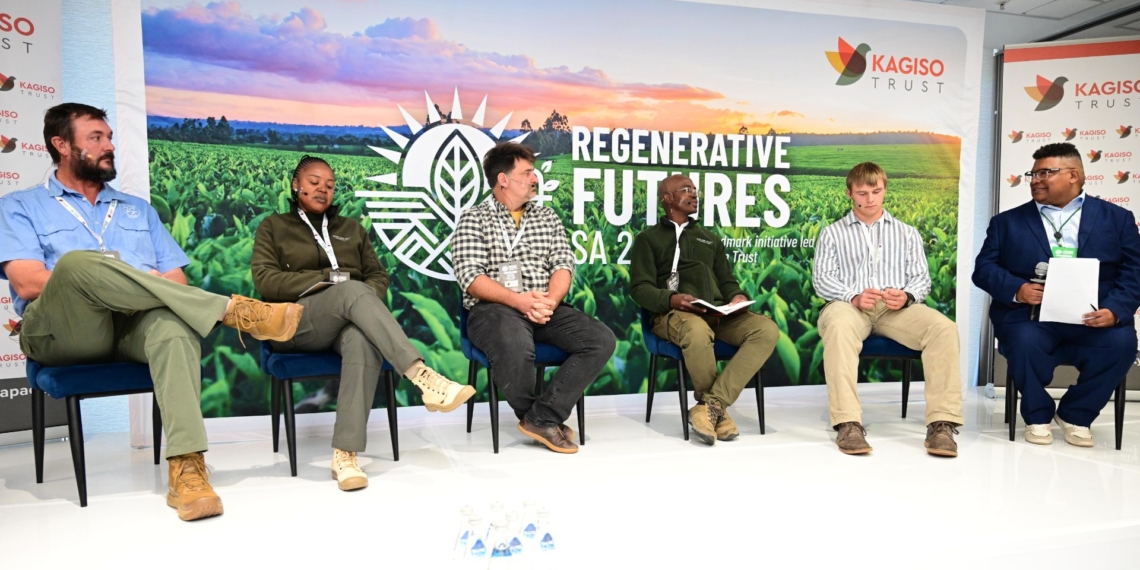
From left to right: Danie Slabbert, owner of Sewe Slabberts farm; Free State, Mookho Chaka, stakeholder relations, enterprise and ecosystem building manager at Rustlers Valley; Bertie Coetzee, owner of LowerLand farm, Northern Cape, Tshalenyana; Charles Tsenase, Rustlers Valley Regenerative Farm and Eco-Tourism; Francois Maree, Free State egg farmer; and Ivor Price, managing director, Food For Mzansi Group. Photo: Kagiso Trust/Food For Mzansi

From left to right: Danie Slabbert, owner of Sewe Slabberts farm; Free State, Mookho Chaka, stakeholder relations, enterprise and ecosystem building manager at Rustlers Valley; Bertie Coetzee, owner of LowerLand farm, Northern Cape, Tshalenyana; Charles Tsenase, Rustlers Valley Regenerative Farm and Eco-Tourism; Francois Maree, Free State egg farmer; and Ivor Price, managing director, Food For Mzansi Group. Photo: Kagiso Trust/Food For Mzansi

Share on FacebookShare on TwitterShare on WhatsApp

For decades, farmers have worked the land their own way. Some use traditional methods while others depend on chemicals to push yields. But today, those intensive practices have degraded the soil and broken the land.

Now, Kagiso Trust is changing the story through Regenerative Futures SA, a landmark initiative launched in partnership with Food For Mzansi today.

The respected development institution is championing regenerative agriculture, an approach that works with natural systems to build resilient soils that retain more water, support healthier crops and livestock, reduce reliance on costly inputs, and strengthen farms against the growing pressures of drought and climate change.

Regenerative Futures SA was launched at The Venue in Melrose Arch, Johannesburg to address the actual work and financial strains of changing how producers farm.

The gathering brought together participants from six provinces, including farmers, policymakers, scientists, academics, development practitioners and industry leaders, reflecting a cross-sector effort to rethink and reshape the future of agriculture.

Institutional barriers for next-gen farmers

The jam-packed programme, amongst others, included a fireside chat on regenerative farming in practice.

Panellists included Bertie Coetzee from Lowerland Organic Farm in the Northern Cape. Danie Slabbert joined from Sewe Slabberts farm in the Free State and Francois Maree represented RegenRoots farm, also in the Free State.

Mookho Chaka and Charles Tsenase from Rustlers Valley Regenerative Farm and Eco-Tourism also took part. Together they unpacked the real risks farmers face when trying to restore and rebuild soil health, as well as the on-the-ground successes, practical realities and moments of inspiration emerging from farms already in transition.

Maree, a well-loved TikTok farmer and egg producer known for his pasture-raised system, highlighted how a lack of institutional trust is actively penalising the next generation of farmers. He explained that financiers often favour traditional, long-term production models, which creates steep barriers for younger operators trying to build viable agricultural businesses.

His pasture-raised approach sees hens living outdoors on fresh veld 24/7, with flocks rotated to new grazing areas every two days to maintain soil and animal health.

Despite having guaranteed buyer contracts in hand, the 19-year-old Maree said he struggles to secure financing for a delivery vehicle and faces inflated insurance premiums simply because of his age.

“Just because I’m young, there’s no trust yet. I have the eggs, I have contracts, I have guys that want the eggs, but I can’t buy a vehicle [due to high lending rates linked to my age and perceived risk] because I’m still too young,” he said.

Charles Tsenase, Francois Maree and Ivor Price during Regenerative Futures SA 2026, sharing insights on the realities, risks and on-the-ground experiences shaping the transition to regenerative farming in South Africa. Photo: Food For Mzansi

The disconnect of outdated banking and training systems

Slabbert, who has successfully transitioned over 1 300 hectares from conventional to regenerative farming, highlighted how outdated banking models actively stall the growth of sustainable agriculture. He bevelieves financial institutions remain completely out of touch with ecological realities, choosing the comfort of rigid checklists over forward-thinking practices.

“Our banking models are 50 years old. If you type in the word ‘regenerative’, the computer blanks. It doesn’t even know what it means.”

This lack of institutional understanding creates impossible demands, with banks routinely expecting farmers to guarantee their income months in advance despite volatile climate risks.

Slabbert noted that without pre-existing collateral or a guarantor to stand in the gap, starting or securing basic operational assets is an unrealistic expectation.

“You cannot start farming without a kickstart. How can you get collateral if you start?”

Danie Slabbert of Sewe Slabberts farm in the Free State during Regenerative Futures SA 2026, sharing practical insights on regenerative farming. Photo: Food For Mzansi
Related stories
  • Kagiso Trust to convene Regenerative Futures SA this June
  • Carbon credits 101: A guide to regenerative farming & income
  • Regenerative farming: Healthy soil, healthy food, healthy profits
  • Khula! and Kagiso Trust unite to get farmers funding ready

Mookho Chaka of Rustlers Valley Regenerative Farm and Eco-Tourism in the Free State during Regenerative Futures SA 2026. Photo: Food For Mzansi

Chaka, the stakeholder relations manager at Rustlers Valley, highlighted how standardised training actively penalises those trying to transition to sustainable agriculture. She said many farmers struggle on the ground because critical information is rarely accessible in their own language.

“We learn better when we do things together. If we can make this training manual available in a local language, it will also help,” she said.

This lack of tailored engagement also extends to the younger generation. Chaka noted that rather than forcing old approaches, the sector must adapt to modern platforms to make regenerative agriculture appealing to the youth.

“They like to make their mark on social media. Let’s involve the youth to be more involved in making regen a trend.”

Bertie Coetzee of Lowerland Organic Farm in the Northern Cape during Regenerative Futures SA 2026. Photo: Food For Mzansi

Shift towards regenerative agriculture

Lowerland’s Coetzee stated that traditional agricultural models pushing for massive scale and hyper-specialisation are draining the life out of soil and local communities. He explained that a sudden loss of land forced him to rethink conventional methods and focus on localised value addition.

Coetzee noted that processing food directly on the land by building local mills, butcheries or wine cellars creates purposeful jobs and revives quiet rural towns.

According to him, traditional banks stall this transition because they rely on outdated checklists. He stated that lenders readily fund expensive tractors that lose value immediately, rather than biological assets like cattle, which actively improve soil fertility.

Coetzee said that investors must look beyond simple spreadsheets and provide patient capital to support the long transition period required to move away from chemical-heavy farming.

“That switched the thing for me [realising] we are not farming commodities, we are farming food,” Coetzee said. “And that changed everything for me… because for me, there was absolutely no passion in poison.”

He added that bridging the gap between farmers and financiers remains a critical hurdle.

“I think that is the big discussion that needs to be had on [regenerative agriculture], because I think it’s an investment that goes through farms back into local communities,” he said. “Building enterprises, putting up factories on farms.”

READ NEXT: Fitch upgrade sparks new investment wave in SA agriculture

Sign-up for the latest agricultural news delivered straight to your inbox every day with Mzansi Today!

Vateka Halile

Vateka Halile grew up in rural areas of Cofimvaba in the Eastern Cape. She was raised in a traditional family setting and found writing to be a source of comfort and escape. Vateka participated in an online citizen journalism course through Food For Mzansi, and her passion for health and medicine-related stories was born. Her dedication to community work and love for social justice and solidarity spaces is evident in her quality time with the community when she isn't working.

Tags: Agricultural financeInform meKagiso TrustRegenerative agriculture
Food for Thought

What we’re missing in regenerative farming: A new way to learn

by Prof Kosheek Sewchurran Bertie Coetzee and Quinton Naidoo
27th June 2026

Prof. Kosheek Sewchurran, Bertie Coetzee and Quinton Naidoo explore what it will take to develop a new kind of farmer...

Read moreDetails
Learners swap classrooms for farms and labs to tackle food crisis

Learners swap classrooms for farms and labs to tackle food crisis

26th June 2026
Engineer Mfanzile Maseko takes leap of faith into full-time farming

Engineer Mfanzile Maseko takes leap of faith into full-time farming

26th June 2026
Farmers, researchers must walk regenerative journey together

Farmers, researchers must walk regenerative journey together

26th June 2026
Northern Cape youth lead the fight against water scarcity

Northern Cape youth lead the fight against water scarcity

26th June 2026

Karoo Winter Wool Festival brings wool, food and big ideas

Agri sector on edge as anti-immigration ultimatum looms

‘Severe blow’: Industry hit hard by unchanged wheat tariff

How RDP house rooftops can help solve SA’s hunger crisis

Matjee Mokgoadi is turning Limpopo farming into serious business

Join Food For Mzansi's WhatsApp channel for the latest updates!

JOIN NOW!
Next Post
Land Bank urges greater youth participation in agriculture

Land Bank urges greater youth participation in agriculture

THE NEW FACE OF SOUTH AFRICAN AGRICULTURE

With 21 global awards in the first six years of its existence, Food For Mzansi is much more than an agriculture publication. It is a movement, unashamedly saluting the unsung heroes of South African agriculture. We believe in the power of agriculture to promote nation building and social cohesion by telling stories that are often overlooked by broader society.

Reject xenophobia, restore South Africa’s promise

Simangele turns school lease into retail-supplying agribusiness

Nedbank backs regenerative agriculture in new podcast series

Agri sector on edge as anti-immigration ultimatum looms

This week’s agri events: 29 June – 03 July

How RDP house rooftops can help solve SA’s hunger crisis

  • Awards & Global Impact
  • Our Story
  • Contact Us
  • Cookie Policy
  • Privacy Policy
  • Copyright

Contact us
Office: +27 21 879 1824
News: info@foodformzansi.co.za
Advertising: sales@foodformzansi.co.za

Contact us
Office: +27 21 879 1824
News: info@foodformzansi.co.za
Advertising: sales@foodformzansi.co.za

  • Awards & Global Impact
  • Our Story
  • Contact Us
  • Cookie Policy
  • Privacy Policy
  • Copyright

Chat Options

I'm Lerato, your AI assistant!
No Result
View All Result
  • News
  • Changemakers
  • Lifestyle
  • Farmer’s Inside Track
  • Food for Thought

Copyright © 2024 Food for Mzansi

This website uses cookies. By continuing to use this website you are giving consent to cookies being used. Visit our Privacy and Cookie Policy.