Agriculture continues to anchor South Africa’s economy. NAMC agricultural economists Buhlebemvelo Dube and Mahlogedi Thindisa explain how Fitch’s credit rating upgrade to BB strengthens the country’s macro-financial foundations.
Fitch’s upgrade of South Africa’s sovereign rating from BB- to BB marks the first upward revision by the agency in nearly two decades and reflects a material repricing of sovereign credit risk.
The decision follows four consecutive years of primary fiscal surpluses averaging 1% of GDP, a projected primary surplus of 1.7% of GDP by FY2027, the stabilisation of public debt near 80% of GDP, and significant energy surplus and logistics reforms. The upgrade comes as the IMF projects global growth of 3.1% in 2026 amid heightened geopolitical uncertainty, elevated commodity price volatility, and tighter global financial conditions.
Strengthening agricultural exports
Considering South Africa’s agricultural sector exported more than US$15.1 billion in 2025, with 6% year-on-year growth, the lower economy-wide financing costs strengthen export supply by (i) lowering financing costs, (ii) likely improving logistics efficiency, and (iii) enhancing competitiveness.
Figure 1 shows South Africa’s sovereign rating remaining at BB- before being upgraded to BB in June 2026. Fitch attributed the upgrade to sustained fiscal consolidation, including four consecutive years of primary surpluses averaging 1% of GDP, a projected surplus of 1.7% of GDP by FY2027, debt stabilisation near 80% of GDP, and progress on energy and logistics reforms.
Although South Africa’s economic growth is forecast to remain modest at 1.4% by 2027, these improvements have strengthened sovereign creditworthiness and the broader macro-financial environment in which agricultural exports operate.
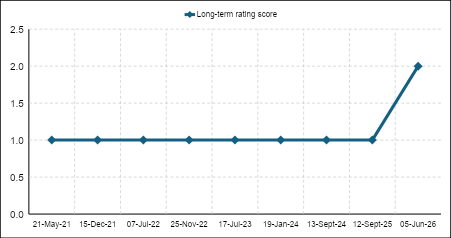
Figure 1: Fitch Rating Trend (2021–2026)
Source: NAMC calculations based on Fitch ratings data
NB: BB- score is 1; BB score is 2
Figure 2 shows that the credit-to-GDP ratio has stabilised near 65%, broadly in line with its long-run trend, while the credit gap has narrowed from approximately +15 percentage points in 2020 to around zero by 2025. The absence of a positive credit gap suggests that financial conditions are no longer characterised by excessive leverage or cyclical credit imbalances.
Related stories
- Development finance key to growing future commercial farmers
- Compliance gaps threaten farmers’ access to finance
- EC sheep farmers face rising climate risks to communal flocks
- Funding and raw truths inspire farmers in Mpumalanga
Together with improved sovereign creditworthiness, these conditions support capital formation and reduce financing frictions, especially in the export-driven agricultural sector. This brings massive optimism and confidence to the sector, encouraging stronger investment in productive assets, logistics networks, and export capacity, especially in horticulture.
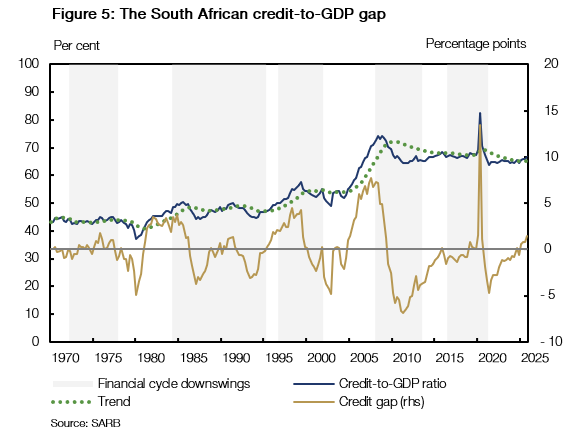
Figure 2: Balanced credit conditions
Source: South African Reserve Bank (2026)
As shown in Figure 3, agricultural exports increased from US$12.3 billion in 2021 to US$15.1 billion in 2025, while imports rose from US$6.8 billion to US$7.7 billion. Consequently, the agricultural trade surplus widened from US$5.5 billion to US$7.4 billion, reinforcing agriculture’s role as a major source of foreign-exchange earnings.
This expansion occurred despite IMF forecasts of slower global growth of 3.1% in 2026 due to heightened geopolitical uncertainty, climate variability, and elevated volatility in commodity prices.
In this environment, improved sovereign creditworthiness, lower country risk and more favourable financial conditions strengthen the investment, logistics and competitiveness fundamentals that underpin export supply and long-run trade performance for South Africa.
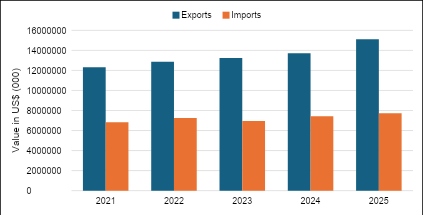
Figure 3: South Africa’s trade performance
Source: NAMC calculations based on UN Comtrade (2026)
Conclusion
Fitch’s upgrade reflects a sustained strengthening of South Africa’s fiscal and macroeconomic fundamentals, underpinned by four consecutive years of primary surpluses, debt stabilisation near 80% of GDP, and improving financial conditions.
For agriculture, a sector that generated US$15.1 billion in exports and a US$7.4 billion trade surplus in 2025, the upgrade supports stronger export growth, improved investment conditions, and enhanced competitive performance.
These gains are particularly significant in an economy expected to grow by less than 1.4% in 2026 amid heightened geopolitical uncertainty, biosecurity lapses, and climate variability.
While logistics constraints and weak economic growth remain important challenges. The upgrade strengthens the macro-financial foundations that support South Africa’s position as a dominant and competitive agricultural exporter and a major source of foreign-exchange earnings.
- Buhlebemvelo Dube and Mahlogedi Thindisa are agricultural economists at the National Agricultural Marketing Council (NAMC). The views and opinions expressed in this article are those of the author and do not necessarily reflect the views or positions of Food For Mzansi.
READ NEXT: SA and Italy sign major pact to unlock new agricultural pathways