 In 2012, a group of women from Mapetla East in Soweto looked at a rubbish dump behind a primary school in the area and saw untapped potential. Instead of seeing the obvious dirt that covered the waste infested site, they envisioned a vegetable garden that would flourish with greenery.
The garden would later be called Boikanyo Vegetable Garden – The Garden of Hope – and would change the lives of a deeply impoverished community.
The garden was started in association with Boikanyo the Dion Herson Foundation, a non-profit organisation (NGO) working with children and their caregivers in township communities within Gauteng. Founder of the NGO, Marilyn Bassin, says they believe in addressing poverty alleviation holistically through food security and social upliftment programmes. As well as opportunities to develop skills.
“Boikanyo Vegetable Garden was the foundation’s first project in that area and was established at Sediba Thuto High Primary School. We believe that community food gardens are a great way to help alleviate hunger in poor communities,” Bassin says.

The 1000 square meter vegetable garden was started in response to the schoolchildren and broader community who deal with hunger issues daily. “With the help of generous donations, we were able to expand and grow the garden, and for the past 5 years the NGO has continued to maintain the garden,” Bassin explains.
From rubbish dump to vegetable garden
These women, with the help of the schoolchildren and community, transformed the rubbish dump behind Sediba Thuto Primary school into a vegetable garden the size of a mini soccer field.
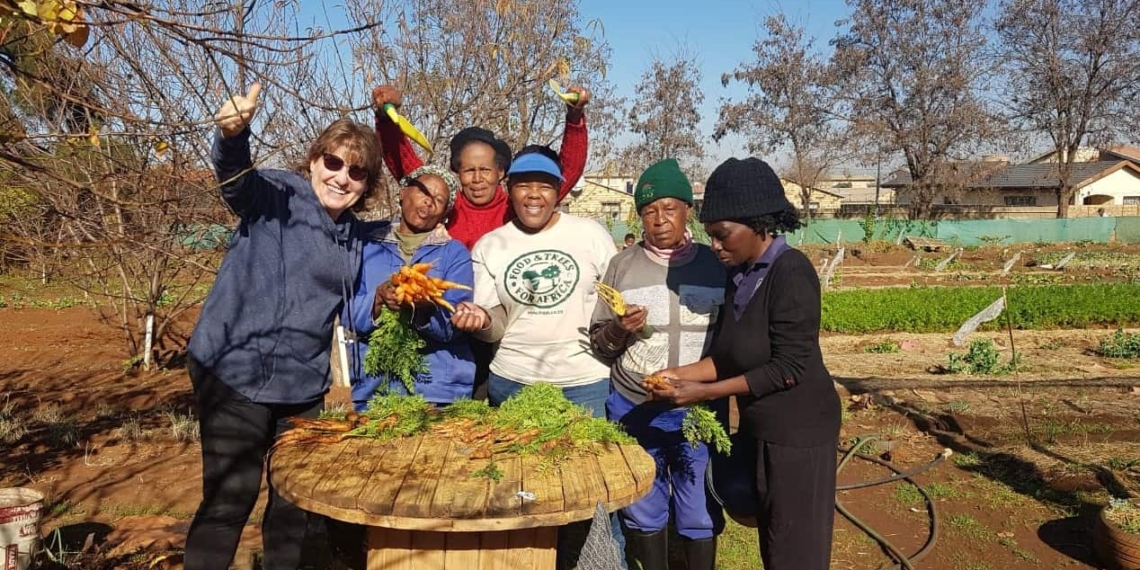
“We grow carrots, beans, peas, spinach, cabbage, brinjals, chillies, peppers, potatoes, onions, spring onions, leeks, tomatoes – a big variety of herbs, and 14 assorted fruit trees,” says Mme Sarina Motseoane.
Mme Motseoane is one of three volunteers and forms part of the Izindaba Zokudla organisation (Conversations about Food) which was started by Dr. Naude Malan of the University of Johannesburg at the Soweto campus. Izindaba Zokudla is a monthly forum hosted by the University of Johannesburg where urban farmers meet to discuss issues pertaining to farming and the agricultural value chain.
Bassin says the garden has become quite successful, but getting there wasn’t all that easy. When they started clearing the ground, they discovered a lot of broken glass and this proved to be a challenge. Another challenge was the design of the garden. “We wanted to have raised garden beds for the garden, but the community felt that it looked like graves,” Bassin says.

Many community food gardens use raised garden beds (or garden boxes), as they are great for growing small plots of veggies and flowers. They keep pathway weeds (wildflowers, that can quickly adapt to any environment) from your garden soil, prevent soil compaction, provide good drainage, and serve as a barrier to pests such as slugs and snails.
Let the elders show us how it’s done
Today, the garden is run by three older female volunteers who live in the area and whose grandchildren or children either attend or historically attended the school.
According to Bassin, the garden was forced to become a self-sustaining program in 2017 and the foundation stopped paying stipends to the workers. “Workers were not taking ownership of the project and became dependent on the foundation for a stipend,” Bassin says.
She further explains that once the stipends ended, some of the volunteer workers left, while those that remained continued working at the garden with much passion and dedication.
The remaining volunteer gardeners were then trained by Foundations for Farming (FFF) after Bassin noticed that there were differences in the way volunteers had been taught to garden. “So, we sent everyone to do the same course at FFF,” she explains.
FFF is an agricultural initiative aimed at bringing transformation to individuals, communities and nations through providing small-scale operations, like community food gardens in Zimbabwe, Malawi and South Africa training.
In addition to that, in 2018, Food and Trees For Africa (FTFA) stepped in and mentored the women on how to run the garden as a business. “We are very grateful for this and it has helped the ladies grow immensely,” Bassin adds.
FTFA is an NGO that utilised funding from Shoprite Checkers for the upskilling and mentoring programme at Boikanyo Vegetable Garden.
FTFA addresses food security, environmental sustainability, and greening. According to one of the volunteers, Mapaballo Rachane, the garden benefits the community of Mapetla East in such a way that they no longer have to travel far distances to buy wholesome, competitively priced vegetables.
“The school’s feeding programme has also benefited. The school enjoys easy access to the vegetables for when they’re running short and need to add to a meal,” Rachane says.
Most of the vegetables are sold to the families of the school learners. They buy the vegetables when they fetch their children from school. “The sales are recorded monthly and the volunteers take the money home at the end of the month, enabling them to meet their family needs with it,” Bassin explains.
Together, the three women hope to continue supporting and providing nourishment to their families, while supplying the community and school with nutritious, cheaper vegetable options.