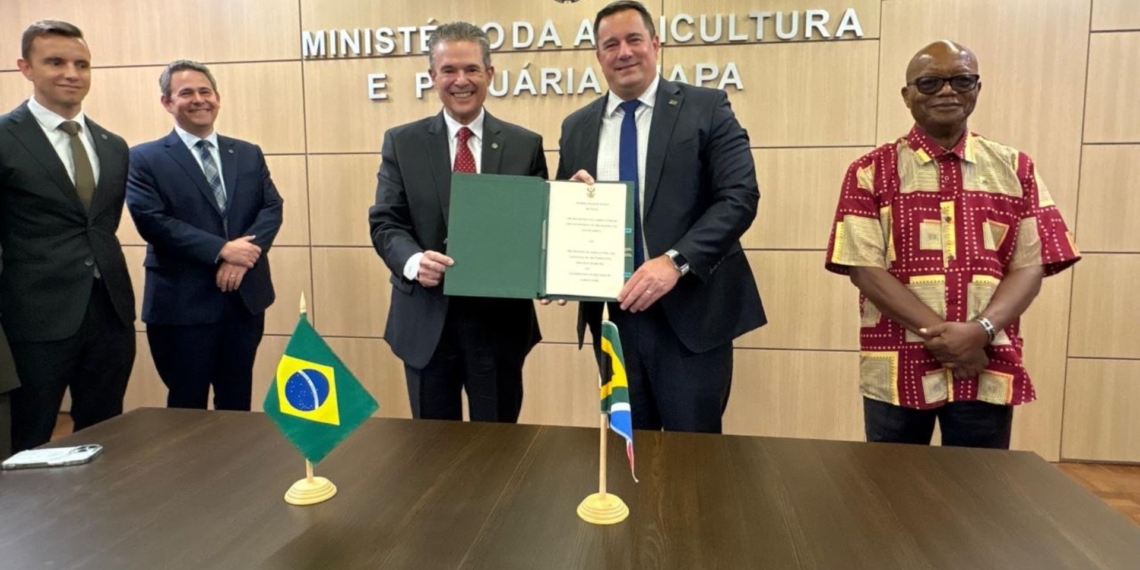
In a decisive move to reverse an unprecedented animal health challenge, the minister of agriculture, John Steenhuisen, has secured a strategic alliance with Brazil with the signing of a memorandum of intent and a comprehensive action plan designed to accelerate South Africa’s fight against foot-and-mouth disease (FMD).
Meeting with his Brazilian counterpart, minister Andre Carlos Alves de Paula, Steenhuisen welcomed their willingness to support South Africa in broader technical areas such as technical support with vaccination, post-vaccination monitoring, and field-based evidence generation.
De Paula shared with Steenhuisen how Brazil achieved recognition by the World Organisation for Animal Health (WOAH) as an FMD-free country without vaccination on 29 May 2025.
According to the department of agriculture, this was a historic milestone which took the country 64 years of implementing policies, regulations and programmes to eradicate the disease.
Collaboration to fight SA’s FMD
“This status was achieved through a phased regionalisation and vaccination approach. Minister de Paulo encouraged Minister Steenhuisen to learn from Brazil by ensuring that government do not abdicate its responsibility to be at the centre of the fight against FMD, as it is a notifiable disease and needs a regional approach,” the department stated.
Steenhuisen shared with his Brazilian counterpart the ten-year strategy that South Africa is implementing to regain FMD-free status with vaccination. He implored the Brazilian experts on FMD to assess whether the strategy is adequate to control and eradicate the disease in the next ten years.
“By aligning with a nation that has successfully eliminated the disease, South Africa aims to achieve FMD-free status with vaccination, transforming biosecurity from a trade barrier into a bridge for economic growth,” Steenhuisen said.
Related stories
- No market access, no future: The heavy cost of FMD
- Animal health graduates strengthen defences as FMD risk grows
- North West ramps up FMD vaccination drive in Marikana
- Why SA is importing FMD vaccines from Argentina
Following this visit, South Africa will host a seminar for all stakeholders and experts that will include the Brazilian delegation on animal health, research institute EMBRAPA and Brazilian livestock farmers.
The purpose of the seminar is to share experiences, knowledge, strategies, policies, regulations, and technologies used by Brazil in its 64-year fight against the disease. This delegation will be led by De Paula.
After the FMD seminar, Brazil will be sending FMD field experts and researchers to visit South Africa within three months to join their counterparts in the field across the country to practically guide the implementation of measures to control and eradicate the disease. These interventions will also include the development of new protocols and regulations that govern public and private partnerships to eradicate the disease.
Expediting and improving market access for SA exports
The two ministers agreed to also address the current agriculture trade imbalance, which is in favour of Brazil. While bilateral agricultural trade reached US$1.55 billion in 2025, of this, Brazil exported US$1.24 billion to South Africa and South Africa in return exported US$310 million worth of agricultural produce.
Brazil agreed to expedite the market access of South African apples in the next few weeks, and after that, citrus fruit before the end of the year.
“We can only be able to improve trade between our countries if we can commit to negotiating a simplified sanitary and phytosanitary (SPS) equivalency arrangement for key product categories to reduce duplication of inspections and speed up negotiations for market access.
“Given the current emerging threat on multilateralism and trade through protectionism, the above approach is much more needed today than a year ago. As countries of the South, we are stronger working together for economic development of both our nations,” Steenhuisen said.
READ NEXT: SA growers keep Middle East citrus supply flowing