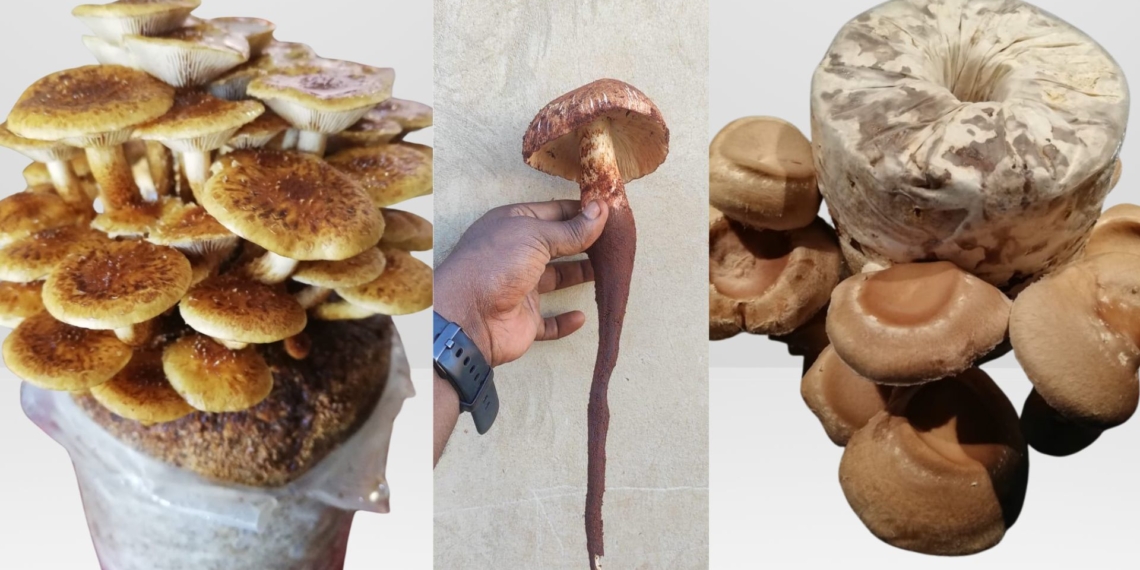
Mushrooms are a solid protein go-to for eating cleaner without the meat. Lately, more people have realised they grow perfectly indoors with almost zero equipment or space.
Ashley Maslamoney, the co-founder of Wild Plum Growers from Sunningdale, Cape Town, started in 2020 by growing about 27 exotic mushrooms. For them, oyster mushrooms have been a strong starting point due to their adaptability and relatively fast growth cycle.
“We’ve also worked with varieties like lion’s mane, which offer strong market appeal. The key has been starting small and focusing on getting the fundamentals right,” Maslamoney said.
Mastering the fundamentals
He cautioned, “Indoor mushroom farming is highly sensitive to environmental consistency, and that’s where most early results are made or lost.”
There are common challenges that can impact indoor production. Maslamoney said contamination and quality inconsistency are key issues. Some of these challenges, he added, include moulds and competing fungi that can affect both yields and quality.
“Managing this comes down to maintaining a clean, well-controlled growing environment and being consistent with handling practices throughout the process.”

In terms of market, they focused on markets where there was already an appreciation for quality and built from there. He added that it’s better to start with fewer buyers and build trust properly before scaling supply.
Growing beyond seasons
All mushroom farming enterprises operate indoors, depending on the scale, and in the case of commercial farming, one may need climate-control technology, explained Professor David Katerere, research chair in pharmaceutical and biotech advancement at Tshwane University of Technology (TUT).
Related stories
- MSc graduate turns mushroom waste into poultry gold
- Oyster mushrooms fuel Daniels’s dream for community growth
- Cape couple cultivates thriving exotic mushroom business
- Homegrown: TUT turns traditional grains into modern medicine
However, he noted that it’s possible to grow mushrooms in damp, dark, and warm places without the need for climate control, for example, in a garage or small outbuilding.
“Mushroom farming is easy and can be done by anyone, no need for land or heavy lifting; they require a minimum amount of water and time.”
Katerere said oyster mushrooms are the easiest, as they utilise locally available materials such as grass, wood shavings, hay, and straw.
“The most popular mushroom is button mushrooms. They are also relatively easy to grow but require composting of the growing media.”
For a startup, Katerere said you need very little. You need access to grass or straw or hay (that’s your growing material), plastic bags to pack and grow the mushrooms, string for tying the bags and, of course, the spawn (mushroom “seeds”), some kind of housing or dark cupboard, or even tyres which can be covered with sacks.

“At TUT, we try to use materials that people have in their vicinity. For small-scale commercial production, we have calculated that R6 000 will make 100 bags and that in turn will bring in R16 000 in turnover.”
He added that a punnet of 250g of button mushrooms sells for over R35, so the money is good. “Something great about this business is that mushrooms have no season; they may grow more slowly when it’s cold, but they still grow all year round. For farmers, getting the proper training is important and then ongoing support.”
He noted that if you are not trained properly, then contamination becomes a problem, leading to production losses and a possibly unsafe product.
Mushroom demand in SA
South Africa is the only African country among the top 40 global agricultural exporters, according to Thabile Nkunjana, a senior agricultural economist with the National Agricultural Marketing Council’s (NAMC) trade research unit.
“Due to the growing demand for plant-based proteins and functional foods, the global mushroom market is likely to double in the next ten years, with a projected value of over USD 71 billion in 2025.”
As a net importer, South Africa has massive domestic and international opportunities to increase production, he added. While Mzansi produces just over 20 000 tons annually, the industry is expanding.

“In 2025, the country’s mushroom exports showed positive growth of 17.6% year over year,” he said.
Nkunjana noted that while large facilities use high-tech systems for mass production, there is room for small-scale growers. The hospitality and retail sectors are driving demand that local supply cannot yet meet.
“South Africa is a net importer of mushrooms, which means that domestic production is insufficient to meet local demands. For example, South Africa’s imports of prepared or preserved mushrooms rose from R17.7 million to R19.7 million in 2025, a 10.9% year-over-year rise.”
However, he told Food For Mzansi that electricity remains a major threat. Successful cultivation requires controlled temperatures, which is difficult for small growers facing power cuts and high tariffs as of April 2026. Without backup power, these farmers remain vulnerable despite the market’s potential.
READ NEXT: Disability is no barrier for bold mushroom farmer Nkalanga