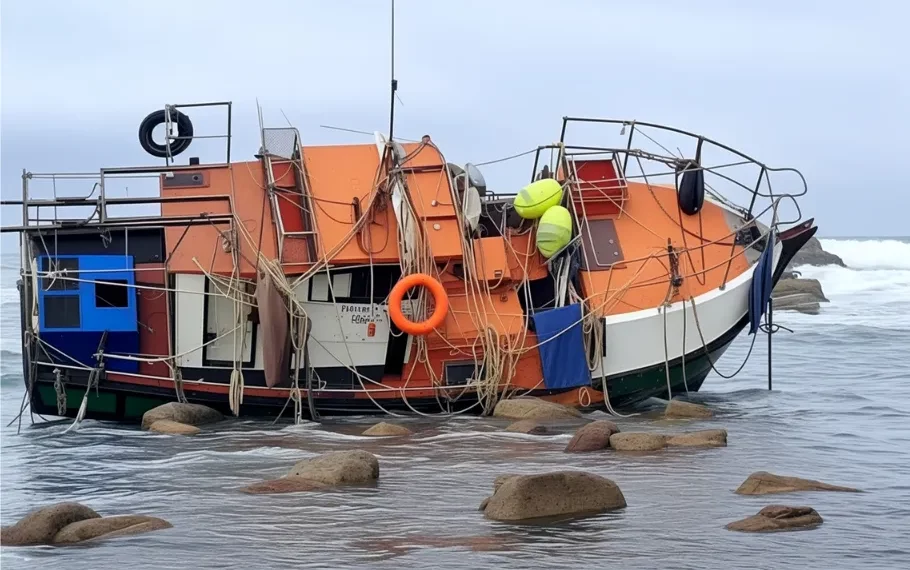
A shipping shakedown is imminent as the SA Maritime Safety Authority finds many ships in South Africa’s national fleet are unsafe and in poor condition. Fishing remains one of the deadliest jobs on Earth – and in Africa, the fatality rate for fishers is estimated to be 12 times the global average.
These disturbing figures were shared by South Africa’s deputy minister of transport, Mkhuleko Hlengwa, at the Cape Town launch of the marine safety audit. Since 1996, nearly 400 commercial fishing fatalities have been recorded in South Africa – more than half in the Western Cape – each representing a family, a community, and a promise lost to the ocean.
The nationwide safety audit is underway – and the findings so far are as stark as the sea in winter: many of South Africa’s fishing vessels are dangerously old, ill-maintained, illegally modified, or simply operating outside basic safety norms.
The consequences, as the deputy minister reminded all in attendance at the Cape Town docks launch, are counted not in rands and cents, but in coffins and missing bodies.


For many, the horror of the 63‑year‑old fishing trawler Lepanto, which sank in just minutes on 17 May 2024 with the loss of 11 crew off Hout Bay, is still in their minds. Its sister ship, the Armana, caught fire only months later and was lost at sea.
As Thandimfundo Mehlo, who led the SA Maritime Safety Authority’s (Samsa’s) audit team in Gqeberha noted: “These tragedies were not freak accidents, but symptoms of a neglected system.
“We’re sitting with fleets whose average age is 35 years, and many are over 60,” he said. “Steel doesn’t last forever. If owners don’t maintain or modernise these ships, structural integrity is just a myth on paper – until it fails at sea.”
READ NEXT: Fish farming and aquaponics: Start your journey with expert tips
His audit team in Gqeberha has spent months crawling into engine rooms and hulls, checking paperwork and examining vessels that should have been decommissioned decades ago. The findings? A pattern of expired certificates, makeshift repairs and shocking levels of noncompliance.
Worse still, some owners have secretly modified vessels – extending decks or changing gear – to chase better catches in an overfished market. These shortcuts can destroy a vessel’s stability, making it more vulnerable to capsizing or fire.
“Ship repair facilities are also in crisis,” Mehlo explained. “There was a time, not long ago, when not one single dry dock was operational in this country. We were forced to keep giving exemptions, extending certificates so these rust buckets could keep working. It has come back to bite us.”
Related stories
When a door becomes a death sentence
Even when a vessel’s hull is sound, small oversights can kill. Principal Officer Captain Thembela Taboshe from Mossel Bay highlighted a detail so simple it seems absurd: open doors.
“When deck doors are left open in rough seas, one wave can flood a compartment, sink the ship and drown the crew in minutes,” Taboshe said. “Basic drills, watertight doors – these are things that should be second nature. But we see again and again that the culture of safety is missing.”
The audit revealed that safety drills are often tick-box exercises. Some crews cannot demonstrate evacuation procedures or don’t even know how long it would take to get everyone off the vessel in an emergency. Navigation lights are out of place or blocked by deck clutter, leaving ships invisible at night. For fishers already battling brutal seas, these are risks they should not have to take.
Lives are not bargaining chips
Deputy Minister Hlengwa’s speech cut through the defensive murmurs of industry guests in the room. Some worried about losing income while ships were inspected. But Hlengwa was unwavering: “No profit is worth a life. Compliance is not optional. It is your responsibility.”
He described the audit not as a tick-box exercise, but as “a risk intervention in real time”. South Africa, as a signatory to the International Maritime Organization’s 2012 Cape Town Agreement, is obliged to enforce stringent safety standards for fishing vessels – especially small vessels of under 10 metres, where capsizing is most common.
For the new Government of National Unity, the audit was more than just policy housekeeping, said Hlengwa. It was about rebuilding trust between the people who fished for a living and the government that regulated them. “Oversight is not just about identifying what is wrong,” he said, “but about building a system that makes it right.”
READ NEXT: Hydroponics beginner’s guide: Grow more crops in less space
A sector under strain
Fishing in South Africa is not just an industry. It is the lifeblood of coastal communities. It feeds a huge number of people and sustains tens of thousands of jobs. But the audit suggests a possibility that this backbone is buckling under the weight of neglect.
Mehlo reminded the Cape Town gathering of this brutal reality: “When we launched this audit in Port Elizabeth in March, we were clear that this was not ceremonial. Every hull and hatch involves a crew and a family waiting at home. Our job is to get those crews home safely.”
He praised the cooperative spirit shown by some vessel owners – but warned that enforcement had to bite where persuasion failed. “We will strengthen our oversight. We will leverage digital tracking tools, risk profiling, and, if needed, we will take non-compliant vessels out of the water. This is not about punishing the industry. It’s about protecting it.”
What happens now?
So far, more than 160 vessels have been inspected, about 10% of the national fleet. Inspections have spanned every major port: Cape Town, Port Elizabeth, Mossel Bay, Saldanha Bay and Richards Bay. The audit team’s preliminary report reads like a catalogue of an industry stuck in another century: old ships, dodgy modifications, patchy crew training and inadequate safety equipment.
But the audit is only the beginning. The findings will feed into a national Fishing Vessel Safety Improvement Plan. This plan, according to the deputy minister, must tackle three urgent fronts:
- A recapitalisation programme to retire or modernise unsafe ships;
- Mandatory annual training and random drills for crew and owners; and
- Tough consequences – including prosecution – for owners who put profit above people.
Critically, the audit aims to embed a culture shift. As Samsa board leaders put it, safety is not an annual trade-off; it’s the foundation of sustainability and accountability.
Safety as a culture
Mehlo believes this mindset is long overdue. He recalls a telling conversation in Port Elizabeth: “We were doing a stability test on an old trawler. The owner shrugged and said, ‘It’s always been fine.’ The same sentiment echoes down the coast. But the science doesn’t lie. And the ocean doesn’t negotiate.”
Captain Taboshe said she hoped the message got through before another tragedy unfolded. “Please, just close the doors,” she told the audience, half-joking, half-pleading. “If your parents taught you to close the door behind you, you can do it at sea too.”
It’s a simple habit – but one that might mean the difference between a crew coming home or not coming home.
*This article was first published by Daily Maverick and written by Don Pinnock.
READ NEXT: Mixed farming: Double the hustle, double the rewards