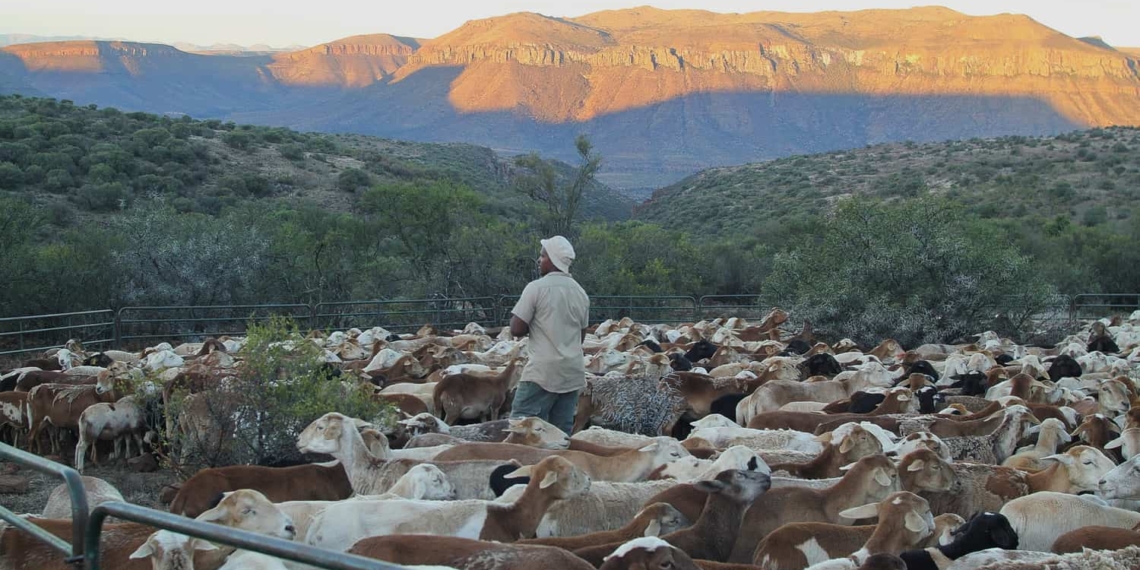
 The last sun sweeps across the ironstone krantzes of Kasteelberg, Compassberg and Ouberg north-west of Graaff-Reinet as herder Chris Martins sings out commands to his dog Roxy. She jinks and darts behind a thousand sheep pouring steadily through the bossies, patterned as Joseph’s technicolour coat.
As they walk and nibble fresh shoots, their hooves flatten moribund grass tussocks into mulch, exposing the growth points to sunlight again. They break up the crusted earth with their sharp hooves. Wherever they go, they leave their dung as a gift to the land and its seeds. When the rains come again, green grasses will spring up here.
It is time to kraal the animals. The sheep stream steadily into the temporary enclosure, made with interlocking gates. Her job done, Roxy heads off and flops down in her basket under Chris’s caravan. It’s been a long day. In dry conditions like these, sheep move further and faster.
A Fine Office Indeed
This must be one of the most scenic workplaces in the world. Chris (25) sighs with satisfaction as the hills turn pink in the last light. This is his first full time job, and its requirements were distinctly unusual:
“Do you love nature? Do you enjoy working with animals? Are you happy to spend long periods of time by yourself?”
Three years later, his working conditions are still exactly as advertised. The full moon bellies up behind the mountains and lights up the valley carved by the Gats River.
“I love the peace, the clean air and the stillness. I love working with Nature. This is the life I learnt to treasure when I was growing up in Nieu-Bethesda and we would visit my father at Coloniesplaats farm on the other side of these mountains.”

Spaghetti & Movies
After he has fed Roxy, Chris says he’ll make himself a supper of spaghetti and beef on the gas stove in the caravan, which was custom-made with a toilet, shower, and a solar panel.
“I might listen to the radio tonight. Or maybe watch a movie I downloaded on the laptop.”
Chris and four other shepherds work here on St Olives farm near the top of Ouberg Pass between Graaff-Reinet and Murraysburg, each with a dog they have trained themselves. For seven days at a time, they guard and move sheep, using them to invigorate degraded veld. Then they return to the bustle of town for a week’s break. In their wake, the veld is refreshed and revitalised, primed for recovery and growth.
The Flocking Instinct
Johan Bouwer, manager of the Herding Academy based on St Olives farm, points out where the sheep have been kraaled previously. These areas are invariably covered in grass, distinctly different from untouched or degraded veld.
The Herding Academy accepted its first intake of students in 2018. Along with the Tracker Academy it falls under the SA College for Tourism (SACT), owned and run by Gaynor and Johann Rupert. All three training institutions are supported by the Peace Parks Foundation.
The year-long Herding Academy course, also backed by Conservation South Africa, is intensely practical and field-based. Only 20% of the training is done in the classroom.
The students will not necessarily be herders themselves. They will go back to their communities to train others.
“The demand for trained herders is phenomenal. In the short term, we literally need thousands all over southern Africa,” explains Johan.

The Savory Way
This method of veld restoration using livestock is also known as regenerative agriculture, holistic resource management, or more popularly, the Allan Savory planned grazing method.
Savory, a former Zimbabwean game farmer, had seen how the veld deteriorated during the 1960s when wild animals were culled to reduce the tsetse fly (to absolutely no effect). Until then, it was often assumed that if veld was left ungrazed, it would recover to pristine condition.
He concluded that plants, soils and animals (including humans) evolved together and all need each other to flourish. Grasses grow moribund and die when not consumed. Many seeds need to be distributed and fertilised by animals.
Savory’s ideas seemed radical and counter-intuitive to many. He said most ranges were overgrazed, not because there were too many animals, but because they were left in one place too long. It was a function of time, not numbers.
The Trekbok Herds
What the veld needed, he said, was to have brief, intense grazing on it, and then be left to recover for many months. The concept resonated with some Karoo farmers, perhaps because it seemed to echo the scenario in the land before European farmers arrived with their fences and livestock.

Records show that there were sporadic but enormous springbok migrations across the dry plains. Many are reliably estimated to have numbered in the many millions. Some even say the migrations would have contained more animals than there are livestock present on Karoo farms today. (Before the current drought there were around 7 million sheep and goats in the Little and Great Karoo.)
One particular trekbok migration in 1849 took three days to pass through Beaufort West. Writer Lawrence Green reports that they left the veld looking as if it had been consumed by fire.
The theory is that the buck, following the scent of rain and fresh forage, travelled mostly bunched together by predators. They would eat almost any living plant before them – there was no time or space to pick and choose the most palatable ones. All the while they would be churning up the crusted soil with their hooves, depositing their dung on the waiting seeds. Then they would move on, leaving the plants to recover and grow over months or years.
The veld thrived on this rough and irregular treatment. Explorers and hunters in the mid 1800s reported how the tall grass reached their booted shins while travelling through on horseback near Richmond in the Northern Cape, something almost unimaginable today.
Livestock and Veld Restoration
By the mid-1900s, when sheep were kept for most of their lives in the same camps, it had become accepted wisdom among agricultural academics that the veld condition deteriorated by 5% every year and there was nothing anyone could do about it.
Some rebelled, like Paul McCabe, previous owner of St Olives farm. He spent his entire life trying to repair what his forefathers had done to the land.

“I remember several years ago, after a huge rainfall, there was standing water everywhere, but not on Oom Paul’s farm,” says Johan. “Here it was quickly absorbed into the earth and held there because of the plant cover and the increased organic soil content – or as we like to call it, our carbon bank.
“The current drought has been a challenge, but our ewes are lambing and the sheep are in good condition. It’s hard to say yet if this is because of the holistic regenerative approach and increased carbon in our soils that hold more moisture. But it does go against normal trends.
“Restoring the veld using livestock is probably one of the most effective measures in mitigating against climate change,” adds Johan. “This has global significance.”
A Dozen Students
Morning on St Olives farm, and the new Herding Academy students are up and about at dawn, doing the morning chores in their neat sponsored uniforms. Unlike last year’s group, these are mostly young women. The four men are completely outnumbered. Two of the students are from the Namaqualand area. The other ten are from rural villages around Matatiele in the Eastern Cape.
These 12 students have been chosen for this opportunity by local community leaders in their rural villages and are absolutely thrilled to be here.

We catch up with Nomahlubi Simoyisi (24) and Nwabisa Mkhandlwana (30) as they feed and water the fowls, which are housed in “chicken tractors”, doing on a miniature scale what is being done with the larger livestock. Every few days their hoks are moved to another area of land, where the fowls will eat the vegetation and chickenfeed, scratch open the soil and fertilise the earth.
The day before, the students spent time with Chris, Roxy and the sheep.
“I’ve never seen sheep like that,” exclaims Nomahlubi. “In my village of Mafube, they just go out and they wander around in the veld. These ones are all together and it’s like they know what to do. Chris whistles and they all move in a direction together.”
The Mentors
After chicken duty, the students head off to feed the horses with farm manager Gavin Steyn – himself a graduate of the Tracker Academy and one of those who came face to face with the famous runaway lion Sylvester after he escaped from the Karoo National Park.
Gavin takes the opportunity to teach little animal husbandry tips along the way. The students are still agog about having seen giraffe, buffalo and kudu in the flesh for the first time. Later they’ll head up to the classroom with Sarah Cromhout, who is doing her Master’s degree on aspects of sheep grazing in the Karoo. Both Gavin and Sarah are accredited assessors for the Herding Academy.
Different Backgrounds
The students vary in backgrounds and age. This year, there is one taxi driver, a Tupperware salesperson, a small business development adviser, a volunteer at a soup kitchen, a trainee teacher, several alien plant removers, one recycling entrepreneur, and a few caretakers of family livestock.
Phumla Zweni (32), the eldest of the students, worked as a ‘paravet’ volunteer with the state veterinarian to vaccinate community-owned livestock against various diseases, before she came here. Like the others, she is delighted to have been accepted, and is wide-eyed at the opportunities that lie before her.
“I used to read Farmer’s Weekly articles, and now, wow, I’m doing it, I’m in it. I want to teach people to take care of the land and animals, to think of the future, to repair the erosion around my village. I am an empty cup and I want to be full so I can give back to my community.”