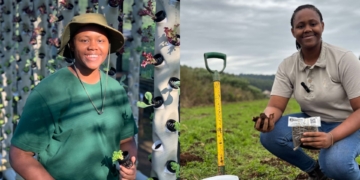
Limpopo farmer Thabo Phasha proves that passion alone doesn’t build a sustainable farm. In this Farmer Mentor episode, he shares the realities of funding, the power of mentorship, and why pride has no place when building a farming legacy.
For Limpopo farmer Thabo Phasha, agriculture is about more than growing crops. It is about building businesses, strengthening communities, and shaping the future of African food systems.
A third-generation farmer, agribusiness entrepreneur and youth advocate, Phasha represents a new generation of producers combining production knowledge with business thinking and policy awareness.
Thabo Phasha’s journey into agriculture began at a young age through family farming activities and a strong generational farming background. His family history combines entrepreneurship and agriculture: his mother, Marakgodi Phasha, worked in retail, while his father’s side focused on small-scale crop production.
His grandfather, Maloke Phasha, grew tomatoes, cabbage, spinach and other household cash crops for the local community in what was largely a subsistence farming system. After his grandfather’s passing, his father, Kgagudi Phasha, continued the work, and Phasha developed his agricultural knowledge by observing and learning from their activities.
After school, however, Phasha realised passion alone would not build a sustainable enterprise.
Related stories
- Hopa brings hope and market access to EC grassroots farmers
- Ex-cop beats poisoning disaster to build growing livestock business
- Backyard bounty: Soweto graduate grows smarter with hydroponics
- New Bayer and Khula partnership to boost funding for 50 farmers
Choosing business to strengthen farming
Although agriculture remained his preferred path, Phasha intentionally chose not to study agricultural production.
“I already had practical production skills,” he explains. “The bigger question was how to build the business and administrative knowledge needed to run a successful agricultural enterprise.”
Guided by supportive parents, he completed a diploma in business management instead.
“Theoretical business knowledge, combined with technical farming experience, gave me a framework for running agricultural enterprises,” he says.
He has since expanded his skills through mentorship programmes, agribusiness development training and industry certification.
Building a grain and agro-processing business
Phasha operates across two farms in Limpopo, a smaller five-hectare farm and a larger operation exceeding 100 hectares.
His core focus is grain production, particularly yellow maize for livestock feed markets. “We supply commercial livestock producers across cattle, poultry, pigs and small stock systems,” he says.
Crop rotation, including beans, forms part of his production system, while he is also expanding into agro-processing through animal feed formulation.
“Agro-processing requires attention to detail. Different livestock categories need different feed compositions, so understanding formulations is critical.”
Scaling through support, discipline and collaboration
Like many young farmers, Phasha is candid about the realities of capital. “Starting a business requires significant capital injection.”
He credits family support for helping finance essentials such as seed, fertiliser and operational requirements, but emphasises that managing capital wisely matters just as much.
“I don’t make decisions in isolation. Having mentors and people who challenge your thinking is extremely important.”
Mentors encouraged him to seek cost-effective alternatives, negotiate locally, and free up resources for operational priorities. He also believes young farmers should not fear supplementary income streams.
Phasha notes that there were periods when he took on part-time work to generate additional income, acknowledging that pride initially made the decision difficult. However, he says the experience reinforced an important reality: building a business requires sacrifice, discipline and a willingness to do what is necessary.
In his view, meaningful connections and collaboration can unlock opportunities that farmers may not discover on their own.
Farming with purpose beyond profit
While profitability remains essential, Phasha says his motivation goes deeper.
“The love I have for people keeps me going. We feed nations. People need to eat.”
He believes farmers should actively consider giving back to vulnerable communities while building sustainable businesses rooted in integrity and empowerment.
Beyond his farming business, Phasha is also active in agricultural leadership and advocacy. Through his involvement in Afasa Youth and the World Food Forum, he works to amplify the voices of young farmers, promote youth inclusion in agriculture and advocate for stronger agricultural food systems
The legacy he hopes to leave centres on youth empowerment, stronger agricultural businesses and policy reform.
“Policy influences access, implementation and whether young farmers’ voices are heard. Real change in agricultural food systems requires policy advocacy,” Phasha says.
READ NEXT: Start small, grow big: Zen Teitge’s blueprint for sustainable farming