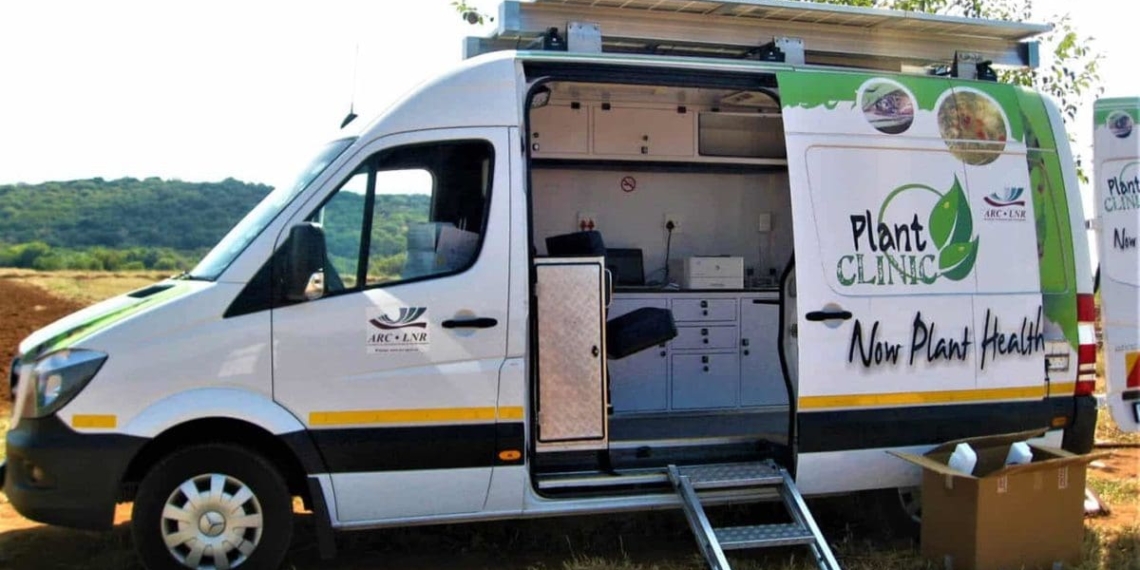

Farmers in deep rural areas and far-flung agricultural communities across Mzansi could soon be receiving agricultural advice right on their doorstep. This is thanks to a mobile agricultural laboratory launched by the Agricultural Research Council (ARC).
The ARC confirms that it is working on this concept that could see farmers get close to immediate analysis of their soil.
The project is still in its pilot phase. It was first rolled out to residents of the Sinqumeni village in the Eastern Cape. Other provinces will soon also benefit from the soil-testing lab on wheels. This was developed by experts from the ARC’s Institute for Soil, Climate and Water, as well as the departments for plant health and protection, and vegetable and ornamental plants.
The ARC team converted a panel van and equipped it with a cabinet and shelves for storing laboratory equipment. Together with a backup diesel generator, the lab also has a solar panel system installed for power when out in the field.
Great cost benefits for farmers

According to the ARC’s Dr Goodman Jezile the mobile soil testing lab differs from other previously introduced labs through its focus on analytical techniques besides traditional “wet chemistry”.
He says, “In comparison to traditional wet chemistry laboratories, there is no need of chemicals for testing soil.”
Instead of chemicals, the current method uses light in a technique called near-infrared spectroscopy.
This technique has been used for many years in the sugarcane industry. It measured soil characteristics such as texture, organic matter and nitrogen content. More recently, it also supplied the data-hungry requirements of precision agriculture.
Although this technique is currently not as completely accurate as the standard laboratory methods, it offers acceptable results when a large number of samples need to be analysed. The cost of the analysis is also lower.
ALSO ADD: Researcher brings global touch to agriculture training
Assisting small-scale farmers
“The preparation time required by mobile soil testing lab is significantly less intensive than other laboratories demand,” adds Jezile.
The emergence of the ARC’s mobile soil testing lab could mean that the days of collecting soil samples, sending them to a far-off laboratories with extended waiting times to get the results, may soon be a thing of the past

“The lab’s cutting edge technologies will offer a faster soil testing method compared to the traditional two or three weeks, and users can receive their soil testing report between one to two days.
“This is especially important in the busiest periods of the growing season as most laboratories tend to get over-whelmed.”
Real-time soil testing, the ARC states, is ideal for farmers who want to make timely decisions about what crops to grow. It will also help them with specific fertiliser and lime requirements in a quick, logical and easy-to-understand manner.
Many small-scale farmers, in particular, aspire to farm more efficiently, improving their yields and adding value to their production. The mobile soil testing lab will help farmers achieve these and other goals.