South Africa’s livestock industry has welcomed a new framework allowing voluntary vaccination against foot-and-mouth disease (FMD), describing it as a major step towards controlling the outbreak and reducing economic losses.
However, industry leaders and animal health experts caution that vaccination alone will not end the crisis, with success depending on widespread uptake, strict biosecurity and robust traceability.
The publication of the Section 9 FMD regulation follows months of uncertainty and provides producers with a clearer framework for managing the disease.
Roelie van Reenen, supply chain executive at Beefmaster Group, said the revised regulation offers much-needed economic relief for the beef industry.
“The revised regulation is significant as it provides much-needed economic relief for SA beef role players. It allows stakeholders to operate very differently compared to previously, and opens the door to a new era in how we conduct business, access markets and source cattle,” Van Reenen said.
Related stories
- FMD: South Africa’s beef industry pays price for poor traceability
- SA livestock exports take massive hit amid ongoing FMD crisis
- Mixed reactions as court rules on private FMD vaccinations
- No market access, no future: The heavy cost of FMD
Previously, producers who vaccinated cattle outside quarantine or controlled zones risked losing market access because vaccinated herds could be regarded as FMD-positive. Van Reenen said the revised framework addresses this challenge by creating stronger incentives for producers to report cases and comply with disease-control measures.
He added that the regulations were informed by scientific research, including a study led by Professor Armanda Bastos of the University of Pretoria in collaboration with Red Meat Industry Services (RMIS), which identified opportunities to reduce costs without increasing disease risk.
Van Reenen stressed that the fight against FMD is far from over and called for reliable vaccine supplies and continued investment in biosecurity.
Greater private-sector involvement
The developments follow a settlement reached among the department of agriculture, Sakeliga, the South African Agri Initiative (SAAI), Free State Agriculture and other respondents.
Under the agreement, owners and managers of cloven-hooved livestock may voluntarily vaccinate their animals against FMD, provided they comply with biosecurity measures, traceability and reporting requirements.
Agriculture minister Willie Aucamp described the agreement as a milestone for the agricultural sector.
“Today’s settlement is not only a win for the parties involved in the case but is a win for all South African farmers as this sector contributes significantly to the country’s job creation efforts and GDP,” Aucamp said.

He noted that government would continue working with the private sector to control the outbreak.
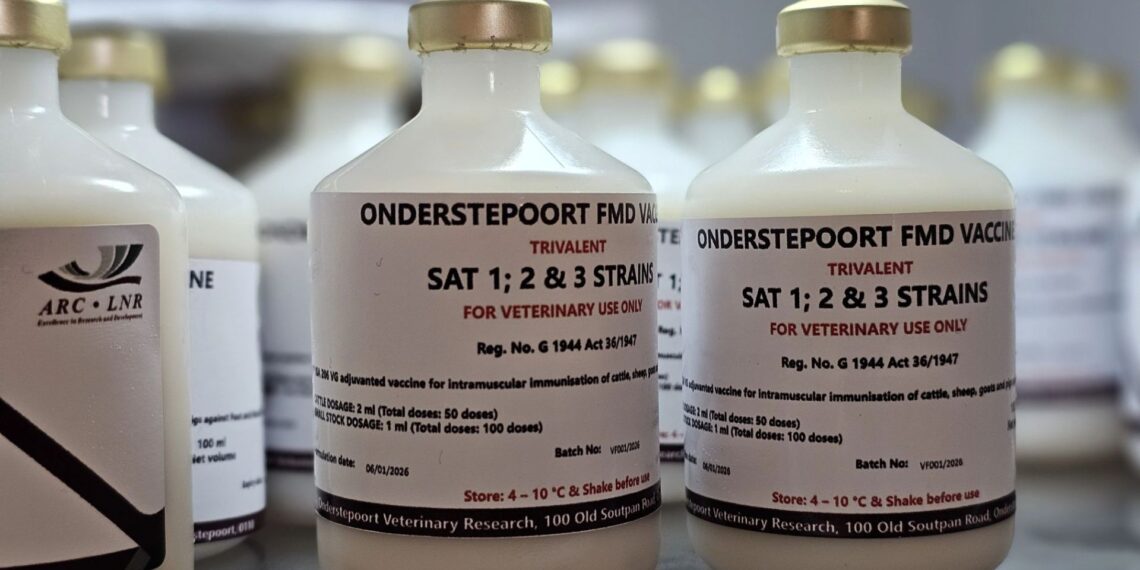
The minister also confirmed that the department and Onderstepoort Biological Products (OBP) had relinquished their sole rights to import and distribute FMD vaccines, allowing the private sector to procure vaccines at scale.
Vaccination alone will not stop the outbreak
Professor Ishmael Jaja, associate professor and head of the department of animal and pasture sciences at the University of Fort Hare, said the agreement resolves a legal dispute but challenges remain.
“This settlement solves a legal problem, but it doesn’t automatically solve a disease-control problem, and that distinction matters,” he said.
Jaja explained that FMD can only be controlled when vaccination coverage is both high and evenly distributed.
“Foot-and-mouth disease is only brought under control when vaccination coverage is high and, just as importantly, uniform. We typically need something in the order of 80% coverage with two doses before we can be confident that transmission chains are actually breaking down,” Jaja said.
He warned that voluntary vaccination could lead to uneven uptake between commercial producers with ready access to veterinary services and communal or smallholder farmers, creating gaps where the virus could continue circulating.
Jaja also said the increased involvement of private veterinarians would place even greater importance on traceability, reporting and accurate record-keeping, warning that weak enforcement could delay South Africa’s efforts to regain export market access.
Traceability remains the key to market access
Although RMIS was not part of the settlement negotiations, chief executive officer Dewald Olivier said voluntary vaccination was already introduced under the Section 10 scheme, and farmers had been vaccinating cattle for months.
“Voluntary vaccination is not a new development that flows from this settlement; it was agreed months ago through the implementation of the Section 10 scheme, and was negotiated between the national and provincial departments of agriculture and the industry. Vaccination has not been compulsory at any point in this campaign,” he said.
Olivier explained that the industry’s immediate priority is building sufficient herd immunity while ensuring every vaccination is supported by reliable animal identification and movement records.
“This is where the real work lies, and it is absolutely crucial. Voluntary vaccination can only support disease surveillance and help curb the spread of FMD if it rests on a foundation of accurate animal identification, reliable movement records, verified vaccination records and continual reporting. ”
He said RMIS’s national traceability platform already includes more than 12 000 registered production locations, with almost 2.5 million vaccine doses distributed through the system between early May and July this year.
Olivier added that accurate identification, traceability and reporting are essential for South Africa to regain its official disease status with the World Organisation for Animal Health and restore export opportunities.
READ NEXT: Gauteng farmers urged to strengthen value-chain participation