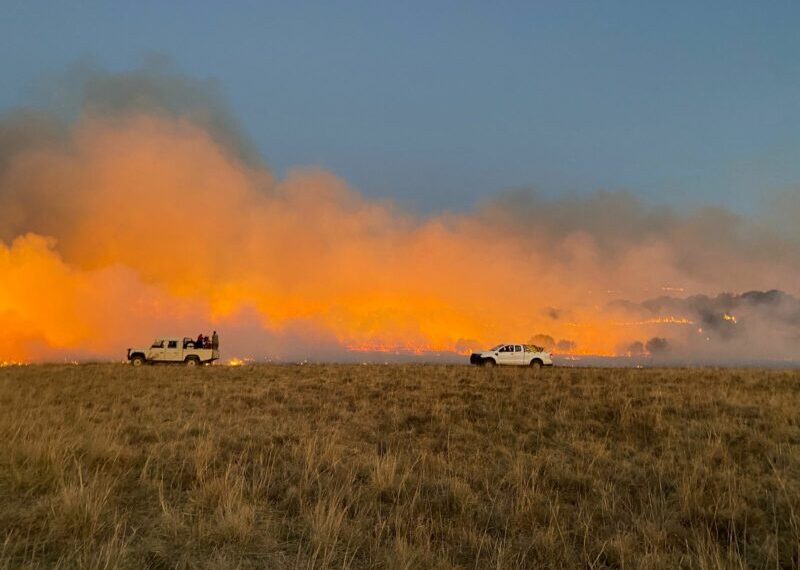
After more than a year of record-breaking heat, the peak of fire season is approaching across vast swathes of our green planet.
Lots of ecosystems have evolved to withstand regular fires and some are even nourished by it – there are, for example, plants that need flames to help them reproduce. However, rising global temperatures have spawned entirely new fire regimes. Not only does this make life more hazardous, it is also making climate change worse.
“It feels like we are getting used to the Earth being on fire,” say Víctor Fernández García and Cristina Santín, wildfire ecologists at Université de Lausanne and Swansea University respectively. According to their new research, this is a fairly recent phenomenon: extreme wildfires, the kind that killed more than 130 people in Chile earlier in 2024, happen twice as often and are doubly destructive compared with two decades ago.
Fossil fuel emissions have risen by more than a third over the same period. The combustion of coal, oil and gas is the main reason the world is burning more frequently, more intensely and for longer. Climate change has made typically dry wildfire-prone regions even drier and raised the prospect of extreme heatwaves. Animal agriculture and deforestation are also significant causes.
But, as we will see, our rapidly heating climate is breeding fires that are effectively laws unto themselves.
READ NEXT: Protect your farm against devastating veld fires
Fire begets fire
“When fires get large and hot enough, they can actually create their own weather,” says Kyle Hilburn, an atmospheric scientist at Colorado State University.
Scientists only discovered that fires could generate thunderstorms in the late 1990s, Hilburn says. His research, using a fleet of satellites launched in 2017, has revealed that the “pyrocumulus” clouds causing these storms are actually common.
Burning vegetation generates heat which warms the air near the ground. This air rises, leaving a void which cold air rushes to fill. If hot air keeps rising it eventually condenses into clouds and some of it freezes. Liquid and frozen particles collide, generating a charge which lightning neutralises.
The parched atmosphere above a wildfire may not produce rain, but the “dry lightning” it does yield will seed new fires in dry grass and brush. The air rising from a wildfire is also buffeted by winds which can make “fire whirls”: flaming vortices resembling tornadoes which scatter hot ash and spread fire further.
Fires beget more fires because of their influence on the local climate. The same is true on a global scale: as forests burn, they release the carbon they stored while growing. More carbon in the air means more climate change; more climate change means more fires, and more carbon in the air.
Russia is reporting a 50% rise in the extent of its wildfires this summer, as enormous blazes hurl smoke into the Arctic Circle. Wreathing the far north of Europe, Asia and North America is the boreal forest, one of Earth’s biggest carbon sinks.
“Over the past few thousand years it has removed around 1 trillion tonnes of carbon from the air, storing it in the trees and soil,” say Natascha Kljun and Julia Kelly, environmental scientists at Lund University.
Kljun and Kelly argue that computer simulations of Earth’s climate could be underestimating the contribution of these wildfires to global heating. According to their research on Swedish boreal forest, CO₂ emissions from burnt areas continue for several years after the flames die.
Hold your breath
Even with a warming atmosphere that turns forests into tinderboxes, a lot of wildfires wouldn’t ignite unless people started them. Some of these are a matter of negligence, like sparks from old power lines.
In South Africa, neglectful landowners who fail to install firebreaks could be sued for allowing fires to burn out of control. Tracy-Lynn Field, a professor of environmental law at the University of the Witwatersrand, believes this could become a powerful tool for limiting the number of fires that break out.
More ruthless regulation may be necessary in wildfire hotspots in western Canada – and not just for environmental reasons.
“In the last two decades, while emissions from most pollution sources [have] declined, Canadians’ exposure to wildfire smoke has increased by approximately 220%,” say health scientists Stephanie Cleland and Ryan W. Allen at Simon Fraser University.
READ NEXT: Joining Fire Protection Associations key to combat veld fires
Health experts once studied the sporadic effects of wildfire smoke – how a few days of exposure might exacerbate asthma, for instance. With communities now breathing months of harsh air under smoggy skies, researchers are braced for grimmer outcomes: impaired lung function, higher dementia risk and premature death.
Long-term exposure to wildfire smoke is a mounting public health problem in many places. It’s not just us who are struggling to breathe, though.
“[Plants] respond a bit like us [to wildfires], it turns out,” say Delphine Farmer and Mj Riches, experts in chemistry and botany at Colorado State University.
“Some trees essentially shut their windows and doors and hold their breath.”
Farmer and Riches discovered by accident that ponderosa pines in Colorado sealed leaf-bound pores called stomata in response to wildfire smoke. The trees effectively stopped breathing, halting the photosynthesis that keeps them alive.
The long-term consequences of smoky air in forests are still unclear. But, as with human exposure, the prognosis could be very bad indeed.
This article was first published by The Conversation.
ALSO READ: EC farmers face ruin following devastating veld fires
Sign up for Mzansi Today: Your daily take on the news and happenings from the agriculture value chain.