Thursday, August 6, 2026
SUBSCRIBE
22 GLOBAL MEDIA AWARDS
Food For Mzansi
  • News
  • Changemakers
  • Lifestyle
  • Farmer’s Inside Track
  • Food for Thought
No Result
View All Result
  • News
  • Changemakers
  • Lifestyle
  • Farmer’s Inside Track
  • Food for Thought
No Result
View All Result
Food For Mzansi
No Result
View All Result
in News

Women abandon dry vegetable gardens to sell scrap

"Everything here in Qunu has collapsed after Madiba passed away," says 62-year-old widow No-Andile Nompoko. She is one of several women who have had to abandon their vegetable gardens when taps ran dry. Now, in order to feed their families, they brave the highways to sell scrap

by Mkhuseli Sizani
9th December 2021
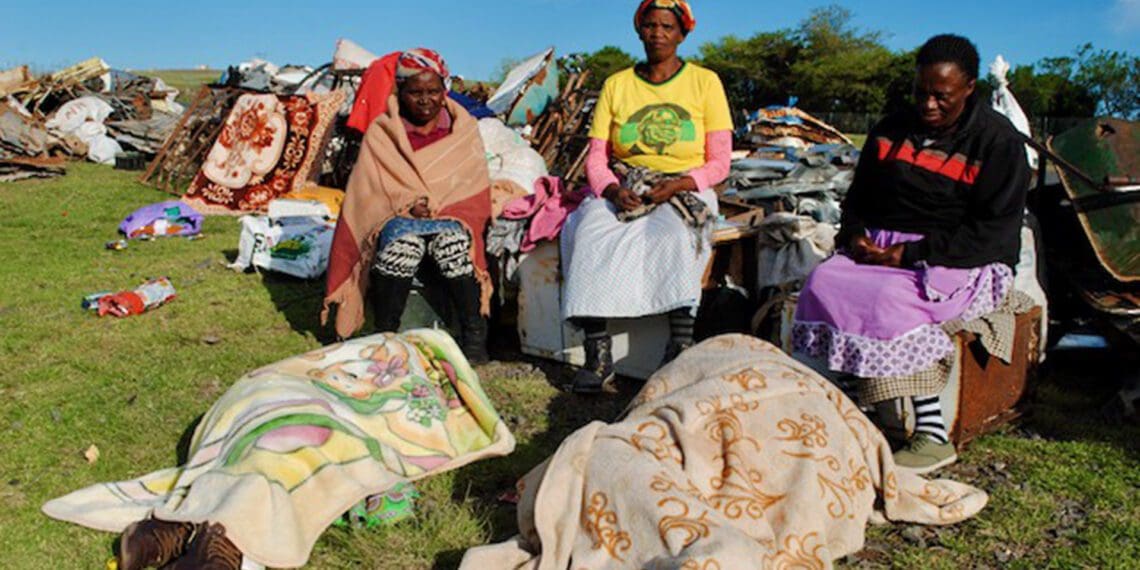
Nolusindiso Popana, Nobongile Bokoboko and Ntombentsha Hako take their turn looking out for trucks while No-Andile Nompoko and Khuselwa Bandla catch some sleep. Photo: Mkhuseli Sizani

Nolusindiso Popana, Nobongile Bokoboko and Ntombentsha Hako take their turn looking out for trucks while No-Andile Nompoko and Khuselwa Bandla catch some sleep. Photo: Mkhuseli Sizani

Share on FacebookShare on TwitterShare on WhatsApp

Many unemployed women in Qunu in the rural Eastern Cape have abandoned their vegetable gardens to collect recyclable scrap to earn cash to feed their families.

Sometimes they sleep for days next to the N2 and other major roads, guarding the scrap they have collected, hoping for a truck to take them to the recycling centres in distant Durban, 450 km away.

We spoke to five women from Lwalweni village, Qunu, who were waiting on the N2 roadside opposite the Madiba homestead.

“Everything here in Qunu has collapsed after Madiba passed away [in 2013],” said No-Andile Nompoko, a 62-year-old widow.

“There are no [public works] projects for youth and women to collect rubbish. The roads are not maintained. The access tarred road that Madiba built for us is full of potholes. These are projects that could create jobs for our children,” she said.

“I am the only breadwinner at home. Three of my children have no jobs. They all depend on me. In the past, our husbands used to leave us and work in the mines, but all those things are no longer happening.”

Khuselwa Bandla, like many Lwalweni villagers, hitchhikes on the N2 opposite the Madiba homestead in Qunu for trucks to take them to Durban to sell the scrap they have collected. Photos: Mkhuseli Sizani
Khuselwa Bandla, like many Lwalweni villagers, hitchhikes on the N2 opposite the Madiba homestead in Qunu for trucks to take them to Durban to sell the scrap they have collected. Photo: Mkhuseli Sizani

No water and support for gardens

The water crisis has played no small part in this shift in livelihood. Taps run dry for weeks at a time and the villagers share springs and ground water sources with livestock.

Ntombentsha Hako, who has two children and six grandchildren, started collecting scrap last year.

She said when Mandela returned to his homestead people were planting vegetables in their home gardens in order to sell and feed their families.

“Water was also available in our taps to sprinkle our gardens,” she said. “But after his death, we suffered with water and his garden project also shut down.”

She was referring to garden projects for the community at Madiba’s homestead where many people from Qunu worked. Each person was given a small plot to water, weed and plant vegetables, and they were paid R50 when they worked there.

“I became a domestic worker in 2008 until 2020 and I was earning R1 000 a month. My duties included cleaning, feeding of pigs and planting of the garden. I worked for eight hours [a day] or more sometimes. I had to endure those abusive working conditions because I didn’t want my children to go to bed with an empty stomach.”

“Mandela’s death made us victims of wealthy people,” said Hako.

Making a living

She said that the R350 Covid grant allowed her to quit domestic work and pursue collecting recyclables, which earns her more. She collects scrap lying around the villages.

Hako had brought her collection by bakkie to the roadside the previous afternoon. They can wait days for a lift. The women take turns sleeping and guarding the scrap.

“No matter if it rains or gets very hot, we won’t move until we get a lift. We buy food from nearby spaza shops because our homes are very far from the road. We have a young man, who we pay a R20 a day, to look after our scrap when we go to the river to wash ourselves.”

The lifts are not free. She said the truck drivers demand R600 per person together with their scrap; some want R900 but that is too much for them. They return from Durban by bus (R280) or taxi (R320).

The tarred access road in Lwalweni that “Madiba built” is potholed, cracked and not maintained.
The tarred access road in Lwalweni that “Madiba built” is potholed, cracked and not maintained. Photo: Mkhuseli Sizani

After expenses they still earn enough to make a monthly trip to Durban worthwhile. If they sold their scrap in Mthatha, they’d only get R300 to R400.

The oldest of the group is Nobongile Bokoboko. She is 81 and has been collecting scrap since 2014. “Our gardens are dry because there is no water,” she said.

“I have been collecting scrap … carrying it on my head because my social grant is not enough to feed my family. Four of my grandchildren are still at school and I am unable to pay their school fees. My burial policies will collapse if I cannot collect the scrap,” said Bokoboko.

Masiza Mazizi, provincial spokesperson for the department of rural development and agrarian reform, said Qunu is among the poorest wards in the country. He said there was an “anti-poverty strategy”.

He said in the current financial year, each local municipality would assist 800 households – 40 in each ward – with “food production input packages”. He did not say what this was.

Mazizi said the department is “exploring other avenues to provide water to our communities, in partnership with service providers, for example the World Bank”.

This story was written by Mkhuseli Sizani and originally appeared on GroundUp.

ALSO READ: Chilli farmer builds a solid business on just one hectare

Mkhuseli Sizani

Tags: Eastern Capepovertyvegetable garden
Smart irrigation key to getting more value from every bag of fertiliser
Advertorial

Smart irrigation key to getting more value from every bag of fertiliser

by Patricia Tembo
3rd August 2026

PARTNER CONTENT: Effective fertigation begins with effective irrigation. Netafim agronomist Louis Fourie shares how precision drip fertigation keeps costly nutrients...

Read moreDetails
Limpopo youth turns backyard broiler project into poultry business

Limpopo youth turns backyard broiler project into poultry business

3rd August 2026
ASF outbreak contained, but pig farmers urged to stay vigilant

ASF outbreak contained, but pig farmers urged to stay vigilant

3rd August 2026
This week’s agri events: 03 – 07 August

This week’s agri events: 03 – 07 August

3rd August 2026

A super El Niño looms: Africa’s five lessons in climate resilience

2nd August 2026

Rooibos project turns classrooms into space labs

New agriculture chair targets FMD, governance, oversight

Bikouta bridges African flavours through handcrafted teas

Book now for Soul To Soil Women’s Month brunch

Minister Willie Aucamp: What farmers need now

Join Food For Mzansi's WhatsApp channel for the latest updates!

JOIN NOW!
Next Post
Robertson Tourism's first custom agri-tour group. From the left are Sean Murray, Renate le Roux, Mike Fowler, Peter Blankenberg and Chris Brunt. Photo: Nicole Ludolph/Food For Mzansi

Robertson steps up agri-tourism for rural revival

THE NEW FACE OF SOUTH AFRICAN AGRICULTURE

With 21 global awards in the first six years of its existence, Food For Mzansi is much more than an agriculture publication. It is a movement, unashamedly saluting the unsung heroes of South African agriculture. We believe in the power of agriculture to promote nation building and social cohesion by telling stories that are often overlooked by broader society.

How grain farmers can secure cash flow and funding in uncertain seasons 

Professionalism pays: How Jantjies built a thriving lucerne business

New agriculture chair targets FMD, governance, oversight

South Africa’s child nutrition crisis demands urgent action

More than gadgets: How practical agritech boosts your bottom line

Western Cape suffers driest July on record ahead of intense El Niño

  • Awards & Global Impact
  • Our Story
  • Contact Us
  • Cookie Policy
  • Privacy Policy
  • Copyright

Contact us
Office: +27 21 879 1824
News: info@foodformzansi.co.za
Advertising: sales@foodformzansi.co.za

Contact us
Office: +27 21 879 1824
News: info@foodformzansi.co.za
Advertising: sales@foodformzansi.co.za

  • Awards & Global Impact
  • Our Story
  • Contact Us
  • Cookie Policy
  • Privacy Policy
  • Copyright

Chat Options

I'm Lerato, your AI assistant!
No Result
View All Result
  • News
  • Changemakers
  • Lifestyle
  • Farmer’s Inside Track
  • Food for Thought

Copyright © 2024 Food for Mzansi

This website uses cookies. By continuing to use this website you are giving consent to cookies being used. Visit our Privacy and Cookie Policy.