Recent floods have taken a heavy toll on South African farmers who have reported major losses on their farms. Food For Mzansi’s Tiisetso Manoko and Sinenhlanhla Ngwenya report.
Farmers across the country are reporting substantial damage to farms after days of heavy downpours which led to farm floods. In some areas, the damage to fields and crops is so extensive that crop losses are almost 100%.
While farmers count their losses, the government has declared a state of disaster in at least seven provinces. Farmers say the declaration must be followed by resources to provide relief to farmers and rebuild critical infrastructure.
Vegetable farmer Dineo Mphahlele from Winterveld, Pretoria, is one of the many farmers facing untold damages to her produce. Mphahlele reports a loss of over R10 000 to her crops.
“It is devastating,” she tells Food For Mzansi. “This will lead to food being expensive because if one is losing a profit of such a huge sum of money, replacing it will take forever.”
Natural disasters taking their toll
In KwaZulu-Natal, one of the hardest hit provinces, Idry Mohammed reports major losses to his crop and livestock farm in Newcastle.
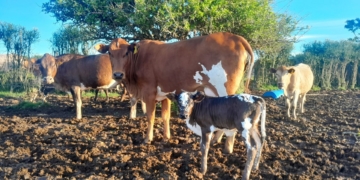
“This year is a complete loss for us in terms of the planting and we have a feedlot where the cattle are drowning in water. The water is knee-high. It is difficult being a farmer, especially this year with all these natural disasters,” Mohammed said.
He added that farmers in the area suffered a lot of damage to their infrastructure, planting lands, as well as the bridge over the Buffalo River. He also uses the road to get to town, a 7km drive from his home. “But now we must travel about 45km because the bridge collapsed. It has been very difficult for us.”
Mohammed’s biggest concern, however, is how it will take stakeholders to assist in rebuilding the bridge.
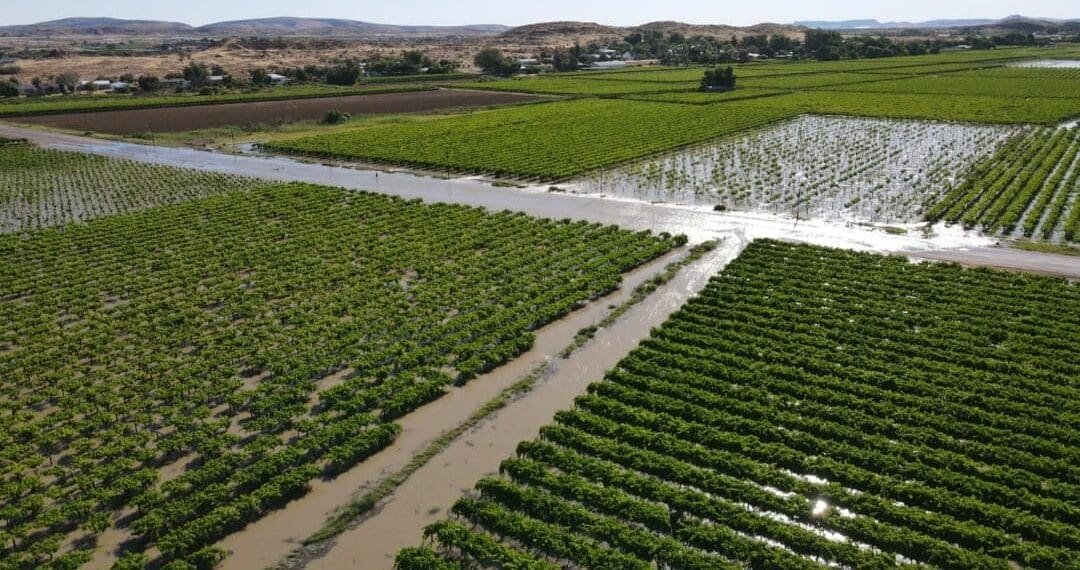
Meanwhile, a wine and raisin farmer in Keimoes, Northern Cape, Martin Rooi, said the production of his raisins has also been affected. Rooi was banking on a good grape harvest this year.
“This means that some of us will not get very good prices for the raisins. The heavy rains have caused a lot of damage to our vineyards. I almost lost 1.9 hectares from the floods.”
Wine and raisin farmer Martin Rooi
“The losses, so far for me, amount to R120 000 on top of the problems we are facing as farmers with load shedding,” Rooi said.
ALSO READ: Floods: There’s more to come, warn experts
Farmers still recovering from previous disasters
David Mthombeni, provincial chairperson for the African Farmer’s Association of South Africa (Afasa) in Mpumalanga, says farmers and residents of the Ehlanzeni district reported losing almost all of their crops.
“In many of the cotton fields, crops are submerged, while in their fields gullies have formed,” he explained.
As a result, insects and pests are multiplying because pest control is impossible in the super wet areas, Mthombeni said.
“In these trying times, it is important for farmers to take necessary precautions measures to minimise damage.”

Meanwhile, Marius Rooi of the National African Farmers Union (Nafu) based in Upington, said the floods have had a detrimental effect on farmers in Eksteenskuil, explaining that water from the Orange River filled up to the top, and spilt over the bridge.
“The previous year’s flooding has already placed our members on the back foot and some of them started farming just recently. I don’t know how they will be able to recover.”
Rebuilding bridges
“Because of the flooding, farmers are not able to cross one of the bridges to reach the farmland and that makes it so difficult for us. The farmers are sort of sitting at home waiting for three to four months for the area to dry, and some will have to start from scratch,” he said.
Meanwhile, private companies in the area have taken it upon themselves to rebuild the bridge, he said. “It is going to take too long for the government to get involved and the department of transport to rebuild the bridge.”
Commercial manager for Free State Agriculture, Jack Armour, said heavy rainfall over the past two years has led to the collapse of strategically important infrastructure.
He reports that bridges have not been rebuilt in the last two years. “The real disaster is an administrative and management disaster in the Free State,” Armour added.
State of disaster welcomed
Famers in the Chris Hani District Municipality in the Eastern Cape, have also not been spared.
“The sector is working with other sectors convened by a municipality in each area to ascertain the extent of the damage. We are still awaiting those reports of the extent of the damage. It is therefore not easy to come up with specifics now,” a spokesperson for the Eastern Cape department of rural development and agrarian reform said.
Agri SA has in the meantime welcomed the declaration of a state of disaster addressing flood damage in the Eastern Cape, Mpumalanga, Gauteng, KwaZulu-Natal, Limpopo, Free State, and North West.
The announcement was made by the minister of cooperative governance and traditional affairs, Dr Nkosazana Dlamini-Zuma.
“We urge minister Dlamini-Zuma to put measures in place to ensure the deployment of relief funding in a transparent and accountable manner. We trust that the national disaster management centre (NDMC)and the auditor-general’s office will play their role in this regard,” Andrea Campher, risk and disaster manager at Agri SA said.
READ NEXT: ‘Hau! What’s up with my farm soil?’
Sign up for Mzansi Today: Your daily take on the news and happenings from the agriculture value chain.