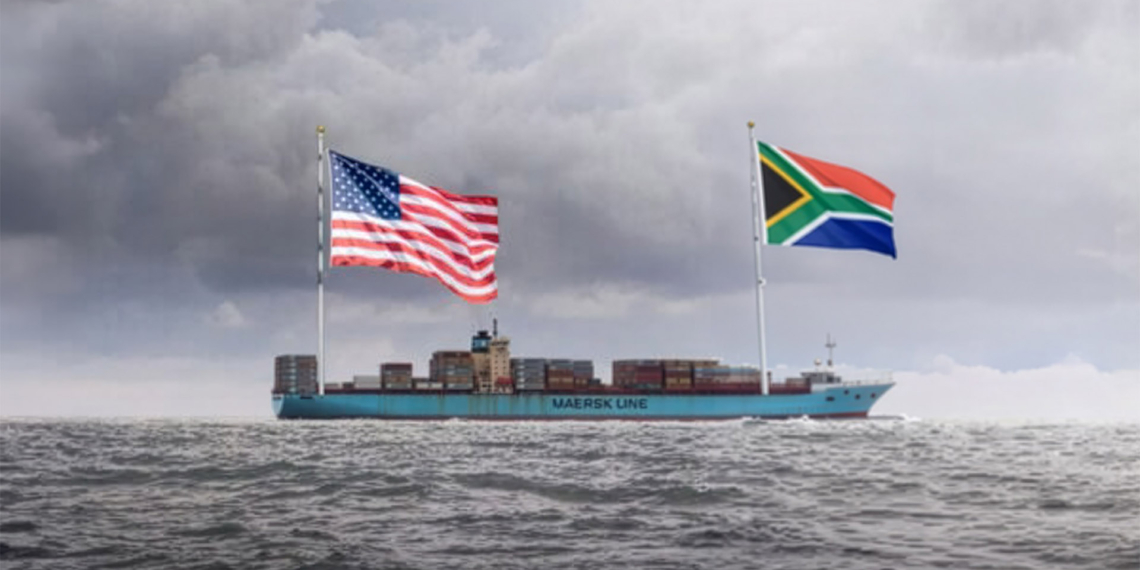
The agricultural sector has urged the South African government to swiftly appoint an ambassador to the United States to safeguard vital trade relations, as tensions between Pretoria and the Trump administration continue to strain diplomatic ties.
The post became vacant following the resignation of Ebrahim Rassol almost a year ago, after a fallout with the government of President Donald Trump. South Africa has not had an ambassador since then.
Earlier this week, deputy director general Clayson Monyela, acting chief of state protocol, received copies of letters of credence from H.E. L. Brent Bozell III, the newly appointed United States Ambassador to South Africa.
‘Time to restore relations’
Western Cape Agri chief executive officer, Jannie Strydom, said seeing that the Western Cape exports 58% of all primary products exported in the country, it is very important that trade relations are well maintained and sustained.
“The appointment of an ambassador to the USA is critical and should focus on good relations between the two countries, and also focus on trade relations,” he said.
South Africa Wine chief executive officer, Rico Basson, said it is of utmost importance that the country’s representation in Washington is restored.
Related stories
- No genocide, no evidence: What Trump got wrong
- ‘Tell the truth’: Ramaphosa heads to US for critical Trump meeting
- Grape and citrus growers await Trump’s next move on tariffs
- Trump’s land claims: Agri stakeholders set record straight
Motsepe Matlala, president of the National African Farmers Union of South Africa (Nafusa), added that the country is being strategic in not appointing an ambassador because of the high hostile nature towards the South African government.
“We believe as farmers we need to work together, we need to show solidarity towards our government. Farmers of all races need to speak the same message across the board. That does not need an ambassador, but us to work towards a single goal. We know our needs as a country, and we know the truth.
“There is no need for us to go abroad to badmouth our government. We might have differences, but we need to sit around the table and address them, irrespective of political differences. We are not politicians; we want to work with everyone. Once we start making farming political, we’re losing the plot,” he said.
US a strategic market for agriculture
Matlala said it is important for South Africa to nurse the trade relations before appointing any ambassador, and the tensions need to go down so that there could be meaningful dialogue.
“We cannot just appoint an ambassador to throw him or her into the tensions between the two countries; we need to establish a fertile ground to be able to do trade,” he said.
Meanwhile, Agbiz senior economist Wandile Sihlobo said for South Africa’s agriculture, the US remains an important market, accounting for 4% of our agricultural exports.
“Now that the tariffs are down to 10% (and may increase to 15% at some point), we are at the same level as our competitors in South America, including Chile and Peru. This places South Africa in a better position than the second half of 2025. We can compete fairly.
“We are approaching the citrus export season and have ample wine supplies. If the tariffs remain at these levels for some time, we may have a better export season to the US.”
Wandile Sihlobo
According to Sihlobo, without Agoa, South African products exported to the US would typically face an additional 3.4% tariff on top of the “Liberation Day” tariffs, which were 30%, bringing the total to 33.4%.
Decidious farmer Dibesho Serage said it is important and urgent that an appointment be made as the US, which os a strategic and important market for South Africa.
“It is short-sighted for South Africa not to deploy someone. By now that post should have been filled, because things change and discussions are ongoing, and we do not have a representation in those discussions at a global scale.
“We should be having an ambassador to be part of the discussions because by the time we send an ambassador, he or she will be subject to decisions taken there and just following what has been decided. I think that remains a loophole and the sooner we close it, the better,” he said.
READ NEXT: Relief at last: 1 million FMD vaccines touch down in Mzansi