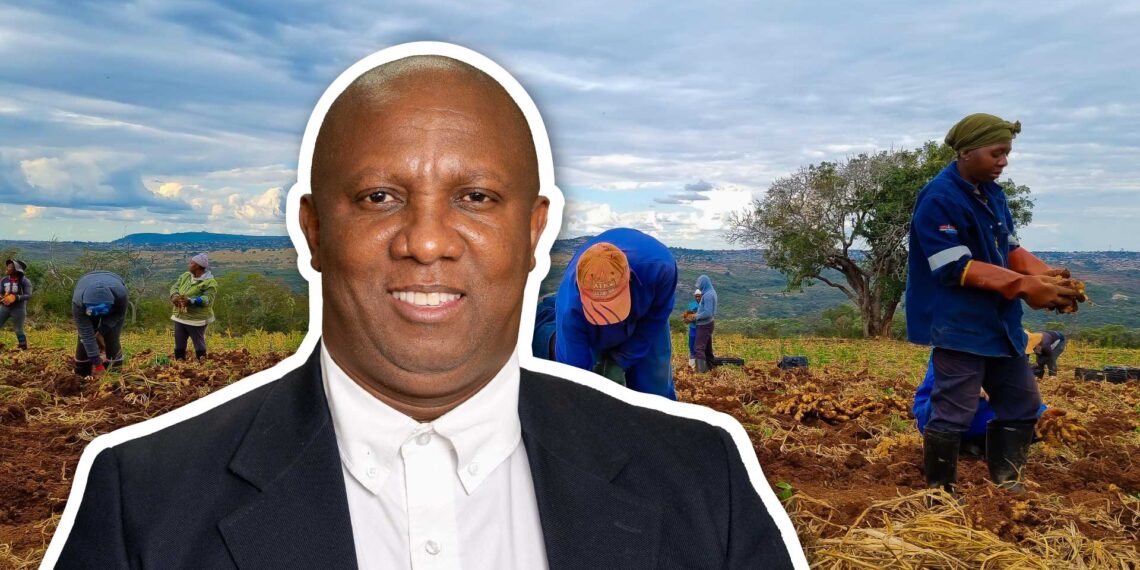
Land reform remains a vital pillar of restorative justice in South Africa. While 80% of valid restitution claims are settled, Vumelana Advisory Fund CEO Peter Setou argues that land transfer alone isn’t enough.
Land reform is arguably one of the most challenging undertakings that the post-1994 government has embarked on, and it remains a critical part of restorative justice that seeks to address the legacy of centuries of colonialism and decades of apartheid.
The land reform programme is anchored on three pillars: restitution, redistribution and land tenure reform. Restitution focuses on returning land or compensating claimant communities that were forcibly removed from their land after 1913. Redistribution aims to correct historical racial imbalances in land ownership by transferring state-acquired land to black beneficiaries.
Land tenure reform focuses on securing and formalising land rights, particularly for people living in communal areas, farm dwellers and labour tenants, to ensure legal protection against eviction or insecure tenure.
Land reform remains important in South Africa because land dispossession was central to the subjugation of the indigenous population. The land reform project, therefore, marks a reset of the foundations that defined the suppression of African people. It signals a step towards correcting the wrongs of the past.
Progress on land restitution
The land reform programme has been used for political expediency by both sides of the political divide. Detractors point to reported failures, including productive land that lies fallow after being awarded to land claimants.
On the other hand, supporters of the programme highlight the slow pace of delivery and continue to point to perceptions of widespread “landlessness” among poor black communities, which fuel public frustration.
Despite these challenges, government has made some progress in restituting land to claimant communities. According to figures released by the minister of rural development and land reform, Mzwanele Nyhontso, a total of 83 614 land claims have been settled, which amounts to approximately 80% of the total number of valid claims that have been finalised.
The minister added that the budget allocated for the settlement of claims is normally split on a 50:50 basis between land restoration and financial compensation, and that additional funding has been allocated to beneficiaries of land restitution for the purpose of providing them with development support. This is different from what used to happen in the past, where the majority of claims would be settled through financial compensation.
Professor Cherryl Walker, Emeritus Professor of sociology at Stellenbosch University, notes that the restitution process has made the largest contribution to land reform, accounting for a significant share of land transferred, either through financial compensation or land restoration.
Related stories
- Expropriation Act: Land reform faces its toughest test yet
- Land reform and rural safety top AgriSA’s 2026 agenda
- SA shearers honoured as wool sector rides global resurgence
- Women farmers call for inclusive growth and development
However, official figures from the government remain modest. Senior officials report that 5.3 million hectares have been transferred through redistribution, 3.9 million hectares through restitution and 30 530 hectares through labour tenant claims. Combined, this represents about 11% of commercial farmland as it stood in 1994.
In a paper titled Progress of Land Reform in South Africa, Wandile Sihlobo and Professor Johann Kirsten of Stellenbosch University also note that private acquisition of farmland by black individuals outside formal government-assisted processes is a salient element missing in the land reform discourse. In these cases, individuals have used their own resources or financial arrangements with commercial banks or the Land Bank to fund the purchase of farmland.
The Bureau of Economic Research at Stellenbosch University estimates that since 1994, a total of 1.9 million hectares of farmland were acquired by black South Africans without the assistance of the state. This might even be an undercount because some surnames, such as Van Wyk, Van Rooyen, and even Schoeman, do not necessarily belong to white South Africans, and many transactions to proprietary limited companies are majority black-owned, but with names that might resemble an Afrikaans name, e.g. Sandrift Boerdery.
While progress has been uneven, there appears to be a stronger focus on restitution at the expense of broader land redistribution and land tenure reform.
Accelerating implementation by govt
Recognising this gap, President Cyril Ramaphosa has committed to advancing key reforms, including the Expropriation Act, the establishment of the Land Reform Development Agency and the release of state land for development.
While these commitments are encouraging, their impact will depend on implementation. The effectiveness of the Land Reform Development Agency will depend on its ability to operate with the necessary skills, capacity and independence.
Land tenure reform is another area that requires urgent attention, and we have always held the view that expanding access to land is important in reducing hunger and creating meaningful livelihoods.
However, expanding access to land without the necessary support will not deliver the desired outcomes. Access to water rights, infrastructure, finance and providing title deeds to beneficiaries remains critical. Providing land without post-settlement support risks setting beneficiaries up for failure. Beneficiaries need access to markets, skills development, mentorship and proper governance structures to ensure sustainability.
The United Nations Food and Agriculture Organisation (FAO) highlights that secure land tenure is essential for sustainable livelihoods, as it enables individuals to invest, produce and build long-term resilience.
Minister Nyhontso has the policy tools to accelerate land reform. The focus now must be on implementation. This includes strengthening institutions such as the Land Bank, addressing known bottlenecks identified in reports, such as the Motlanthe Report and ensuring accountability in the system.
- The views and opinions expressed in this article are those of the author and do not necessarily reflect the views or positions of Food For Mzansi.
READ NEXT: Maize farmers tighten defences as Goss’s wilt spreads