For Timmy Baloyi, the path to becoming a plant breeder began in Mamelodi, Gauteng, where he spent his childhood as a “little scientist, artist, and engineer”. From moulding and constructing to manufacturing projects, he was always experimenting to find answers.
That lifelong curiosity eventually led him to specialise in plant biotechnology. Now at the Agricultural Research Council (ARC), Baloyi is turning his childhood knack for discovery into professional scientific innovation.
All the experience, the manufacturing, and the exploring at a young age gave Baloyi a raw sense of how nature and the world around him operate.
“I used to assist lizards giving birth,” he says, “until I got to understand it was unethical when I grew older.”
Growing up, he felt he had endless opportunities regarding what he could become. But as time went on, he hit a wall of reality.
“As I grew older, I realised there are some limitations in terms of the number of disciplines one can do over a period of time, as I wanted to be a jack of all trades.”
Perseverance in bad times
Life wasn’t always kind. Baloyi recalls, “There were times I had no shoes and no food to eat. My parents would improvise for me to have something to eat, and they would also assist others with the little we had.”
That experience fuels his eagerness to contribute something to people’s lives today, whether directly or indirectly. It taught him to always find a way through any situation.
He still remembers those childhood years, travelling by train from Ga-Rankuwa to Mamelodi for school. He had to make sure that by the time he got home, his homework was done and he was ready for the next day. The hard work, the tiredness, and the weight of that situation, he says, gave him the wings of perseverance and discipline.
Related stories:
- Gene editing: Time for SA to embrace plant breeding innovations
- Plant breeding wins support when South Africans see the benefits
- AgriCareers: Plant breeder teaches eager agri minds
- Testing the waters: Can the Eastern Cape grow SA’s rice?
Baloyi tells Food For Mzansi that his fascination with nature soon evolved into a deep-seated interest in the intersection of plants, animals, and technology.
This passion led him to the University of Pretoria, where he studied biotechnology with a specialisation in plants, and he graduated in 2011.
He credits his studies as the foundation of his career, as they allowed him to understand plant behaviour through the lens of technology. By deploying these methods, he can identify genes of industry importance to improve crops at a much faster rate than traditional means.
Getting to the root of plant breeding
Baloyi joined the ARC in 2012 after spotting an opportunity that called for the specific technical capacity he had developed during a biotechnology internship.
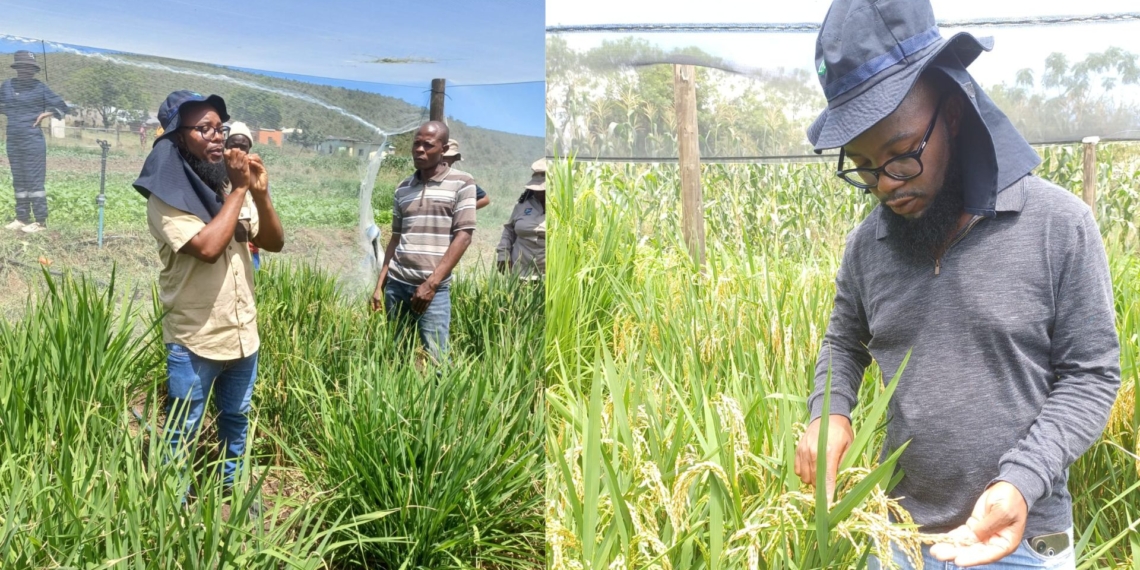
“I do pre-breeding in my current role, which involves research on identifying, developing, and introducing the genes the industry needs into the programme.”

This work involves characterising crops under various environmental conditions to trace specific traits that can improve locally adapted cultivars.
“As a result, my day-to-day work involves looking for new solutions to enhance crop performance for farmer profitability.
“It is about adding value to the chain until it reaches the consumer as a high-quality product that meets the required standards.”
This mission keeps him busy on a global scale, requiring constant interaction with stakeholders across the value chain, both nationally and internationally.
Designing the ‘perfect plant baby’
Baloyi explains that plant breeding is essentially about reproducing plants to get the best features from each parent.
“It’s more like making a new short baby with yellow eyes that can survive without water in a desert for more than a week,” he explains. “Or making a banana-shaped grape which is blue in colour that can survive in a very hot and dry environment.”
With plant breeding, he notes, you can introduce any features of interest from one parent while keeping the traits of the other to make a “new baby” with the specific improvement you’re looking for.
For Baloyi, this isn’t just a science experiment; it’s a lifeline for the industry. It’s what helps farmers stay profitable and stay ahead of new pests or sudden disease outbreaks.

“It contributes to farmer profitability by making crops perform better and adapt easier. It ensures they can resist diseases or drought without needing to spray pesticides or irrigate constantly, which saves the farmers a lot of money on input costs.”
He sees his career path as fulfilling, with endless room to grow. Right now, as a researcher with ARC, his heart is set on building prototypes that can speed up the development of these improved cultivars.
Baloyi also has a very specific goal in his sights: establishing sustainable rice production right here in Mzansi.
READ NEXT: How plant breeding reshapes grain farming in SA