Wednesday, May 20, 2026
SUBSCRIBE
21 GLOBAL MEDIA AWARDS
Food For Mzansi
  • News
  • Changemakers
  • Lifestyle
  • Farmer’s Inside Track
  • Food for Thought
No Result
View All Result
  • News
  • Changemakers
  • Lifestyle
  • Farmer’s Inside Track
  • Food for Thought
No Result
View All Result
Food For Mzansi
No Result
View All Result
in News

Plan before you plant: Key insurance lessons for SA farmers

Heavy rains, floods, and droughts are constant reminders of how vulnerable farming is. Experts emphasised that agricultural insurance shouldn't be a grudge purchase, and farmers should not wait for disaster to strike before protecting their hard work

by Patricia Tembo
20th May 2026
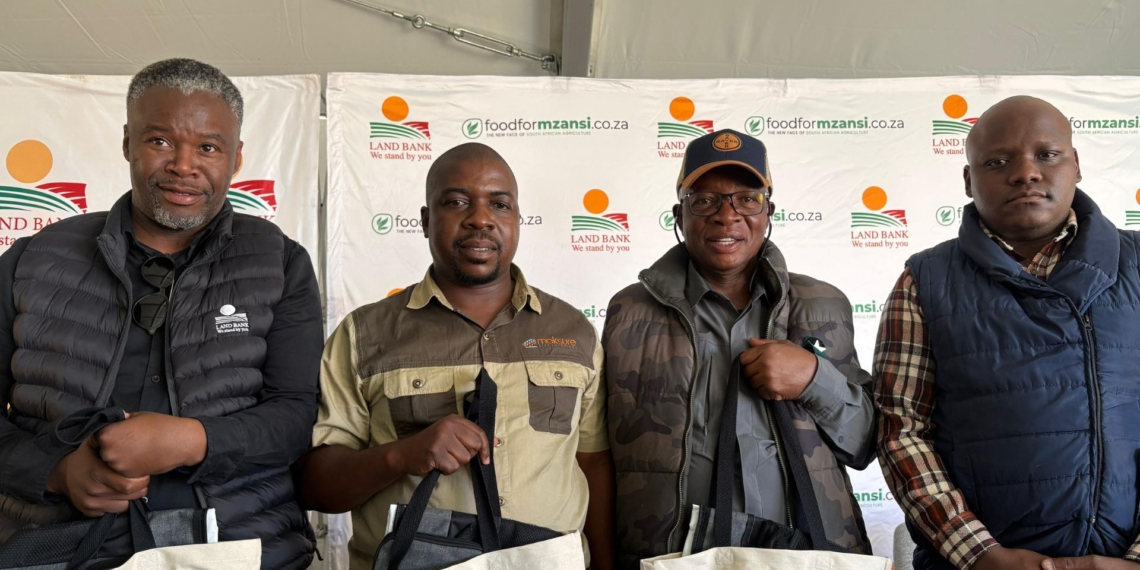
From left to right: Herbet Mokoena, Thabo Mnumzana, Phillip Mukhithi, and Silas Seokoma. Photo: Meshaan Van Wyk/Food For Mzansi

From left to right: Herbet Mokoena, Thabo Mnumzana, Phillip Mukhithi, and Silas Seokoma. Photo: Meshaan Van Wyk/Food For Mzansi

Share on FacebookShare on TwitterShare on WhatsApp

Extreme weather, rising input costs and production uncertainty are forcing farmers to rethink how they manage risk on their operations. Despite the growing pressure, agricultural insurance is still too often viewed as an optional expense rather than a core farming tool.

That was a key message during a panel discussion hosted by Food For Mzansi and Land Bank at Nampo last week, where insurers, brokers and farmers unpacked the realities of agricultural risk management.

Herbert Mokoena, provincial manager at Land Bank Insurance Company (LBIC), said insurance is a vital tool for managing risks farmers cannot control.

“Insurance should not be seen as a grudge purchase,” he said. “Farmers should view it as a risk management tool for risks beyond their control.”

Mokoena pointed to recent years of drought, floods and excessive rainfall as reminders of farming’s vulnerability.

FARMER POLL

📢 Which bank is powering your farming journey?

Tell us which bank you use so we can better advocate for the specialised financial tools and accessible capital needed to help South African farmers overcome growth barriers and thrive!

All submissions are kept strictly confidential. 

He referenced regional droughts between 2016 and 2018, the devastating KwaZulu-Natal floods in 2022, and heavy rains during the current season that disrupted planting plans.

“Perils such as hail, fire and wind damage are outside a farmer’s control. Insurance helps cushion that risk,” he said. 

He encouraged farmers to budget for insurance as part of their production input costs rather than treating it as an optional expense.


Related stories
  • Development finance key to growing future commercial farmers
  • Blended finance: Closing the gap for Africa’s smallholder farmers
  • Land Bank unlocks growth, tackles financing gaps at Nampo
  • Farmers embrace smarter strategies for sustainable growth

Brokers simplify a complex process

The discussion also tackled the perception that insurance is complicated.

Insurance broker representative Silas Seokoma said brokers help farmers navigate products, policies and claims.

“We begin with a client-needs analysis, identify suitable products and assist throughout the policy lifecycle, including claims,” he explained.

He said brokers also play a role in challenging the belief that insurers do not pay claims. “Farmers often hear that insurance companies are a scam or that claims are never paid. Our role is to guide them through the process and show how insurance works in practice.”

Independent broker representative Thabo Mnumzana agreed that brokers can make insurance easier by translating technical policy wording into practical terms.

However, he warned that brokers can also contribute to confusion by overcomplicating products or failing to understand farmers’ realities.

“If you are not on the farm, you are not going to get a farmer’s attention. You need boots on the ground, and you need to understand their lifestyle,” Mnumzana said. 

Lessons from the field

Farmer Phillip Mukhithi, who has farmed since 2007, shared how inaccurate policy details affected a claim on his operation.

“You cannot farm without insurance,” he said. “Disaster does not announce itself.”

He urged farmers not to accept insurance quotations based only on phone conversations. “Make sure the broker comes to your farm. They need to see exactly what you are insuring.”

Mukhithi explained how broad land descriptions, rather than detailed field mapping, reduced compensation for weather damage. He noted that insurers increasingly use GPS coordinates and field-level mapping, making accurate information essential.

In one instance, only part of the farm was damaged. Still, because the land had been insured under broad, generalised descriptions rather than accurately mapped sections, the resulting payout was lower than expected.

Despite the experience, Mukhithi remained convinced of the value of insurance, noting that without cover, he was unsure how he would have recovered after losses that forced him to replant nearly 60 hectares.

Plan before planting

Seokoma identified poor timing as one of the most common mistakes farmers make, noting that many producers only approach brokers after planting. 

This can create unnecessary risk, as waiting periods may apply before cover becomes active. He encouraged farmers to consider planning policies before the season begins to ensure cover is in place.

“A planning policy is not a final policy. It allows farmers to prepare cover early and adjust it later according to actual planted hectares,” Seokoma explained. 

READ NEXT: Beating the rot below ground: How to protect your root crops

Sign-up for the latest agricultural news delivered straight to your inbox every day with Mzansi Today!


Patricia Tembo

Patricia Tembo is motivated by her passion for sustainable agriculture. Registered with the South African Council for Natural Scientific Professions (SACNASP), she uses her academic background in agriculture to provide credibility and technical depth to her journalism. When not in immersed in the world of agriculture, she is engaged in outdoor activities and her creative pursuits.

Tags: Agricultural insuranceCommercialising farmerCrop farmingInform meNampo 2026
‘Cayenne Chilli Lady’ brings the heat with 8.5ha farming success
Inspiration

‘Cayenne Chilli Lady’ brings the heat with 8.5ha farming success

by Lisakanya Venna
18th May 2026

Nhlazatje’s Iris Nkosi didn't let a lack of land stop her. Starting in her backyard with a loan from her...

Read moreDetails

Beating the rot below ground: How to protect your root crops

18th May 2026
Lack of policies and pricing structures hurts goat farming industry

This week’s agri events: 18 – 22 May

18th May 2026
Deputy director-general Dipepeneneng Serage delivers the keynote address at the International Day of Plant Health commemoration in Mbombela, Mpumalanga. Photo: Supplied/Food For Mzansi

SA marks Plant Health Day with warning over food security

17th May 2026
Bill Blackie, chief executive of business and commercial banking at Standard Bank Group, and Michael Lilje, CEO and founder of Orizon Agriculture, announce a new partnership aimed at enabling South African farmers to turn regenerative farming practices into verified carbon credits and additional income opportunities. Photo: Supplied/Standard Bank

Standard Bank, Orizon launch first bank-backed carbon crop programme

16th May 2026

Steenhuisen boosts SA’s FMD fight with 2 million more vaccines

Development finance key to growing future commercial farmers

Beating the rot below ground: How to protect your root crops

Nampo panel unpacks what makes farmers bankable

Livestock health: Why biosecurity starts at the farm gate

Join Food For Mzansi's WhatsApp channel for the latest updates!

JOIN NOW!
Next Post

Climate variability moves from background risk to core driver of South African agriculture

THE NEW FACE OF SOUTH AFRICAN AGRICULTURE

With 21 global awards in the first six years of its existence, Food For Mzansi is much more than an agriculture publication. It is a movement, unashamedly saluting the unsung heroes of South African agriculture. We believe in the power of agriculture to promote nation building and social cohesion by telling stories that are often overlooked by broader society.

Diamond fibre: How Angora farmers can crack the mohair market

Climate variability moves from background risk to core driver of South African agriculture

Plan before you plant: Key insurance lessons for SA farmers

KZN’s agri gateway grows: Dube AgriZone 2 opens new doors

Infrastructure crisis deepens strain on storm-battered fruit farmers

Why SA should embrace landrace seeds during global uncertainty

  • Awards & Global Impact
  • Our Story
  • Contact Us
  • Cookie Policy
  • Privacy Policy
  • Copyright

Contact us
Office: +27 21 879 1824
News: info@foodformzansi.co.za
Advertising: sales@foodformzansi.co.za

Contact us
Office: +27 21 879 1824
News: info@foodformzansi.co.za
Advertising: sales@foodformzansi.co.za

  • Awards & Global Impact
  • Our Story
  • Contact Us
  • Cookie Policy
  • Privacy Policy
  • Copyright
No Result
View All Result
  • News
  • Changemakers
  • Lifestyle
  • Farmer’s Inside Track
  • Food for Thought

Copyright © 2024 Food for Mzansi

This website uses cookies. By continuing to use this website you are giving consent to cookies being used. Visit our Privacy and Cookie Policy.