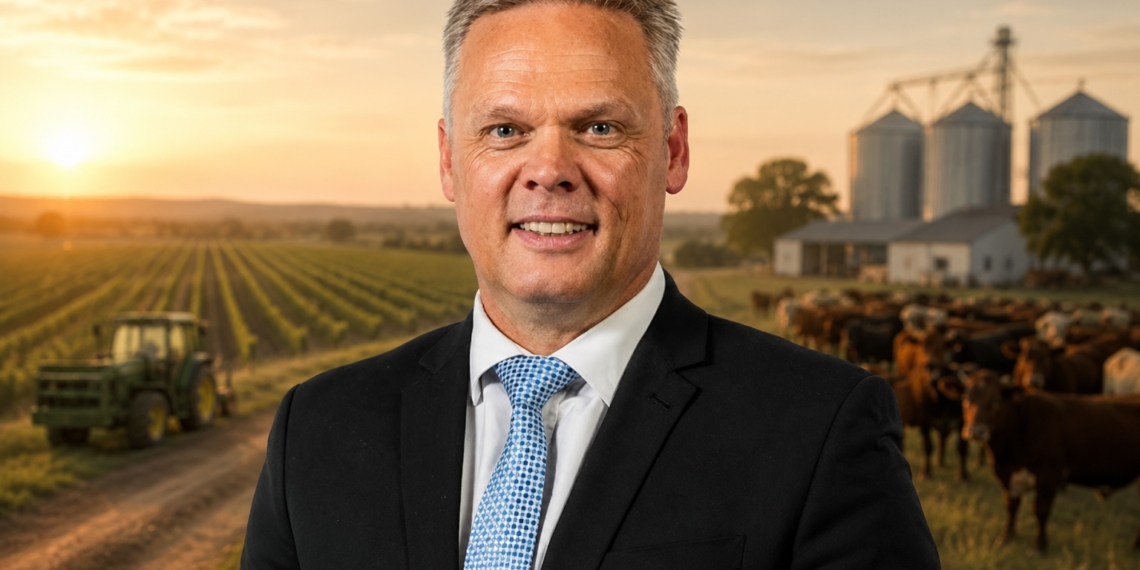
Can agriculture minister Willie Aucamp unlock the full potential of South African agriculture when most of the sector’s biggest constraints lie outside his department? AgriSA CEO Johann Kotzé argues that his success will depend on coordinating the machinery of the state to remove the barriers holding the sector back.
When Willie Aucamp was sworn in as minister of agriculture, he inherited a department in the middle of the country’s worst foot-and-mouth disease outbreak in decades, a far-reaching animal health reform programme, and a sector that has learned to succeed largely without the state.
He also inherited a truth his predecessors discovered at varying speeds: the levers that matter most to South African agriculture sit almost entirely outside the Department of Agriculture.
Consider what the sector has achieved. Agricultural exports reached R266 billion, generating a trade surplus of R124.7 billion.
The sector sustains roughly 950 000 jobs, most of them in rural areas where no other employer of scale exists, and contributes up to 15.4% of the economy once value chains are included. These are the numbers of a sector performing despite its enabling environment, not because of it.
Beyond agriculture
Trace a pallet of citrus from a Limpopo orchard to a Rotterdam supermarket and the minister’s real portfolio reveals itself.
The fruit travels on provincial roads, through Transnet’s rail and ports, in a cold chain powered by an electricity system overseen by another ministry, into markets negotiated by trade and international relations, grown with water licensed by yet another department, and protected by a police service reporting to another still.
At no point does the Department of Agriculture hold the only decisive lever.
Yet the department’s own work still matters enormously. Biosecurity sits squarely within its mandate, and the foot-and-mouth disease outbreak has shown the price of allowing animal health systems to hollow out: lost markets and a livestock industry absorbing costs it did not create.
But that is not the only file on the minister’s table. The grain industry needs support for its wheat tariff application, regulatory modernisation from Act 36 to new plant-breeding technologies is overdue, and horticulture lives or dies by port performance and the quiet diplomacy of market access.
A minister consumed entirely by the outbreak will find that other industries have paid the price.
The aggregate figures also conceal strain. Medium-sized and smaller enterprises across value chains face a persistent profitability squeeze, as input costs, administered prices and compliance burdens scale poorly against them, driving quiet consolidation.
Four priorities
What, then, should the new minister do? The sector does not need another plan; it has a library of them. It needs an advocate inside the state, practising four disciplines.
The first is to treat coordination as the core function of the office. The minister’s most valuable hours will be spent in the rooms where Transnet’s recovery is managed, water licensing backlogs are cleared, rural road budgets are set and trade priorities are decided.
Agriculture needs a seat, a voice and a scoreboard in each, so that the sector’s dependence on other departments becomes their accountability rather than agriculture’s excuse.
The second is to finish what works before starting anything new. Private participation in ports and rail, commodity organisations’ growing role in biosecurity, and co-investment in vaccine capacity all point in the same direction: where the state cannot deliver alone, it should contract, partner and verify.
The third is to protect the sector’s licence to grow. Market access is won over years and lost in weeks.
At home, expanding the ranks of black commercial farmers is the condition for the sector’s political durability, and the land to be released by the Department of Land Reform and Rural Development, once again a ministry of its own, is both an enormous opportunity and the sharpest test of the coordination argument.
Land transferred without secure tenure rights, finance, extension services and a route to market is a transfer of assets, not of livelihoods.
From programmes missions
The fourth is internal, and may be the hardest: to win the confidence of the department’s own officials. They are experienced, deeply versed in the sector and well socialised within the industry they serve.
What they lack is an operating model that allows any of that to count. Programmes designed years in advance commit the money before the year begins, leaving little flexibility to redirect resources, and fund projects that too rarely scale or shift the structure of the economy. Officials know this better than anyone.
The alternative is a shift from programmes to missions: a few defined outcomes built on the consensus that already exists. Rebuild biosecurity. Expand black commercial farming at scale. Grow exports. Build a state that enables.
Agreement on the what is remarkable; the work lies in the trade-offs and sequencing that turn it into the how and the when. Missions give officials and industry a shared object for their considerable passion, and give a minister a way to redirect energy even where he cannot redirect money.
The minister has said government must not stand in farmers’ way. It is the right instinct, but the red tape that binds agriculture is mostly written elsewhere.
The measure of this ministry in 2030 will be whether the trains ran, the ports moved, the water flowed, the borders held against disease, and the sector’s growth reached people and places it has not reached before.
The new minister controls one department. His job is to move a dozen others, and to remobilise his own.
- Johann Kotzé is the chief executive of AgriSA. The views and opinions expressed in this article are those of the author and do not necessarily reflect the views or positions of Food For Mzansi.
READ NEXT: Why citrus deserves special treatment in US-SA tariff talks