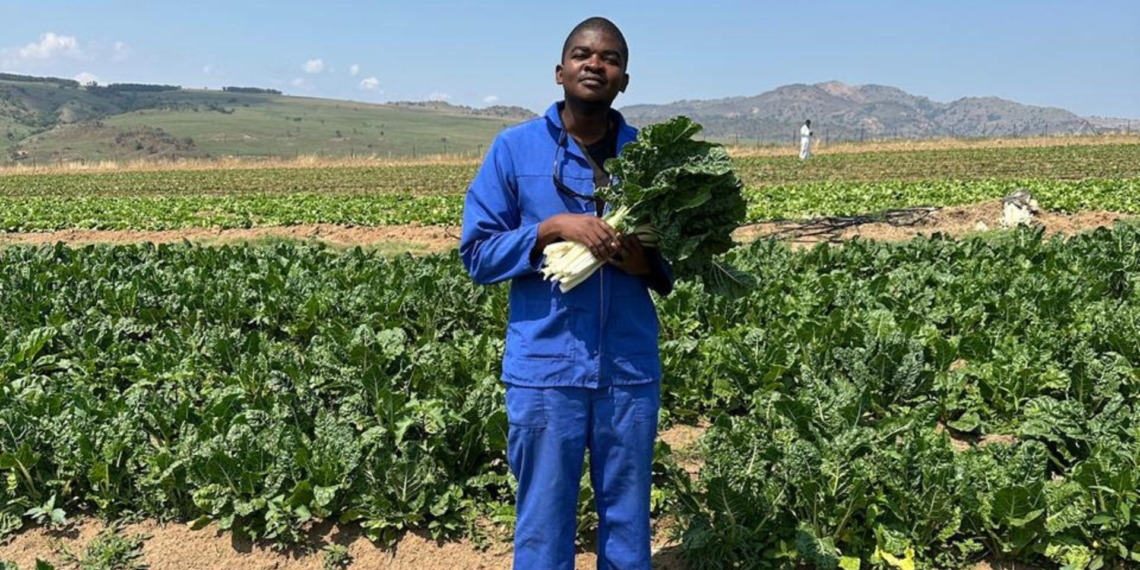
As a schoolboy in Elukwatini, Mpumalanga, Mfanzile Maseko spent his afternoons delivering his family’s milk. Although he later left to study electrical engineering, his roots pulled him back home to his community, where he established the Inkaba Farming Project.
Maseko never abandoned his agricultural background, even though life initially put him on a different path.
After completing his engineering studies, he entered the mining sector, working at Nkomati Mine under the MCC Group contract. However, employment with a contractor meant his stability was tied to the life of the mine. He was constantly moved whenever a contract ended.
Nurturing his entrepreneurial spirit
Through all this relocation, his ultimate dream remained fixed on entrepreneurship. Initially, he sought to enter the property market, going as far as purchasing a stand at Lavender Estates in Pretoria East.
“At that time, there were many things that needed money from me; I ended up selling the stand,” Maseko recalls.
In 2018, he redirected his focus and looked back to his roots. He approached the local village chief to request land for farming and launched an indigenous poultry project, funding the operation directly out of his mining salary. He began with 1 500 birds per cycle, selling a portion live and processing the rest for the local market.

As operations progressed, the business expanded, producing 5 000 chicks per cycle and allowing Maseko to sell the surplus to neighbouring farmers.
However, just as the enterprise was gaining momentum, he lost his delivery bakkie in a severe road accident. It made an already difficult period significantly worse, leaving him with no reliable way to transport chickens to his clients.
Despite this major setback, Maseko took over the full management of his family’s cattle herd and introduced pigs to the farm to diversify his risk.
Related stories
- Khula! and Kagiso Trust unite to get farmers funding ready
- Rethinking farm funding: MEC calls for smarter financing models
- Backyard bounty: Soweto graduate grows smarter with hydroponics
- Hopa brings hope and market access to EC grassroots farmers
Answering the call of diversification
Growth required more space, and Maseko eventually secured a government farm back home, which has since become the primary hub for his vegetable production.
“We still use our communal land farm as we have Boer goats, indigenous chickens, our nursery of 60 000 capacity, and an agro-processing area,” Maseko explains. They also manage a leased farm holding around 60 cattle.
On the crop side, Inkaba Farming Project plants more than 15 000 paprika plants, 20 000 chillies, and 20 000 green peppers, spinach and cabbage. During the summer months, production expands to include seasonal crops like butternut, pumpkin, and okra.
To keep these separate operations running efficiently, Maseko employs three full-time workers on each farm. However, managing multiple properties from a distance while working his corporate job eventually became unsustainable.
“I came to realise that the money I am putting into farming is not coming back, mainly because I am not there to push it extra.”
That realisation led him to resign from his engineering career to farm full-time.
Mentorships and partnerships
Today, the enterprise is part of the Sasol Iphephe programme and receives direct facilitation from Afgri, a partnership that has unlocked vital resources. Recently, the business was granted R350 000 to accelerate its operational growth and infrastructure.
“Hearing my mentors from Afgri sharing how happy they are with our business and how easy it is to work with us was something amazing.”
For him, this support structure is far more than a corporate social investment initiative. He sees it as a business partnership providing the practical framework, mentorship, and technical expertise required to transition into a competitive commercial enterprise.

Maseko reflects openly on the personal sacrifices required to keep the business afloat. He used to drive a brand-new Polo 7 GTI, but he ultimately sold it to fund the enterprise.
“I remember when I sold it, I even had to cover a shortfall on the car, but I needed to have extra money on hand to continue with farming. My brother had a RunX that he was no longer using, so I asked him to lend me that car.”
Sacrifices, hard work & planning breed success
Through these financial sacrifices and the emotional weight of stepping away from a stable salary, his family has been his anchor.
Maseko explains that farming does not yield immediate or easy revenue; rather, profitability improves slowly with time, hands-on experience and careful planning.
Handling the fresh produce market has been another steep learning curve. Maseko initially struggled to sell large volumes of vegetables in the immediate Elukwatini area.
To resolve this, he shifted his focus to the fresh produce market in Nelspruit. This adjustment has worked much better because the market is accessible, transport costs are manageable, and the produce moves quickly.

While Inkaba Farming Project currently supplies prominent local retail outlets such as Roots, Boxer, and Spar, Maseko points out that these individual stores present heavy competition, as many local small-scale farmers target the same delivery bays.
By expanding into agro-processing, his ultimate goal extends beyond revenue. Maseko aims to scale by securing formal contracts with major distribution networks.
Despite the losses and challenges, for him, true success means creating local jobs and leaving a lasting, positive impact on his community.
READ NEXT: Funding and raw truths inspire farmers in Mpumalanga