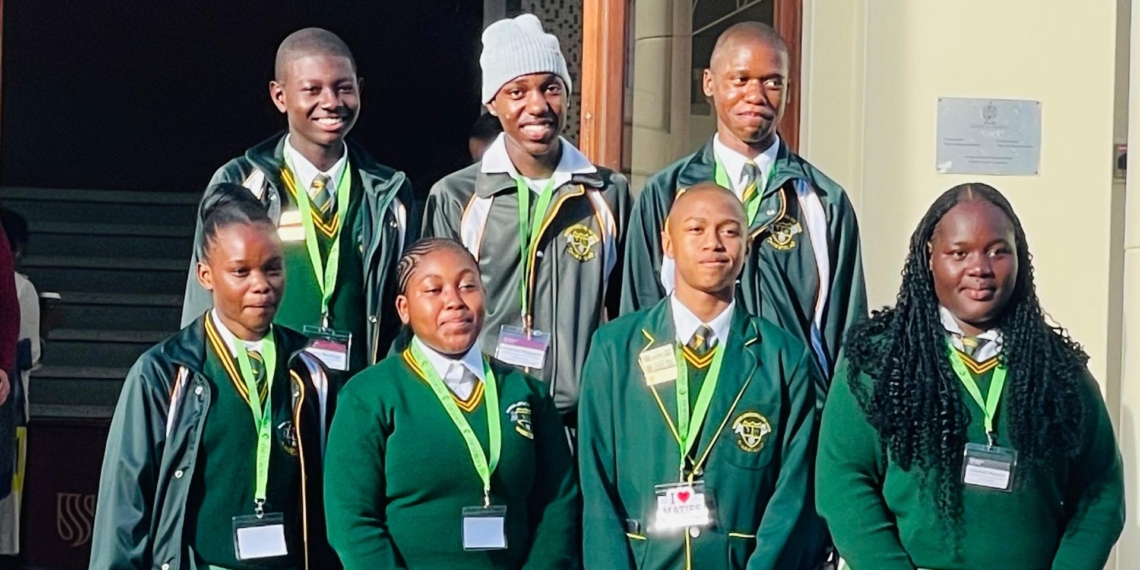
Nearly 40 learners from across South Africa converged at Stellenbosch University, transforming from students into global agricultural leaders prepared to solve the world’s looming food scarcity.
While many teenagers spend their winter holidays away from schoolwork, a select group of high school learners from six provinces spent theirs confronting one of humanity’s greatest threats: global food insecurity.
Marking the official launch of the inaugural South Africa Youth Institute (SAYI), the intensive event served as a historic partnership between Stellenbosch University’s Faculty of AgriSciences and the World Food Prize Foundation.
One of the defining features of SAYI was its multidisciplinary engagement. Learners not only presented to Stellenbosch University experts, but also to industry specialists and representatives from South Africa’s national department of agriculture, underscoring the programme’s deliberate effort to bridge academic insight, public-sector leadership, and private-sector experience.
The initiative establishes a permanent pipeline for local youth, intentionally drawing the majority of its participants from previously disadvantaged backgrounds to grant them direct access to elite scientific and agricultural networks that are traditionally out of reach.
Related stories
- Land Bank urges greater youth participation in agriculture
- Limpopo youth grows grain business from social grant savings
- Young food leaders rise as Youth Institute lands in Mzansi
- Didiza calls for radical shift in youth land access and finance
Science on the Frontlines
The intensive programme quickly shattered the stereotype that agriculture is limited to manual farm labour. Instead, learners were thrown into the deep end of agricultural technology and climate science.
The youth travelled to university research orchards to examine apple and orange production, analysing exactly how rising global temperatures and environmental stress alter fruit physiology. In the labs, they explored cutting-edge circular economies, discovering how fish waste can be harvested to nourish agricultural crops through sustainable aquaponics systems.
For Western Cape learner Sirri Muluh, from Rustenburg Girls High, the hands-on exposure was eye-opening. Muluh, who researched extreme food insecurity in her family’s home country of Cameroon, realised that the future of hunger eradication relies heavily on STEM.
“I really was not aware of the depth of agriculture. Many people just associate agriculture with farming, while there’s much science and biology behind that. The backbone behind agriculture is truly the science, IT, and technology, which has opened many doors for future careers.”
Bridging grassroots communities
Throughout the initiative, learners were given a platform to discuss their ideas on global food security directly with Stellenbosch University experts. This direct interaction allowed them to receive critical feedback on their perspectives while sharpening their public speaking skills.
For schools outside major metropolitan hubs, the event was a game-changer. Relebohle Khumalo, a teacher at Klerksdorp Secondary School in the North West, highlighted the profound local relevance for learners coming from communities scrambling to overcome structural challenges.
“We are a very small town, and our learners come from a community that deals with a lot of issues, such as poverty, drugs, and gangsterism. So to have agricultural learners in Stellenbosch is a huge deal, because these are world leaders. These are the generation of tomorrow that are going to fix food scarcity, that are going to help with the global food crisis,” Khumalo said.
School administrators noted that the event expanded their students’ long-term aspirations.
Lerato Kola, principal of Maquassi Hills Secondary, in the North West shared that her brilliant students “put our school on the map,” while Principal Shapule Modjadji of Makgongoana High School in Limpopo added that the life-changing exposure proved rural learners belong in world-class spaces, opening doors for them to potentially pursue future studies at universities.
A lifetime launchpad
The World Food Prize Foundation has utilised this youth institute model for over 30 years to train high schoolers at scale. Founded by Nobel Peace Prize laureate and agricultural scientist Dr Norman Borlaug, the World Food Prize Foundation’s Youth Institute network now spans 40 institutes globally, including 23 U.S. states, as well as countries such as the Netherlands, Sweden, Kenya and Sierra Leone.
Jon Wogman, senior director of Global Youth Programs and Partnerships at the Foundation, turned the spotlight on how crucial youth leadership is to long-term survival.
“Today is an incredible opportunity to build the skills, the understanding of global food security issues, and certainly the network of all these learners here.
“Part of being able to solve some of the critical challenges before us is being able to make sure that we’re enhancing and investing in the leadership of young people around the world,” Wogman said.
Every learner who completed the event is now officially recognised as a Borlaug Scholar, gaining lifetime entry into an elite international network of global alumni, internships, and development opportunities.
READ NEXT: 39 young South Africans take on global food challenges