Saturday, September 5, 2026
SUBSCRIBE
22 GLOBAL MEDIA AWARDS
Food For Mzansi
  • News
  • Changemakers
  • Lifestyle
  • Farmer’s Inside Track
  • Food for Thought
No Result
View All Result
  • News
  • Changemakers
  • Lifestyle
  • Farmer’s Inside Track
  • Food for Thought
No Result
View All Result
Food For Mzansi
No Result
View All Result
in Farmer's Inside Track

Ethical slaughtering of livestock crucial for animal welfare

Join Jeremiah Jothams from Basadi Agribusiness as he explores humane slaughter practices and the importance of compliance with the Meat Safety Act. From birth to abattoir, learn the essential steps for ethical livestock treatment

by Patricia Tembo
17th July 2024
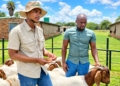
Jeremiah Jothams is the executive director of operations at Basadi Agribusiness. Photo: Food For Mzansi

Jeremiah Jothams is the executive director of operations at Basadi Agribusiness. Photo: Food For Mzansi

Share on FacebookShare on TwitterShare on WhatsApp

Animal welfare is a crucial component to livestock production and needs to be adhered to from the beginning, right to the end of the agricultural value chain. This means that farmers should prioritise ethical slaughtering practices to comply with basic legislation. 

In this episode, Jeremiah Jothams, executive director of operations at Basadi Agribusiness which specialises in poultry agro-processing, discusses key considerations when it comes to the ethical slaughtering of livestock. 

Jothams explains that animal welfare encompasses the physical and mental state of the animal and that there needs to be humane treatment from the moment of birth to slaughter. 


Related stories
  • Humane livestock slaughtering key to safe meat
  • Meat classification: An essential guide for livestock farmers
  • HR graduate ditches desk for piggery: Zintle builds thriving farm

Abiding to welfare legislation 

“There’s what we call the ante-mortem inspection, where we basically inspect the animals before they are slaughtered to ensure that before we slaughter them, they [are not] showing any signs that they were not treated inhumanely. 

“Because then the abattoir has a mandate according to the regulation, the Meat Safety Act, to be able to deny or to refuse the right to slaughter those animals if they have not been handled in a humane way during their rearing.” 

In this episode, Jothams provides insight into welfare practices, conditions livestock should be kept in before slaughter, and why livestock should not be kept in transit for periods longer than four hours. 

“When it comes to inspection at the abattoirs, what we regard as our Bible, the Meat Safety Act 40 of 2000, basically that’s one of the core regulations which governs how we process the meat from livestock to meat.”

He also touches on regulatory requirements for buildings and abattoirs according to the Meat Safety Act regulations. 

In this episode, Jothams also discusses:
  • Requirements for halal abattoirs;
  • Machinery and equipment; and
  • Slaughtering techniques.

Want to know more? Dive deeper into the episode and gain insights from the award-winning Farmer’s Inside Track, officially recognised as Africa and the world’s best podcast at the 2024 Digital Media Awards presented by WAN-IFRA, the global press organisation.

Option 1: Click here to listen on Spotify (all mobile and other devices)

Option 2: Click here to listen on any Apple device

READ NEXT: Egg-cellent ambition! Sizo is building a poultry empire

Sign up for Farmer’s Inside Track: Join our exclusive platform for new entrants into farming and agri-business, with newsletters and podcasts. 
Patricia Tembo

Patricia Tembo is motivated by her passion for sustainable agriculture. Registered with the South African Council for Natural Scientific Professions (SACNASP), she uses her academic background in agriculture to provide credibility and technical depth to her journalism. When not in immersed in the world of agriculture, she is engaged in outdoor activities and her creative pursuits.

Tags: Commercialising farmerLivestockTeach me
News

Aucamp outlines strategy for biosecurity, trade, and infrastructure

by Tiisetso Manoko
2nd September 2026

In an exclusive interview with Food For Mzansi, agriculture minister Willie Aucamp outlines his vision to accelerate the AAMP, tackle...

Read moreDetails
Tobias Doyer, CEO of Grain SA. Photo: Supplied/Grain SA Facebook

Rising costs, climate risk push Swartland wheat farmers to the brink

2nd September 2026
Sick spuds: No need to panic as SA’s potatoes are banned in Zim

Potato turning point ahead as onions double in price year-on-year

1st September 2026
Early calf care: Key growth targets every cattle farmer must track

Early calf care: Key growth targets every cattle farmer must track

1st September 2026

How to align your farming cycles with long-term financial success

1st September 2026

Strategic support sparks record-breaking growth at WC grape farm

Government hikes sugar import price, but industry warns of gap

How to align your farming cycles with long-term financial success

Dragon fruit thrives in KZN valley despite tough national season

KZN farmer loses 90% of crop amid severe water shortages

Join Food For Mzansi's WhatsApp channel for the latest updates!

JOIN NOW!
Next Post
New ministers unveil budgets to boost agriculture, land reform

New ministers unveil budgets to boost agriculture, land reform

THE NEW FACE OF SOUTH AFRICAN AGRICULTURE

With 21 global awards in the first six years of its existence, Food For Mzansi is much more than an agriculture publication. It is a movement, unashamedly saluting the unsung heroes of South African agriculture. We believe in the power of agriculture to promote nation building and social cohesion by telling stories that are often overlooked by broader society.

Honoured roots: A father’s legacy, a daughter’s farming dream

Gauteng farmers urged to harness massive urban market

Foot-and-mouth crisis hits SA dairy industry with R1-billion loss

Tough times, hardy cattle: Why Mzansi farmers are choosing Nguni

Dragon fruit thrives in KZN valley despite tough national season

Government hikes sugar import price, but industry warns of gap

  • Awards & Global Impact
  • Our Story
  • Contact Us
  • Cookie Policy
  • Privacy Policy
  • Copyright

Contact us
Office: +27 21 879 1824
News: info@foodformzansi.co.za
Advertising: sales@foodformzansi.co.za

Contact us
Office: +27 21 879 1824
News: info@foodformzansi.co.za
Advertising: sales@foodformzansi.co.za

  • Awards & Global Impact
  • Our Story
  • Contact Us
  • Cookie Policy
  • Privacy Policy
  • Copyright

Chat Options

I'm Lerato, your AI assistant!
No Result
View All Result
  • News
  • Changemakers
  • Lifestyle
  • Farmer’s Inside Track
  • Food for Thought

Copyright © 2024 Food for Mzansi

This website uses cookies. By continuing to use this website you are giving consent to cookies being used. Visit our Privacy and Cookie Policy.