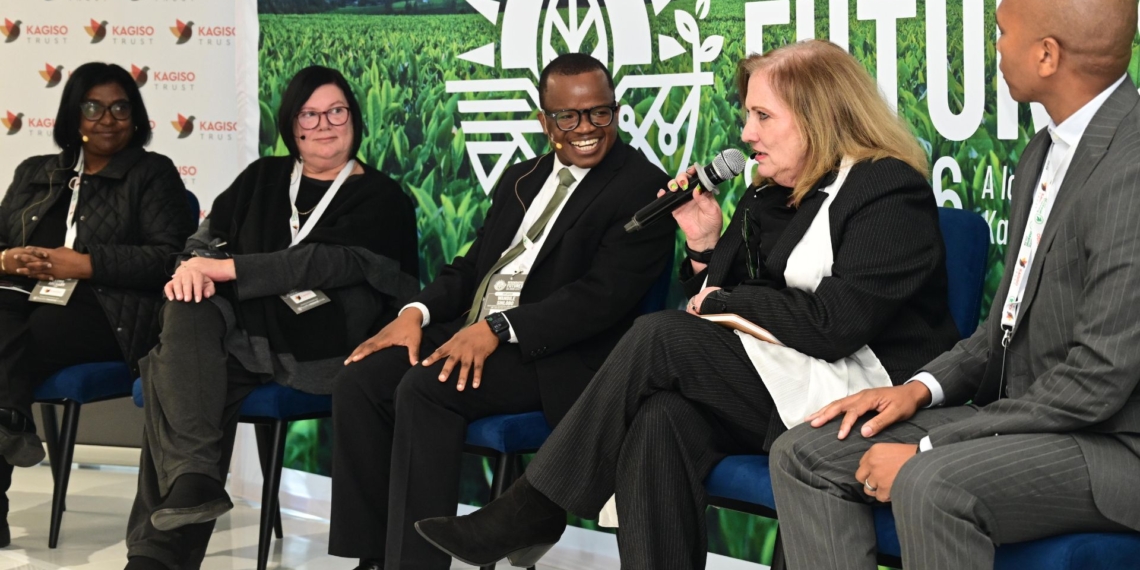
The future of South African agriculture will depend on stronger partnerships, effective policy implementation, infrastructure investment, and support for emerging farmers, according to speakers at the Regenerative Futures SA 2026 conference.
Bringing together leaders from government, agribusiness, finance and farming organisations, the event explored how regenerative agriculture can be scaled while supporting agricultural growth, transformation and job creation.
Speaking during a policy discussion, Free State MEC for agriculture, rural development and environmental affairs, Elzabe Rockman, said South Africa has learned that land ownership alone is not enough to drive agricultural success.
“Transformation has not achieved what it should have achieved because we regarded land tenure as a goal itself, which it can never be,” she said.
Collaboration key to agricultural growth
Rockman said South Africa had learned that land ownership alone cannot drive successful agricultural transformation. She argued that land reform must be linked to production support, mechanisation, skills development, market access and infrastructure to enable new farmers to become productive and sustainable.
She also highlighted the impact of deteriorating rural infrastructure on farming businesses, noting that poor roads and other infrastructure failures directly affect farmers’ ability to produce efficiently, access markets and maintain profitability.
Related stories
- Regenerative Futures: How outdated banking stalls SA farmers
- High input costs threaten land reform success
- No land? No problem: Secunda farmer turns old dumping site green
- Land Bank pushes back on ‘bailout’ claims amid funding talks
Rockman pointed to recent livestock vaccination campaigns as an example of what can be achieved through collaboration between government and industry.
“Without partnerships, we would not have vaccinated a million cattle between March and June,” she said, noting that private veterinarians and industry partners played a crucial role in supporting government capacity.
She also called for a more coordinated approach to agricultural development, moving away from fragmented funding models.
“We must work towards a transformative plan that funds the full package, not just isolated projects,” she said.
Agriculture grows, but inclusion remains a challenge
Wandile Sihlobo, South Africa’s presidential envoy on agriculture and land and Agbiz chief economist, said South African agriculture has performed strongly over the past three decades despite ongoing challenges.
“The sector is now almost more than double, even close to three times larger than it was in 1994,” he said.
According to Sihlobo, primary agriculture currently employs about 960 000 people, while a further 350 000 jobs are supported across the value chain.
However, he cautioned that growth has not been shared equally. “The prosperity is not shared. Many black farmers remain at the periphery of South Africa’s agricultural progress.”
Sihlobo noted that black farmers account for only about 10% of the country’s agricultural output, highlighting the need for improved support, financing, training and market integration.
Referring to the transfer of title deeds to beneficiaries of state-leased farms, he said secure land rights should be accompanied by broader support measures.
“Land alone is not sufficient. Capital, skills, partnerships and market access are all needed if farmers are to succeed,” he said.
He added that agriculture has the potential to make a significant contribution to economic growth and employment over the next few years if existing plans are effectively implemented.
Private sector ready to play a bigger role
Leona Archary, CEO of Agda, said many land reform and agricultural development policies are based on sound principles but often fail during implementation.
“Title is necessary, but title on its own solves nobody’s problem,” she said.
Archary argued that land reform beneficiaries require a comprehensive support package that includes finance, extension services, value chain integration and market access.
She also stressed the importance of greater cooperation between government departments, development finance institutions, commercial banks and agribusinesses. “We need to think as one collective ecosystem.”
Archary added that the government should focus on creating an enabling environment while allowing the private sector to drive commercial agricultural development.
Meanwhile, Dr Dalene Louw, CEO of AgriGauteng, said private sector organisations are eager to contribute to agricultural development but require stronger coordination and leadership.
“The private sector is begging to be on board,” she said.
Louw highlighted AgriGauteng’s work with government, farmers and industry partners on issues such as regenerative agriculture, fire management, farmer training and biosecurity.
“If we focus on agriculture and the full value chain, we can significantly reduce unemployment and stimulate economic growth,” she said.
READ NEXT: Regenerative Futures: How outdated banking stalls SA farmers