Just north of Pretoria, a quiet revolution is taking root. In Hammanskraal, the NPO SeedLink ZA is bridging critical skills gaps by weaving together agroecology, conservation, and art. The ARC’s Papi Kubeka and Philip Madiba explain how this grassroots network is empowering youth to build sustainable futures right on the doorstep of Dinokeng.
Drive north out of Pretoria along the N1 and, within forty minutes, the city gives way to Hammanskraal, a peri-urban township defined, for too long, by the twin burdens of high youth unemployment and limited economic opportunity.
But look closer, and you will find something unexpected: a constellation of community-driven projects that are using soil, bees, paint brushes, and the wild expanse of the Dinokeng Game Reserve to build a genuinely different future.
At the centre of this movement sits SeedLink ZA, a non-profit organisation (NPO) founded by three young social entrepreneurs. Their mission is both simple and radical: bridge critical skills gaps in rural and peri-urban communities by weaving together art, agriculture, and nature conservation into a single, coherent programme of empowerment.
“Our goal is to empower local children, youth, and small businesses with practical skills that align with the economic opportunities already present in their environment.”
SeedLink ZA
A network built on community trust
In January 2026, a team from the Agricultural Research Council (ARC) made a site visit to Hammanskraal as part of the national Agroecology Management Framework project, a five-year initiative running from 2025 to 2030. What they found was not a single project, but a living network of complementary enterprises, each addressing a different piece of the same puzzle.
The Hammanskraal initiatives had come onto the ARC’s radar through interactions with community facilitators and SeedLink ZA itself, a telling detail that underscores just how important grassroots networks are in a country that currently has no central database for agroecology enterprises. These projects were not waiting to be discovered; they were actively building connections and making their work visible.
Bees, biodiversity & the battle against human-wildlife conflict
One of the most vivid stories emerging from Hammanskraal belongs to Philip Madiba and the team at Dikgweng Bees and Honey. Operating as a community-based enterprise, Dikgweng produces raw, unfiltered honey using conservation-focused beekeeping methods. But honey is only part of what they do.
Hammanskraal sits in the shadow of the Dinokeng Game Reserve, one of South Africa’s few Big Five reserves accessible to Gauteng residents without leaving the province. This proximity creates extraordinary opportunity, but also very real tension.
As wildlife and human settlements share boundaries, conflict is inevitable. Dikgweng has stepped into this gap with practical bee-removal services, relocating swarms safely rather than destroying them, and in doing so models exactly the kind of human-wildlife coexistence that conservation scientists advocate.
Perhaps most powerfully, Dikgweng runs educational programmes for children and the broader community, explaining the ecological importance of bees in language that is grounded in the local landscape. When children understand that the bees in their backyard are the same bees that sustain the game reserve a few kilometres away, conservation stops being an abstract idea and becomes something personal.
Youth at the heart of the movement
If Dikgweng is the ecological heartbeat of the Hammanskraal network, SeedLink ZA and its programmatic arm, the SeedLink SA Skills Development Initiative, is the engine of youth transformation. The organisation offers a remarkable breadth of skills training:
- Art and craft, creative production, and cultural entrepreneurship
- Market access support for craft producers
- Agriculture, local farming, and sustainable and organic farming techniques
- Food security and agribusiness basics
- Nature conservation, game reserve careers, and environmental stewardship
- Conservation awareness and entry-level pathways into game reserve employment
The ARC team’s report highlighted that youth engagement is strongest where agriculture is linked to visible economic, environmental, and social outcomes, and that is precisely what SeedLink has understood intuitively. By placing farming alongside art, conservation, and culture, the organisation makes agriculture feel relevant, creative, and connected to a young person’s identity, not just their economic need.

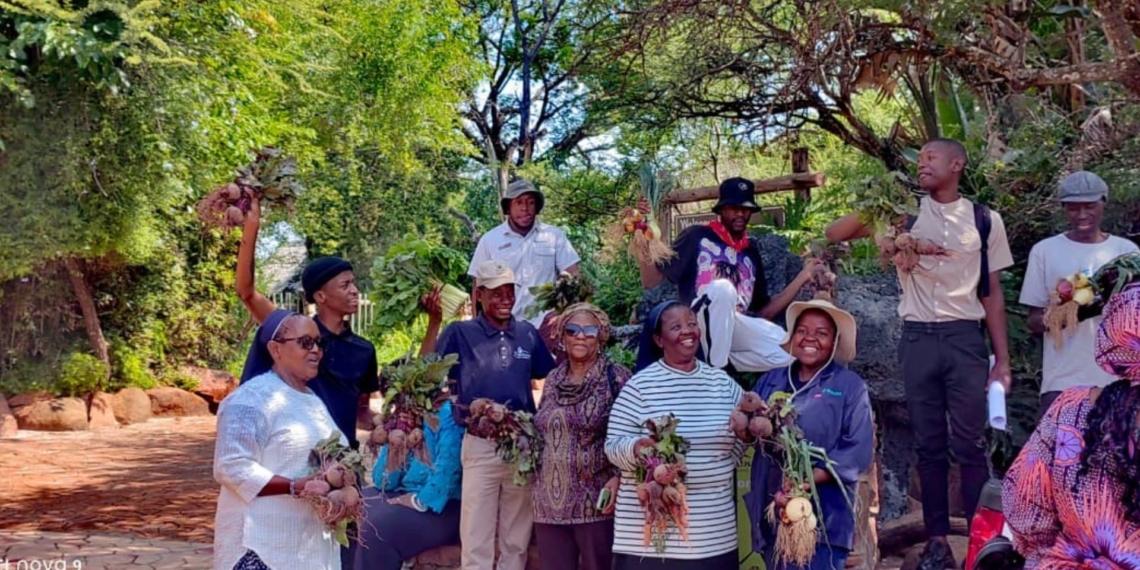
Some of the produce from the project is based in Hammanskraal, Pretoria. Photo: ARC
A gateway to Dinokeng: creating careers in conservation
For many young people in Hammanskraal, the Dinokeng Game Reserve has long been visible on the horizon but inaccessible as a career destination. SeedLink’s Skills Development Initiative is working to change that.
The programme specifically designs curricula to prepare young people for roles in eco-tourism and game reserve employment, including positions as tour guides, conservation assistants, and wildlife management support staff.
This is not a distant aspiration. Dinokeng Game Reserve, spanning over 18 000 hectares and home to lion, elephant, rhino, buffalo, and leopard, requires a consistent pipeline of skilled, locally knowledgeable workers. Young people who grow up near the reserve, who understand the local ecology, the community dynamics, and the cultural context, are potentially its best ambassadors and most committed stewards. SeedLink is building exactly that pipeline.
The ARC researchers noted that community-driven curricula co-created with stakeholders have a particular power: they prepare participants not just for employment as it currently exists, but for the entrepreneurial opportunities that will emerge as eco-tourism and conservation economies grow in the region.
Related stories
- Young food leaders rise as Youth Institute lands in Mzansi
- Limpopo youth grows grain business from social grant savings
- Youth in agriculture: The rise of South Africa’s agripreneurs
- Extension services must bridge the gap from harvest to market
The role of art in agricultural activism
One of the things that sets SeedLink apart from conventional agricultural NGOs is its unapologetic embrace of culture and creativity as tools for change. Community murals brighten public spaces and tell the story of local ecological pride.
Art-based events celebrate local talent and reinforce a sense of ownership over the community’s resources and identity. Organic markets create economic linkages between producers and consumers within the community.
Community clean-ups, particularly focused on reducing plastic waste near the Dinokeng Game Reserve boundary, are not treated as separate environmental interventions but as an integrated part of the agroecology and conservation curriculum. The message is consistent: caring for the soil, caring for the wildlife corridor, and caring for the aesthetic life of the community are all expressions of the same value, respect for place.
The challenges that remain
Honesty demands that the challenges facing these initiatives be named clearly. The ARC team’s report identified several systemic constraints: limited access to secure land tenure, unreliable water infrastructure, insufficient production inputs, and the persistent difficulty of accessing consistent markets for organically produced food. Farmers can grow excellent produce and still struggle to get it to customers at a price that sustains the enterprise.
The skills training offered by SeedLink, while demonstrably valuable, currently lacks formal accreditation, a gap that limits participants’ ability to translate their learning into recognised qualifications for formal employment. Stronger linkages with established training providers and accreditation bodies would dramatically increase the long-term economic return on every young person who passes through the programme.
The ARC’s visit itself is a sign of the institutional attention these challenges are beginning to attract. The recommendation emerging from the report is unambiguous: the Hammanskraal initiatives deserve coordinated support in curriculum formalisation, technical expertise, market development, and policy advocacy.

Community clean-ups, particularly focused on reducing plastic in Hammanskraal, Pretoria. Photo: ARC
An invitation to stakeholders
SeedLink ZA is explicit in its call for partnership. The organisation invites stakeholders from government departments and research institutions, private businesses and civil society to support the initiative through:
- Partnerships and programme design collaboration
- Mentorship and guest training from industry and conservation professionals
- Funding and in-kind support
- Provision of training materials and equipment
- Infrastructure support for training and production sites
- Strategic guidance to help scale the model regionally
For businesses with environmental, social, and governance (ESG) or corporate social investment (CSI) mandates, the Hammanskraal network represents a genuinely impactful opportunity: access to a growing pipeline of trained local talent, reduced recruitment costs, and a contribution to sustainable community development that is demonstrably real.
The bigger picture
South Africa’s youth unemployment crisis is one of the most urgent social challenges of our time. But the answer to unemployment is not only more jobs, but it is more capable, more confident, more connected young people who can create opportunities as well as fill them. That is what SeedLink ZA, Dikgweng Bees and Honey, and their partners in Hammanskraal are building.
The ARC concluded its January 2026 report with a clear verdict: the commitment and innovation demonstrated in Hammanskraal provide a strong foundation for future collaboration and support, with significant potential for growth and replication in similar peri-urban contexts across the country.
In a landscape that has seen too many promises wither, the seeds being planted in Hammanskraal look, for once, like they are genuinely taking root.
- Papi Kubeka and Philip Madiba are agricultural economists at the Agricultural Research Council (ARC). The views and opinions expressed in this article are those of the authors and do not necessarily reflect the views or positions of Food For Mzansi.
READ NEXT: Climate shifts demand integrated risk strategies for farmers