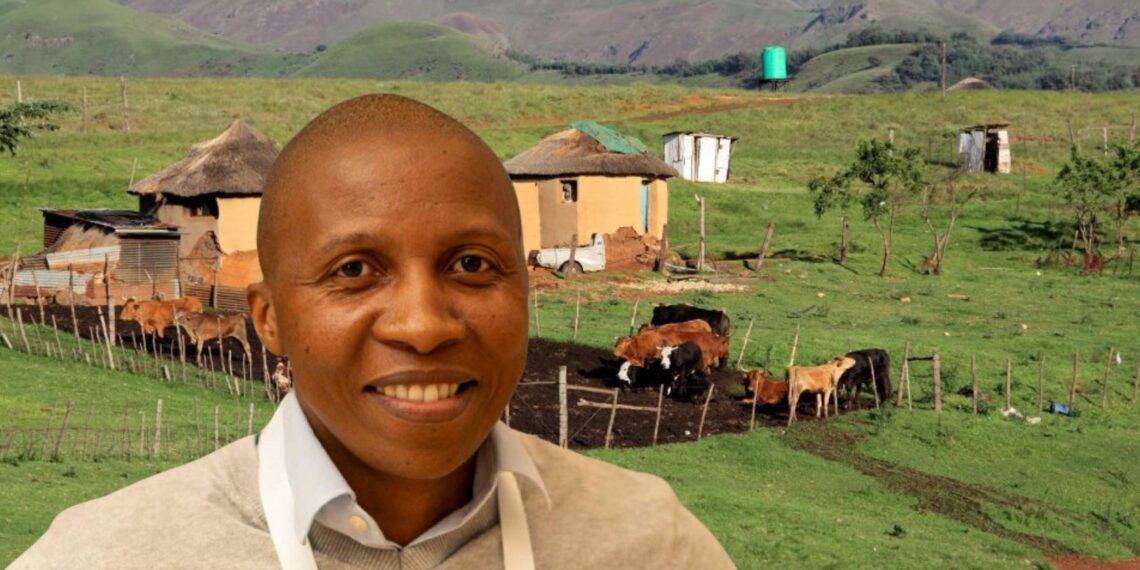
Dr Siphe Zantsi, an agricultural economist at the ARC, explores the growing demand for land in South Africa’s former homelands. Through case studies, he examines land use shifts, conflicts, and potential solutions.
The issue of land in South Africa keeps popping up now and then because it has not been adequately addressed. The most vocal voice on the demand for land is often framed as mainly that of people who want land to farm, but the demand for residential purposes is often overlooked.
This becomes even more complex in the case of the former homelands or ex-Bantustans (also called reserves) – areas created by colonial rulers as black spots, representing about 13% of South Africa’s land, where the majority of the country’s population was designated to live and farm.
Some of the very first state interventions that occurred in the 1930s, such as the Betterment Planning Schemes, segregated and re-arranged the villages into various sections for grazing, residential sites, and arable crop fields. In the process, some households were forced to cull their livestock to meet the recommended stock density/grazing capacity.
Many years later, the land area in the former homelands remains the same, but the population has increased exponentially. One wonders what the situation of land is today in these areas in the wider debate on land reform.
When one passes around the former homelands, one is struck by the fallow arable fields that are no longer cultivated but used as grazing lands.
One also observes that the number of homesteads has grown exponentially, and in some instances, areas closer to national roadways have fancy houses built, representing what we could call rural suburbs. Of course, rural-urban migration is also more prominent, with the former homeland population largely made up of the elderly and young children or grandchildren.
Some of these observations create an impression that land is not an issue for rural former homeland residents because much of the land is not cultivated and the rural population is declining due to rural-urban migration. However, this is not necessarily the case. I use two case studies where I have conducted research to show that in some of the former homelands, land for building homesteads and for grazing is a challenge.
Challenges of limited grazing land
One case study is that of Ndabakazi, a cluster of about five villages situated about 15–20 kilometres from the town of Butterworth, now Gcuwa, where I was born and bred. Using my own observations of growing up in the area and those of elders, together with a simple Google Maps exercise, I have found that the number of homesteads in villages has increased by 30%–50% from the early 1990s to 2021.
However, the size of the homestead surface area is declining from roughly 1.5 ha on average to 0.6 ha. Furthermore, completely new villages have been established in areas that used to be reserved for grazing animals. Unlike the old villages, these new villages only have homesteads – there are no grazing areas, although people still own livestock.
Livestock graze on uncultivated arable fields or in the remaining smaller grazing land in old villages. Some graze between homesteads, which tends to create conflicts as the animals break into homestead gardens. This is also the reason that many stock owners now have livestock herders, mostly Lesotho nationals.
While the number of animals is perceived to have declined, the remaining herds are sustained by the forage in the fallow arable crop fields. However, some fields are cultivated using mechanisation through a government-supported programme. In winter, the shortage of grazing land, coupled with veld fires and drought, necessitates that farmers with large herds, especially sheep farmers, purchase supplementary feed for their animals.
While the number of homesteads has increased exponentially and, in some villages, the fallow fields have been converted into a village, the demand for land for building homesteads seems to surpass the supply, which is the remaining grazing areas and fallow fields.
This is especially the case in areas closer to the national roads – in this case, the N2 from East London to Mthatha – because people from remote areas far from towns and national roads want homesteads that are closer to these routes. This also creates conflicts between villagers and chiefs, as in some cases, local youth do not get land (amanxiwa), while outsiders do due to bribery.
Related stories
- Land reform or land grab? Understanding SA’s Expropriation Act
- Animal traction: A forgotten asset or outdated practice?
Government efforts to address land demand
What we can learn from this case study is that some rural households need land for residential and small-scale farming. This confirms research on the largest demand for land and who would be beneficiaries – those wanting land for residential and small-scale agriculture.
I have witnessed this from my own research, which shows that many potential land redistribution beneficiaries want land for small-scale agriculture. The 2019 Advisory Panel on Land Reform and Agriculture, appointed by President Ramaphosa, reached the same conclusions.
This begs the question: what should be done to address this land demand, or what has the government done to address this growing demand?
This leads me to another case study – the One Household One Hectare programme, which was part of the land redistribution component but did not last long. To me, this seems like one solution to address the demand of people who want land for residential and small-scale farming. I had the privilege of visiting one of the beneficiaries of the programme in Kokstad.
Apparently, due to land shortages for residential and farming purposes, a group of households was given a 12 000-ha farm where they created villages, mimicking the village set-up, with sections for building homesteads, arable crop fields, and grazing areas. By 2022, when we visited the village, there were more homesteads than the original applicants.
Households now combine land-based livelihood strategies with non-farm livelihood strategies – they have homesteads where they keep animals, cultivate gardens adjacent to their homesteads, and farm arable fields as a cooperative. In addition to this, others receive social grants, and some work in town. Above all, they have access to basic services such as running water, roads, and community halls.
You can read more on this in our recently published paper: Creating Livelihoods Through Land Redistribution: Evidence from the One Household One Hectare Programme in Kokstad | South African Journal of Agricultural Extension (SAJAE).
Going forward
Although I believe similar programmes to the One Household One Hectare initiative could relieve some pressure from the former homelands, I also think we should be cautious not to create more of these villages at the expense of commercial farms.
This is a matter of striking a balance between maintaining the country’s food security and creating decent livelihoods for previously disadvantaged racial groups.
Fortunately, the Advisory Panel on Land Reform and Agriculture has outlined how we can manage this demand on the available agricultural land, which is about 78 million hectares (see page 58). It recommends that we allocate about 30% of agricultural land to people who want land for residential and small-scale agriculture.
The challenge now lies in implementation. Hopefully, the proposed Land Reform and Development Agency will help in this regard.
- Dr Siphe Zantsi is an agricultural economist at the Agricultural Research Council (ARC). The views and opinions expressed in this article are those of the author and do not necessarily reflect the views or positions of Food For Mzansi.
READ NEXT: New study paves way for drought- and heat-tolerant sorghum
Sign up for Mzansi Today: Your daily take on the news and happenings from the agriculture value chain
Sign up for Mzansi Today: Your daily take on the news and happenings from the agriculture value chain.