South Africa’s agricultural growth and commercialisation depend on reliable transport infrastructure, stronger public-private partnerships, and better coordination to connect producers with markets.
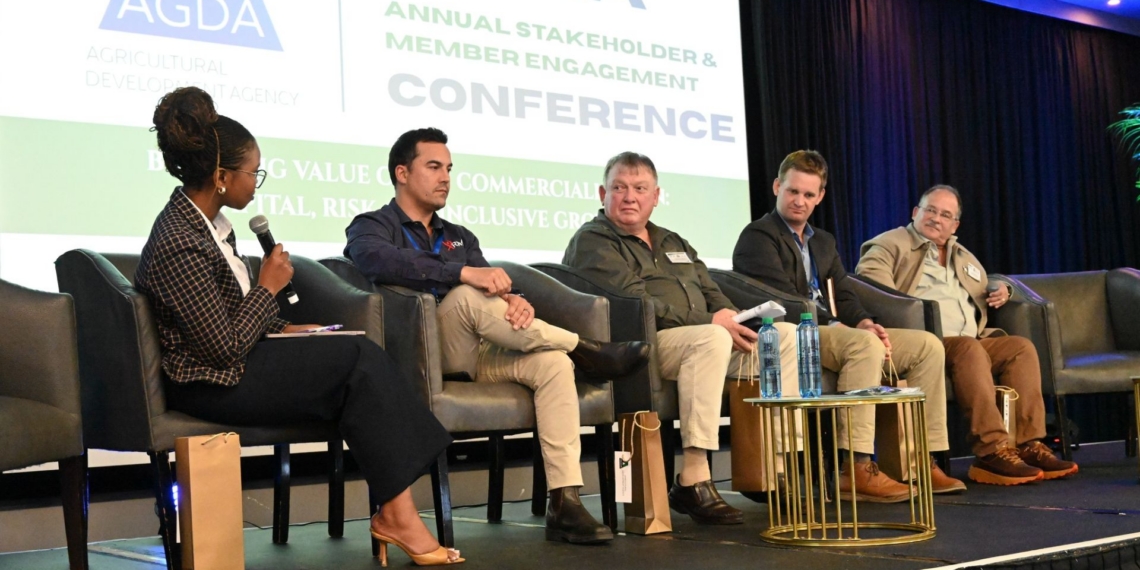
At the recent Agricultural Development Agency (Agda) congress in Boksburg, Gauteng, industry representatives highlighted the need to improve road and rail networks while addressing structural barriers that prevent small-scale and emerging farmers from participating in formal agricultural value chains.
Logistics critical to agricultural competitiveness
Theo Boshoff, CEO of Agbiz, said agriculture’s growth had outpaced that of the broader South African economy over the past decade, making efficient logistics increasingly important to sustain expansion and support exports.
“If you want to continue this growth and also to create additional space, we need to create space by being able to export,” he said.
Boshoff noted that nearly 80% of agricultural goods had shifted from rail to road, placing additional pressure on road infrastructure and increasing transport costs for producers.
He highlighted ongoing reforms under Operation Vulindlela, including the establishment of an independent rail infrastructure manager, open access to the rail network and public-private partnerships aimed at improving port and transport efficiency.
Related stories
- Agda pushes for pathways to commercialise emerging farmers
- Agda conference puts inclusive agricultural growth in focus
- Agda strives towards an inclusive agri sector
- Agda congress: Why production alone won’t save your farm
He also pointed to opportunities for private-sector involvement in 94 rail lines identified for potential transfer to private operators. adding that improved logistics could strengthen the competitiveness of the entire agricultural sector.
Prioritising roads that support agricultural production
The programme manager for the Centre of Excellence at Infrastructure South Africa (ISA), Dr Hubert Joint, said the organisation supports project preparation and prioritisation rather than directly funding or implementing infrastructure projects.
He highlighted a collaboration with AgriSA and Agbiz to assess rural roads in the Free State, where more than 5 000 unique roads were evaluated using economic models to determine their importance to agricultural production and distribution.
“We have actually prioritised all those roads, so we can have a very good understanding of the actual condition of those roads,” he said.
Joint explained that the assessment considered agricultural transport routes to silos, manufacturing facilities and export markets, alongside other economic activities such as mining and manufacturing.
He said ISA also supported struggling municipalities through feasibility studies and project preparation initiatives.
Collective livestock marketing and traceability
Turning to livestock logistics, Dr Philip Oosthuizen, COO of Red Meat Industry Services (RMIS), said improving market access for emerging livestock farmers requires more than repairing physical infrastructure.
He argued that individual farmers selling one or two animals at a time are often restricted to local buyers, limiting their bargaining power and access to better prices.
“The idea is rather to market in groups and to get the bigger buyers, whether it’s feedlots or abattoirs or the auction houses, to come and buy a bigger quantity of animals,” he said.
Oosthuizen also highlighted traceability as an important requirement for connecting small-scale livestock producers to formal markets, particularly amid ongoing animal disease challenges.
Digital systems that provide information about animal identification, vaccination status and genetic potential could help build buyer confidence and make it easier to coordinate transport.
He said larger buyers could then send trucks to rural communities to collect 100 or 150 animals, making transportation more economical.
Collaborate for skills investment and practical solutions
Gehard Diedericks, director of Agri-X, called for stronger collaboration between government, industry and agricultural stakeholders to address infrastructure and investment challenges.
He cautioned against assuming that simply increasing funding would resolve longstanding problems, arguing that projects needed to be grounded in the realities facing farmers.
“We can’t do it in silence,” he said, emphasising the importance of investing in skills, expertise and practical solutions that support emerging farmers.
He added that collaboration was necessary to address challenges across the agricultural value chain, from ensuring timely access to inputs to transporting produce to markets.
READ NEXT: Maleka engineers hydroponic solutions for emerging farmers