Saturday, September 5, 2026
SUBSCRIBE
22 GLOBAL MEDIA AWARDS
Food For Mzansi
  • News
  • Changemakers
  • Lifestyle
  • Farmer’s Inside Track
  • Food for Thought
No Result
View All Result
  • News
  • Changemakers
  • Lifestyle
  • Farmer’s Inside Track
  • Food for Thought
No Result
View All Result
Food For Mzansi
No Result
View All Result
in Innovators, Weird & Wonderful

Floating cows living a blissful life in Rotterdam

It's all going swimmingly for Peter van Wingerden and his cows on the world's first floating farm, which the Dutch farmer believes can work anywhere where there's water

by Duncan Masiwa
2nd November 2022
Floating cows live a blissful life in Rotterdam

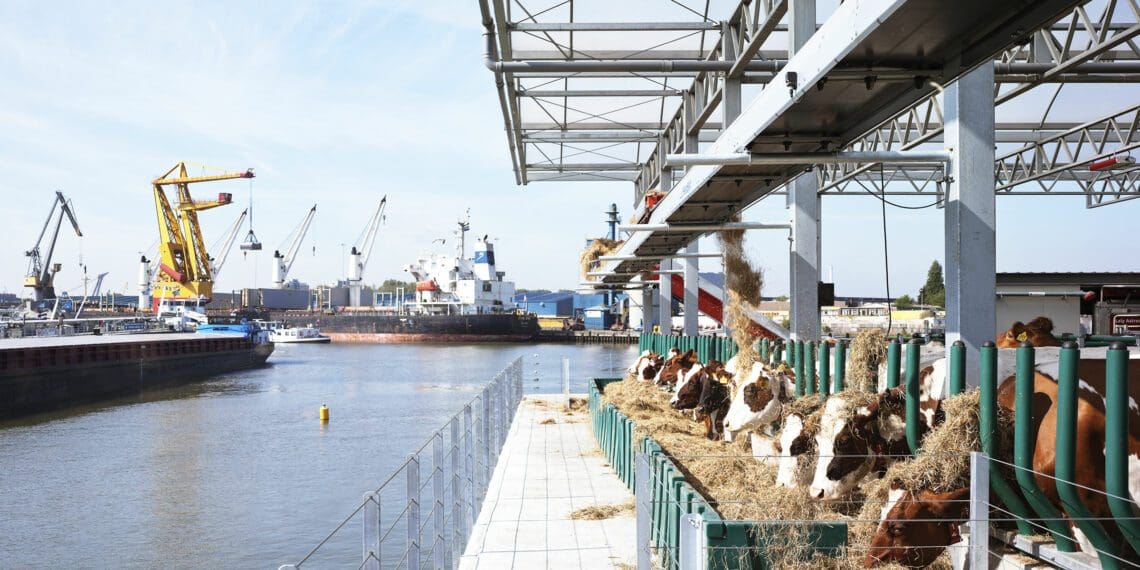
The first floating farm in the world has been realised in Rotterdam. Priorities are: animal welfare, circularity, sustainability and innovation. Photo/GoldSmith

Share on FacebookShare on TwitterShare on WhatsApp

Imagine a farm where cows are afforded the opportunity to live their best lives. In Rotterdam in the Netherlands, a farmer has taken agriculture to a whole new level by creating the world’s first floating dairy farm.

Yep, you heard right! This futuristic farm exists and houses over 30 well-cared-for cows.

Envisioned by Peter and Minke van Wingerden of Beladon, a company that specialises in waterborne architecture, the Floating Farm produces healthy food in the city, close to the consumer. And the aim is to also produce food in a sustainable, innovative, transparent way with animal welfare as top priority.

The farm was designed by architecture studio Goldsmith.

According to Peter, the idea came to them while they were working in New York City, shortly after Huricane Sandy hit. The storm resulted in the deaths of 44 city residents and inflicted an estimated $19 billion in damages and lost economic activity across New York City.

“We saw that stores and shelves were empty of fresh food. This is how we came up with the idea to farm within the city, so that we can always produce healthy food close to the consumer,” Peter said.

Floating cows live a blissful life in Rotterdam
It is important for the Floating Farm to prevent food losses, reduce food transport and improve food quality. Photo: Supplied/GoldSmith

The best stable in the world

Floating Farm stands for circular farming and according to experts, the three-layered building is a tech masterpiece.

One part of the farm is below the water and designed to be used as cool space for storage. The second floor is a processing area, while the third layer is where the stable is located. Talk about transFARMation!

Peter said they also collect rainwater from the roof. The rainwater is filtered with a membrane technology and then goes back as drinking water for the cows. There are also floating solar panels right next to the farm.

In addition to supplying fresh dairy to the city, the largest possible proportion of the raw materials used, including the rations of their cows, consists of residual flows from the same city.  

For example, their animals are already fed brewer’s grains from a number of Rotterdam breweries, bran from Schiedam windmills, grass from nearby sports fields and potato peels from a local processor. 

Floating cows live a blissful life in Rotterdam
The farm produces dairy products in the city, close to the consumer. Photo:Supplied/GoldSmith

Wait, there’s more…

In addition to a lot of attention, love and care, the cows also sleep on beds specifically designed for cows. The beds are made of flexible and strong materials that can be adjusted to the wishes of the cow. In addition to these cow beds, other products are also used to meet all the needs of the cows.

“In our opinion we have created the best stable in the world… For us creating a better world is essential. It’s not only passion but we strongly believe that we [must] change, and we have to change now. We wanted to do something to create a better world.” 

The big question, however, is can this model be replicated in other parts of the world, especially South Africa?

According to Peter, the answer is a definite yes.

“I strongly believe that this model can be applied anywhere in the world where there’s water. We have requests from all over the world because there are countries that do not have space.”

ALSO READ: Freak hailstorm: 80 000 bunches of spinach lost

Sign up for Mzansi Today: Your daily take on the news and happenings from the agriculture value chain.
Duncan Masiwa

DUNCAN MASIWA is the assistant editor at Food For Mzansi, South Africa’s leading digital agriculture news publication. He cut his teeth in community newspapers, writing columns for Helderberg Gazette, a Media24 publication. Today, he leads a team of journalists who strive to set the agricultural news agenda. Besides being a journalist, he is also a television presenter, podcaster and performance poet who has shared stages with leading gospel artists.

Tags: cowsdairy farmerinternational agriculture
News

Aucamp outlines strategy for biosecurity, trade, and infrastructure

by Tiisetso Manoko
2nd September 2026

In an exclusive interview with Food For Mzansi, agriculture minister Willie Aucamp outlines his vision to accelerate the AAMP, tackle...

Read moreDetails
Tobias Doyer, CEO of Grain SA. Photo: Supplied/Grain SA Facebook

Rising costs, climate risk push Swartland wheat farmers to the brink

2nd September 2026
Sick spuds: No need to panic as SA’s potatoes are banned in Zim

Potato turning point ahead as onions double in price year-on-year

1st September 2026
Early calf care: Key growth targets every cattle farmer must track

Early calf care: Key growth targets every cattle farmer must track

1st September 2026

How to align your farming cycles with long-term financial success

1st September 2026

Mamelodi farmers learn how to test soil with just a bottle and spade

Aucamp outlines strategy for biosecurity, trade, and infrastructure

Rising costs, climate risk push Swartland wheat farmers to the brink

Water rights alone won’t fix inequality in SA commercial farming

Beyond finance: Making women-led farms bankable

Join Food For Mzansi's WhatsApp channel for the latest updates!

JOIN NOW!
Next Post
South African food and beverage manufacturers must begin to re-evaluate the processes they have in place and innovate new business models and processes to unlock efficiencies. Photo: Supplied/Food For Mzansi

Manufacturers to ‘future-proof’ food production

THE NEW FACE OF SOUTH AFRICAN AGRICULTURE

With 21 global awards in the first six years of its existence, Food For Mzansi is much more than an agriculture publication. It is a movement, unashamedly saluting the unsung heroes of South African agriculture. We believe in the power of agriculture to promote nation building and social cohesion by telling stories that are often overlooked by broader society.

Honoured roots: A father’s legacy, a daughter’s farming dream

Gauteng farmers urged to harness massive urban market

Foot-and-mouth crisis hits SA dairy industry with R1-billion loss

Tough times, hardy cattle: Why Mzansi farmers are choosing Nguni

Dragon fruit thrives in KZN valley despite tough national season

Government hikes sugar import price, but industry warns of gap

  • Awards & Global Impact
  • Our Story
  • Contact Us
  • Cookie Policy
  • Privacy Policy
  • Copyright

Contact us
Office: +27 21 879 1824
News: info@foodformzansi.co.za
Advertising: sales@foodformzansi.co.za

Contact us
Office: +27 21 879 1824
News: info@foodformzansi.co.za
Advertising: sales@foodformzansi.co.za

  • Awards & Global Impact
  • Our Story
  • Contact Us
  • Cookie Policy
  • Privacy Policy
  • Copyright

Chat Options

I'm Lerato, your AI assistant!
No Result
View All Result
  • News
  • Changemakers
  • Lifestyle
  • Farmer’s Inside Track
  • Food for Thought

Copyright © 2024 Food for Mzansi

This website uses cookies. By continuing to use this website you are giving consent to cookies being used. Visit our Privacy and Cookie Policy.