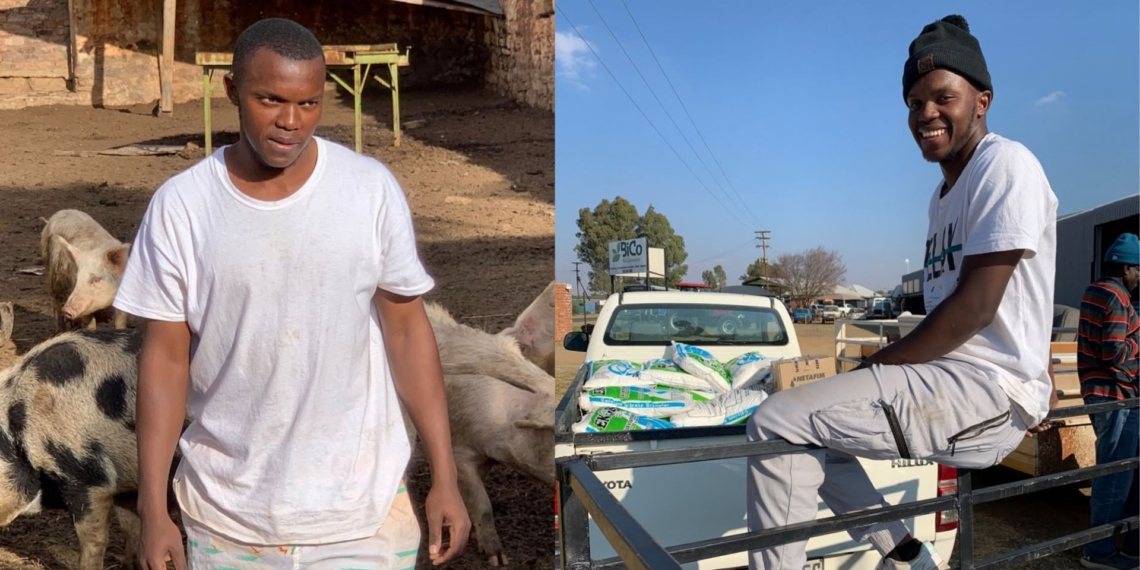
Thando Soroshi from Lady Grey in the Eastern Cape grew up around farming. His family kept livestock, but stock theft eventually forced them to give it up. Years later, a member of his church gifted him four chickens, reconnecting him with farming.
Today, he farms livestock and crops while running other parts of the business.
Although deep down he wanted to become a doctor, Soroshi says he became fascinated by farming when he saw Boer farmers around Lady Grey driving big cars, employing people and building businesses while working with nature and animals.
From four gifted chickens to a thriving flock
In 2018, while he was still in primary school, a member of his church gifted him four chickens. Soroshi says the person told him they had noticed the way he cared for things and wanted to see what could come from it.
By the end of that year, the four chickens had grown to 100 through research he gathered from social media and online platforms. From there, Soroshi started seeing business potential in poultry and diversification in agriculture.
He spoke to his family about needing incubators, and they supported him. The nearest seller Soroshi found was in Gauteng, so he went there and bought incubators that could hold about 360 eggs.
However, his first attempt at incubation failed. “All the 360 eggs got rotten. I didn’t know what I was doing. My research was probably half done,” he admits.
He tried again and got 280 chicks, and that became his way of growing his flock.
In 2022, Soroshi went to an agricultural high school in the Free State. By then, he says, he already knew he wanted to build a farming business.
However, practical poultry work was not much of a focus at the school. He started raising broiler chickens, and with help from his family back home, he was able to sell them.

When Soroshi returned home in 2024, the poultry venture he had been building at school started taking shape as a business. He registered Soroshi Empire Pty Ltd, and his parents, Mzwandile and Nomabali, supported him by giving him more broiler chicks. His flock grew from hundreds to about 2 000 birds.
Soroshi was only getting started. With profits and further support from his parents, Soroshi bought his first four pigs, and with a little more investment, his herd grew to about 30 pigs.
Soroshi now produces around 300 piglets a year. He says his pigs give birth three times a year. His older brother, Qhawe Soroshi, has also provided financial support as the business grew.
Related stories
- Fresh out of farming school, Memani’s agribusiness takes flight
- Growing more than food: Ngxanga shapes future farmers
- Soweto seedling farmer turns old school into thriving agri-hub
- EC women-led co-op turns communal land into retail success
Building a farm-to-table enterprise in Lady Grey
The business has now grown beyond poultry and pigs, with a shisanyama forming part of the enterprise, and he plans to open a butchery.
Four permanent workers are involved in livestock management, while another three work at the shisanyama. During planting and harvesting, he hires about 30 seasonal workers on the three hectares where he grows spinach, cabbage and tomatoes.
“Convincing my parents to start a farming business hasn’t been easy, especially because they have a history of stock theft.”

Soroshi says his parents started seeing the business differently when his cousin, Lifalakhe Maqubela, left his job in Gauteng to come home and farm with him. He has also had guidance from his mentor, Joseph Nkopane, a commercial farmer in Lady Grey.
The business received support from DEDEAT in August this year in the form of poultry cages with a capacity for 644 chickens.
Diversifying into pigs, cattle, and crop farming
Soroshi tells Food For Mzansi that his livestock and poultry include Merino sheep, indigenous cattle, Large White pigs, Boer goats, Lohmann Brown chickens, Ross 308 broilers and White Leghorn chickens.
“With Large White pigs, I chose them because they grow very fast, and I always aim for 100 kg growth within six months.”
With his indigenous cattle, Soroshi says he is aiming to cross them with Bonsmara cattle for meat production.
He says his choice of Boer goats also came from his research, which showed him that they reproduce well when livestock management is met. “They give birth to twins or triplets most of the time. That growth for me is business.”
Merino, he adds, gives him a dual purpose, as he can sell the wool while also having the sheep for the meat market.
With Ross 308 broilers, Soroshi says there are challenges with mortality and getting the birds to the desired weight. The other chickens, he says, grow well.

His customer base has also grown, with local wholesalers and customers in town buying his chicken, eggs, pork, beef and mutton.
Soroshi says his day-to-day involves moving between the different parts of the business.
He wakes up and organises things for the kitchen business before going to the farm to check on everything. Proof that failure is just a step toward building an empire.
READ NEXT: Poultry and potatoes power Fort Hare graduate’s farming vision