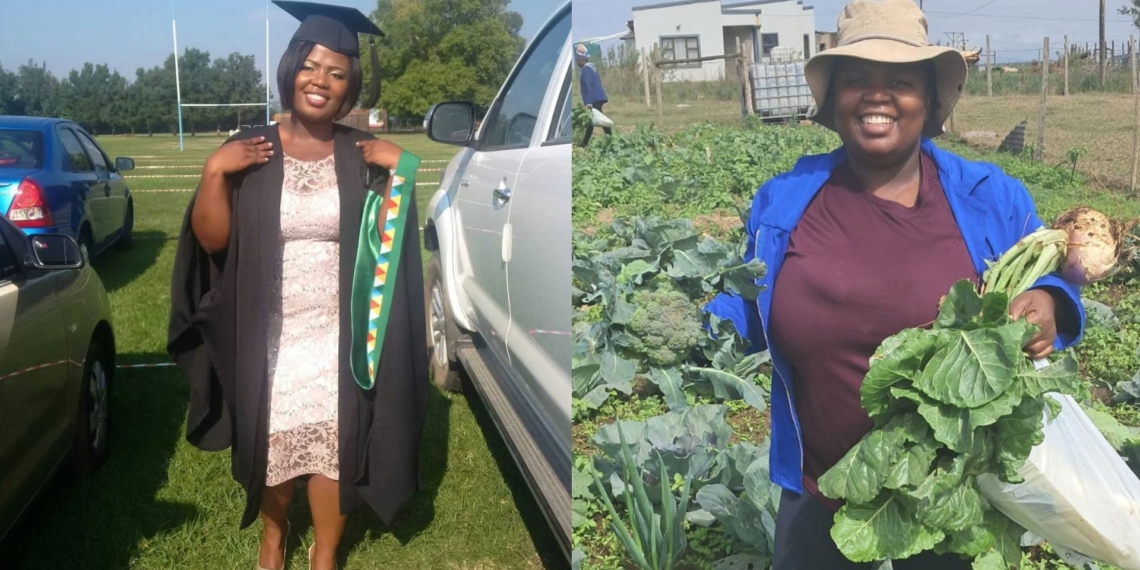
Growing up between rural life and the city brought struggles that forced Phelisa Ndayi to adjust, work harder and find her confidence. Today, Ndayi is an agronomist and co-founder of Lusa Agri Solutions, which offers agricultural training, crop care and consultations to farmers.
Ndayi learned early that being a bright child did not mean every environment would be easy.
Although born in Thembisa, Johannesburg, she was sent to live with her grandparents in Caba village, Dutywa, Eastern Cape, at six months old while her young mother, Thembakazi, stayed behind to work.
From rural Caba to soil science
Caba became home. Surrounded by her grandparents and aunts, Ndayi started school at four, making her the youngest learner in her class. Outside the classroom, she also participated in household chores, including herding the family sheep.
“I enjoyed that responsibility and carried it out diligently, which pleased my great-grandfather,” she recalls.
Just before grade 8, her mother brought her back to Johannesburg and enrolled her at Observatory Primary School. Coming from a village school where English was not the main language of instruction, Ndayi struggled to communicate in English and was moved back four grades.
“That was a difficult adjustment. I was in an unfamiliar environment, and I did not know my mother very well either.”
Her mother arranged extra English lessons until Ndayi caught up. She later moved to Athlone Girls’ High School, where she joined the choir, played netball and became a school monitor.
She also volunteered at a children’s centre and an old age home without telling her parents. “The school eventually found out and gave us an award,” Ndayi says.

Related stories
- NWU hustler skips graduation to fund poultry business
- Science meets soil: Agronomist turns manure into climate solution
- Babalwa’s mission: Saving the Eastern Cape’s medicinal plants
- Meet the EC duo changing the game in livestock care
Finding her place in agriculture
Agriculture was not a career Ndayi had considered. She wanted to become a geologist or architect until a cousin introduced her to soil science and explained that it was a scarce skill at the time.
In 2007, Ndayi enrolled at the University of Fort Hare for a BSc in crop science, completing the five-year programme in four years.
“I did not love the degree from the beginning,” she admits. By her second year, she had started bunking tutorials and ended up with four supplementary exams, until her mother sent her a message of encouragement.
“I cannot remember every word, but I remember her saying, ‘My child, do not despair.’”
Ndayi worked hard, passed all four exams and never looked back.
For her honours research, she investigated the effects of the soil bacterium Bacillus thuringiensis (Bt) maize on earthworms.
Ndayi explains, “I worked with red worms in individual boxes, feeding, weighing and counting them. My family thought I was mad! I had gone from bunking tutorials to spending my holidays caring for worms.”
She went on to complete a master’s in soil science at the University of KwaZulu-Natal, researching how land use changes affected the soil properties of Cedara’s wetlands.

At the same time, she joined the KwaZulu-Natal department of agriculture as a graduate assistant extension officer. She later worked in agronomy on cultivar evaluation trials involving maize, potatoes, dry beans and soybeans before moving into crop protection.
Ndayi eventually joined Pannar Seed as a sales representative in the Eastern Cape, working with farmers, extension officers and scientists through demonstration and on-farm trials.
“At Pannar, I could be hands-on and engage directly with farmers, extension officers and scientists.”
She later joined the Eastern Cape Development Corporation as a crop panellist, using radio and social media to share agricultural knowledge.
Digital innovation at Lusa Agri Solutions
In 2021, Ndayi cofounded Lusa Agri Solutions with her business partner, Lubabalo Bunu. She heads the crop care division, providing consultations on land use, soil fertility, crop care and business plans.
Earlier this year, she designed two apps for the business. One is used by her administrative staff and interns to access information, while the second app is aimed at farmers and will serve as a catalogue for livestock sales.

While building her business, she supplements her income by selling vegetables. “I would never use my current situation to discourage anyone from studying agriculture.”
Ndayi says her experience has taught her that food security comes down to everyday farm decisions, from caring for soil and choosing suitable seed to managing water and keeping animals healthy.
“Farmers need inputs, but they also need advice that suits their land and what they can afford. A solution that a farmer cannot practically use will not help them much.”
Climate resilience and the future
Changing weather patterns, she says, mean farmers need to keep learning and adapting.
“We cannot assume that familiar planting seasons or practices will always give the same results. My soil science background has taught me to understand the land before making recommendations, and to value soil protection and careful water use.”
Ndayi cautions against assuming farmers lack awareness when they do not adopt certain practices. Sometimes, she points out, the information has simply not reached them clearly.

She believes farmers should question familiar practices and consider new evidence, while scientists and corporations also need to listen to farmers and recognise the knowledge gained from working the land.
Looking ahead, Ndayi hopes to own a farm under Lusa Agri Solutions.
She encourages aspiring agronomy students that agriculture offers more than employment. The knowledge can be used to produce food, provide services, consult or build a business.
READ NEXT: From an apricot tree, a career in agronomy blooms