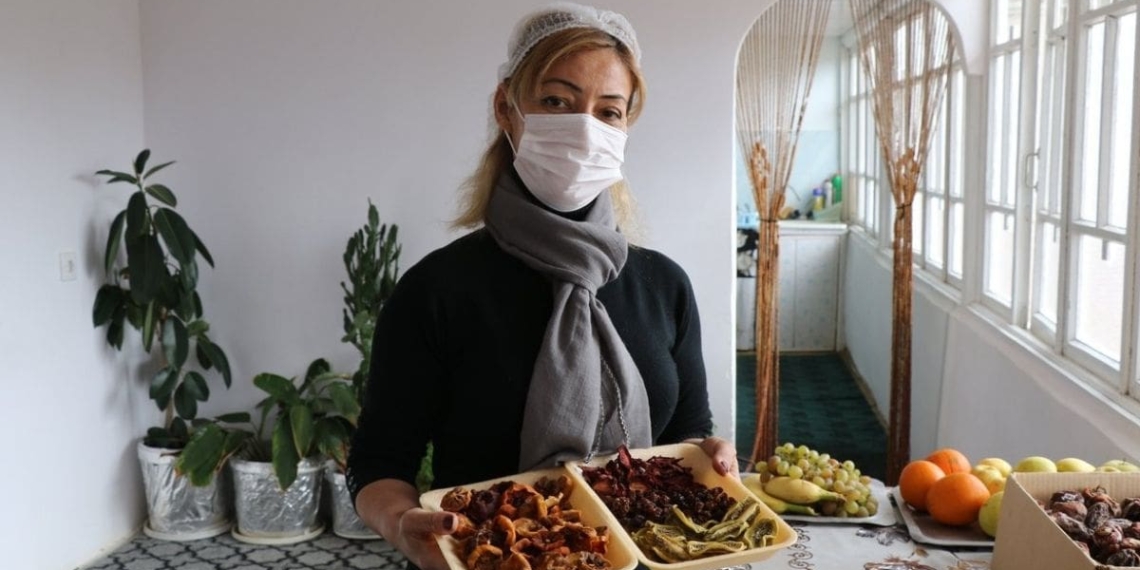
A year before the country faced the Covid-19 pandemic, Tahmina Isayeva from the Zaqatala district in northwest Azerbaijan started a small business drying fruits in her kitchen.
“In the beginning it was my hobby to preserve fruits by drying them. We arranged fruits on the drying tray, spacing them for good air circulation, and then set the tray in the sun for some days. It is a traditional method, but it is a long process,” says Isayeva.
“It started quite well and my acquaintances became my first consumers. For a year, I produced almost 300 kilograms of dry fruits. It was not easy as I did all the processing myself – harvested apples, plums and figs from our garden or bought fruits from the bazaar,” she said.
In 2019, the Women’s Resource Centre in Zaqatala awarded Isayeva a fruit-dry processing machine to enhance her business.
Not long after, the pandemic hit. Although this situation challenged her business’ profitability, she used this time as an opportunity to study new techniques and bring her production to the next level. Now she is the first commercial producer of dried fruits in her village.
“The pandemic was a big challenge for my business as people’s capacity to pay decreased. I was not disappointed. Instead, I was searching tips to improve my business and started setting up the production process with the involvement of other women. Also, I plan to get a quality certificate for my products to increase sales,” Isayeva said.
Fruit and vegetable culture
Fruits and vegetables are a big part of the culture and economy of Azerbaijan. The country is situated in the Caucasus area in south-eastern Europe and south-west Asia.
Its varied climate allows fresh produce to be picked all year round. Many of these fruits and vegetables are celebrated with local harvest festivals, highlighting their importance for the community and national economy.
According to the Azerbaijani state statistics committee, exports of fruits and vegetables in 2020 amounted to about R9.1 billion and provided a third of the country’s total non-oil exports last year.
Fruits are also a part of traditional Azerbaijani tea culture. Visitors to someone’s home, whatever the time of day, are always offered tea alongside bowls of dried fruits and nuts as well as various home-made jams.
Innovating tradition
Fruits and vegetables are also particularly important to another young Azerbaijani farmer, Jalal Alakbarov from the Samukh region in northwestern Azerbaijan.

Alakbarov’s family has been in the business for many years, mostly relying on traditional methods of production.
As part of the new generation, however, Alakbarov was looking to innovate with new techniques and technologies to better their business.
While vegetables are traditionally grown in open fields, the younger generation has been using greenhouses. Greenhouses better control production than in an open field and consequently lead to higher yields, better quality and better use of inputs.
In the last ten years, Alakbarov has managed to expand his farming, producing tomatoes and strawberries in greenhouses.
“I’ve gained new experiences, from growing crops to pest control. Through these gains I achieved an increase in the yield and profitability of my farm,” says Alakbarov.
He notes that he now shares this knowledge, gained in part through FAO’s field training, with other farmers. “No man is an island; we support each other, especially during the recent pandemic.”
Like with Isayeva and farmers around the world, the Covid-19 pandemic created many challenges for Alakbarov. Quarantine measures created a shortage in labour. Decreases in income meant decreased consumption, and market prices of fruits and vegetables went down. Restrictions on market access also affected sales.
“During the pandemic period food security became critical, especially when doctors recommended to eat healthy food and include fruits and vegetables on the daily menu. We, farmers, were like a regiment fighting against Covid-19, and I think we are winners in this war,” Alakbarov concludes.
With the desire to improve their practices and businesses, Isayeva, Alakbarov and others have been in touch with FAO, participating in various projects throughout the country. One FAO project supported by the European Union is helping communities to promote farmers’ products globally, creating agritourism opportunities for foreign tourists.
In Azerbaijan and countries worldwide, FAO focuses on providing family farmers with training and techniques to improve their production, reach more markets and ensure their food and nutrition security.
This article was first published by the Food and Agriculture Organization of the United Nations.
ALSO READ: Farmers are the face of resilience in Afghanistan
Sign up for Mzansi Today: Your daily take on the news and happenings from the agriculture value chain.