South Africa’s Eastern Cape province has several million hectares of open land in rural areas, not privately owned but held in trust by the state on behalf of communities. The people who live there use it mainly for grazing livestock, subsistence farming, and sometimes hunting. A common misperception is that the grassy, rolling hills will take care of themselves. But these rangelands degrade for many reasons, making them unusable for the small-scale and landless farmers who need communal land for their animals. Agricultural scholar Mhlangabezi Slayi researches practical ways of preserving rangeland ecosystems so that farmers can continue to graze livestock there. In his latest study, he worked with 150 people from rural Eastern Cape villages to find out how they planned to restore the rangelands closest to them.
What are the Eastern Cape rangelands?
The Eastern Cape has extensive communal rangelands made up of grasslands, shrubs and scattered trees. These areas form the backbone of rural life. They provide grazing for cattle, sheep and goats, which some families rely on for milk, meat and income. People also gather fuelwood, medicinal plants and building materials from these rangelands.
Altogether, communal rangelands in the Eastern Cape cover more than 7 million hectares, an area roughly the size of Ireland or Sierra Leone. In many rural villages, over 80% of households depend directly on these lands for their daily survival. They serve not only as grazing fields but also as social and cultural spaces integral to people’s identities and traditions.
What’s gone wrong with this open land?
The rangelands in the Eastern Cape are not as self-sustaining as many assume. They suffer from degradation caused by a combination of natural and human pressures. This vulnerability is rooted partly in South Africa’s apartheid history, when Black communities were forcibly removed from cities and town centres and confined to areas with limited livable land, known as homelands. This put lasting strain on the rangelands there.

Today, traditional authorities and local municipalities have oversight of the rangelands, while the state holds them in trust on behalf of communities. Excessive livestock outnumber the land’s capacity and animals keep grazing the same spots without being moved to allow the grass to recover (overgrazing).
As a result, shrubs and thorn trees encroach on areas that were once rich in palatable grasses. This diminishes the quality of the forage (grasses) for animals.
Another problem is that soil erosion is escalating, creating bare patches of land that either turn into giant dusty areas during droughts or wash away during heavy rains. In the Eastern Cape, it’s estimated that more than 60% of communal rangelands show some level of degradation, with soil erosion being one of the most visible signs.
When too many animals strip the land of grass, the soil is left exposed with nothing to hold it in place. Cutting down trees and erratic heavy rains make soil erosion even worse.
Climate change also makes things worse. It has introduced longer dry seasons and unpredictable rainfall, which complicate recovery efforts. Thus, the situation involves an intricate balance of people, animals and land use.
Related stories
- Eastern Cape farmers tackle nappy waste to save grasslands
- Taleni Farmers Co-op grows hope in rural Eastern Cape
- Drought, floods, and dry taps: ‘It’s too much,’ say EC farmers
How can rangeland restoration help?
Rangelands can be restored through government-led measures like fencing off degraded areas to allow recovery. Communities can also restore rangelands by replanting grasses, protecting water sources, and encouraging the regrowth of thicket and trees. Restoring rangelands yields significant ecological and economic benefits.
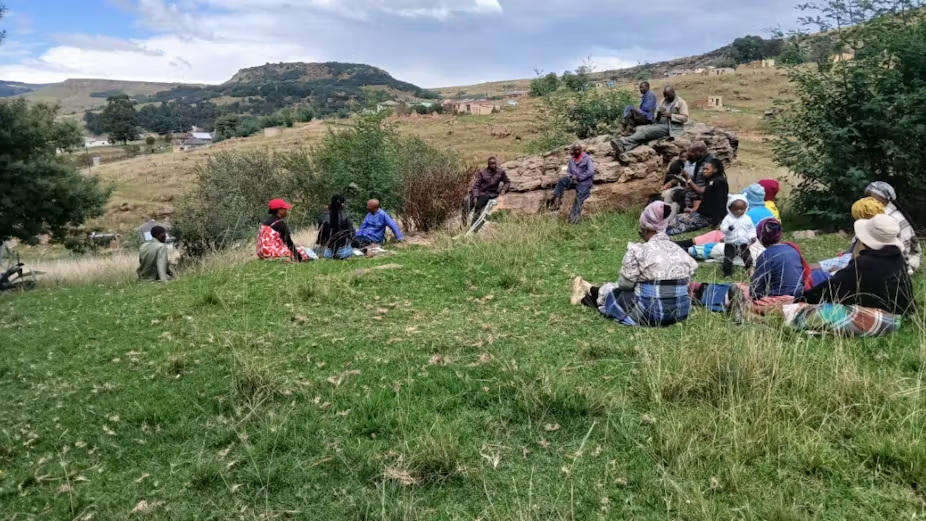
I interviewed 150 people from four villages in the Tyhume area of the Eastern Cape, a rural valley surrounded by rolling hills and small farming communities. They were acutely aware of how their lands had changed over time. Elders recalled hills once lush with tall grasses that are now reduced to bare soil and thorn bushes.
The people I interviewed understood restoration to mean bringing back the grass that cattle can eat, making the land strong again.
They identified four primary advantages to restoring the rangelands:
- preventing erosion, enhancing water retention, and maintaining soil fertility
- healthier grasses, leading to better animal growth, increased milk and meat production, and greater resilience to drought
- recovery of wild plants and animals, strengthening the entire ecosystem
- more reliable and nutritious feed for livestock.
What’s preventing restoration of the rangelands?
Although there was a strong desire to restore the land, the people I interviewed faced substantial challenges:
- They perceived degradation differently. For some, it meant loss of grazing land; for others, it meant that bushes were crowding out grassy areas or that the soil was visibly eroded.
- Community members were eager to take action. But they lacked funding for fencing and tools, and the technical knowledge of restoration practices.
- Land tenure insecurity hindered long-term investment. The communities use communally owned land, which means no single person holds title deeds. While this system allows everyone access, it can also create uncertainty about who is responsible for managing and investing in the land.
- Gender roles also played a crucial role, with women, who are vital to livestock care, often excluded from decision-making processes.
My research found that although communities are motivated to act, they require support, training, and clear governance structures.
In other words, agreed rules and leadership about who makes decisions and takes responsibility are needed to convert their willingness into tangible action.

What needs to happen next?
Several key actions are essential.
First, restoration goals must be clearly defined. In other words, there must be a chosen focus, either one that concentrates primarily on increasing forage for animals, or restoring biodiversity, or achieving both.
Agreeing on this should involve community input, usually led by traditional leaders together with local government officials and supported by agricultural extension officers or non-governmental organisations.
Second, community education and extension services are vital to help farmers understand the causes of degradation and the benefits of restoration. These services should be provided by government agricultural departments, often in partnership with local non-governmental organisations or community organisations.
Third, financial and institutional support is needed. This can take the form of subsidies to farmers, microfinance, or payments for ecosystem services (payments to land users for protecting or restoring the environment). This support is crucial to overcome financial limitations.
Finally, the restoration process must be inclusive, ensuring that both men and women, as well as young and old, have a voice in planning and benefit-sharing. Current governance structures, however, can be a barrier and may need reform to support fair decision-making and effective management.
By taking these steps, restoration can become more than just a technical remedy; it can pave the way for healthier land, stronger rural livelihoods, and enhanced resilience against climate change.
- This article was first published by The Conversation.
READ NEXT: EC farmers receive 300 sheep to boost wool industry