Water is at the heart of livelihoods, farming, and food production. When it becomes scarce, the effects stretch far beyond dry taps and struggling crops; it also places human dignity, sanitation and health under severe pressure.
For Mzansi, the challenge is bigger than simply harvesting more water; it is about protecting the water we have and keeping it flowing.
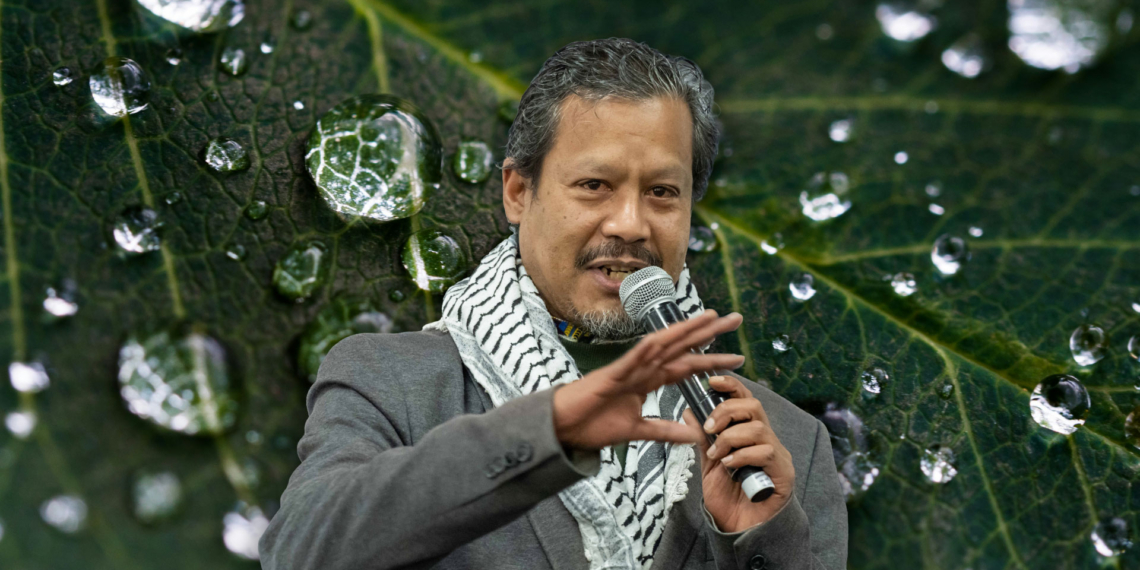
Tauriq Jenkins, high commissioner of the Goringhaicona Khoi Khoin Traditional Indigenous Council and Save Our Sacred Lands, shared with Food For Mzansi what history can teach us about water, power, and survival.
Vateka Halile: Beyond resource management, what shifts when we assign ‘personhood’ to water rather than treating it merely as an economic utility?
Tauriq Jenkins: Water is precious, and we need to completely overhaul our attitude towards it. It is not merely something we drink, wash with, use to water lawns, or consume to drive industry and the economy.
Water needs to regain its personhood. We are dealing with a living entity in how we relate to rivers. We must re-establish deep respect and return water to a place of ritual.
Water is not only necessary to sustain physical life; it carries deep spiritual significance for us as Africans. We need to reframe our relationship with water, shifting from viewing it as a utility to honouring it as a life-giving force that deserves care and protection.
In what ways did early colonial land policy use nature itself as a weapon of dispossession, and why must modern healing extend beyond financial compensation?
When you look at the severing of our connection to water, through the weaponisation of land grants and the seizure of indigenous land for commercial agriculture along rivers, that was one of the primary disruptions that took place.
You also had the destruction of key native species on the landscape, such as the bluebuck, the quagga, and the Cape lion. Ultimately, the human body itself became disconnected from both water and land.
Related stories
- Why South Africa’s land reform has fallen short
- No one-size-fits-all: Liane’s lessons on leaving the land better
- SA’s deepening water crisis threatens national food security
- SA’s water crisis: A permanent threat to farming and economy
When we talk about healing intergenerational trauma, it cannot simply be a question of economics or land access. It must also encompass access to water, ritual, language, and animals, alongside a full acknowledgement of this symbiotic relationship.
How do municipal bylaws and expansions inadvertently dismantle grassroots food security under the guise of modernisation?
We should not approach indigenous communities under the assumption that they need to be taught how to care for their environment. That knowledge has always been present; it is a heritage and a living memory that needs to be revived and recognised.
Furthermore, vast tracts of municipal and provincial land are routinely sold off to the private sector, land that could instead be converted into agricultural green spaces for urban food security.
In suburbs and villages, residents are already growing food in backyards and utilising open spaces, yet these efforts are sometimes penalised as bylaw violations rather than supported.
We must also protect informal food networks. A small grower can supply fresh produce to a local spaza shop or informal trader, sustaining a localised micro-economy.
When these networks are displaced by large supermarket chains, communities lose autonomy and become dependent on formal corporate systems.
The core question is what kind of food and agricultural system we want to build: one that centres large commercial interests, or one that enables equitable, diverse, and sustainable local production?
How does the Khoi and San philosophy challenge the modern tendency to treat human identity and the natural world as separate entities?
I would say it is the symbiotic relationship that defines the connection between humanity and the earth. The Khoi and San soul is forged through this relationship with water, land, animals, the cosmos, ritual, and the self. All of these elements combined create an embodied sense of who we are.
When you disconnect any one of these elements, we are no longer whole. Even our definition of what it means to be human is inherently symbiotic.
If spatial planning in Mzansi began long before 1948, how do centuries-old river disputes mirror modern economic divides across different types of land?
If you look at the first title deeds, how land was granted to early settlers, and how commercial agriculture transformed the landscape, you begin to see how devastating that process was both environmentally and socially.
The loss of water access was fundamental. Indigenous communities were cut off from rivers, and along those very embankments, early forms of spatial control emerged that later developed into apartheid spatial planning.
This system did not simply begin in 1948; it was inherited and expanded over centuries.
Today, two people may hold the same amount of land on paper, but what they can achieve with it is vastly different. Five hectares in Constantia is not equivalent to five hectares on the Cape Flats. Water access, soil quality, the surrounding environment, and population density all dictate what is possible.
READ NEXT: New agriculture chair vows strict public sector oversight