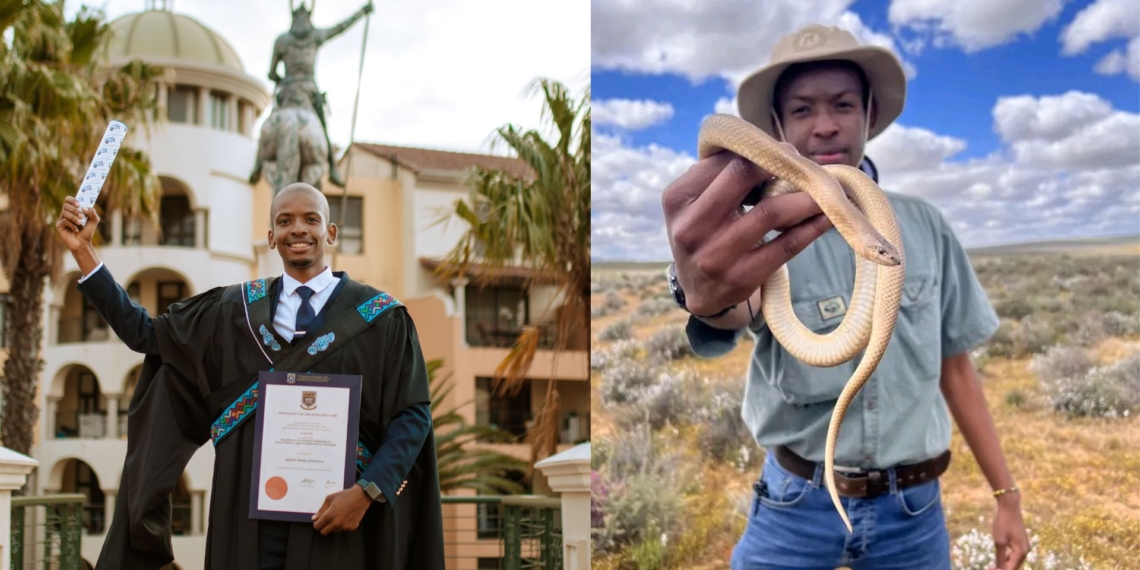
Just like many boys raised in villages, Shane Ngwenya from Madadeni in Nkomazi, Mpumalanga, grew up herding livestock in the mountains and swimming in streams, surrounded by snakes, lizards, birds, locusts, and other reptiles.
Fear and curiosity were part of everyday life, shaped by village myths about snakes, mostly. That changed when he attended the reptile diversity in African savannas field course at the Kruger National Park in grade 10.
That experience shifted his perspective completely, leading him to study biodiversity and conservation biology to bridge the gap between local beliefs and wildlife science.
The shift from village myths
Growing up, Ngwenya says his parents were always fascinated by top well-known careers like being a doctor, nurse, pilot or engineer. “At one point, I was fully convinced that I wanted to be a doctor if not a motivational speaker.”
He says life in rural villages got more fascinating as days went by. “The rhythms of the seasons, the sounds at night, the presence of wild animals, even though we mostly saw domesticated ones, cows and goats.”
It came with a certain reality, he notes: in rural communities, wildlife is often seen through the lens of fear or survival, not appreciation. That tension between living with nature and fearing it shaped how he sees conservation today.

When he joined the University of the Western Cape (UWC) in 2022, he was driven by curiosity and the science behind the reptile course at Kruger National Park.
As a grade 10 learner at Sikhwahlane Senior Secondary School in Ntunda, he saw a career in nature, spurred on by nature programmes such as 50/50.
“Seeing people handle animals that people feared, and do it with respect and passion, changed how I thought about wildlife. It made me question what I had been taught to fear.”
That course taught him how to identify reptiles, especially snakes, which have a not-so-good reputation with most people.
Related stories
- Anti-snake venom shortage is ‘very serious’
- Hardship forged Sihle’s passion for animal health
- Baloyi’s mission: Designing ‘perfect plant babies’ for SA’s farmers
- Eastern Cape scientist is breeding a better future for farmers
Connecting people and nature
Ngwenya says the course balanced what he already knew and gave him a more scientific understanding of what is happening around biodiversity and conservation biology.
“Choosing that path wasn’t random; it felt like the only thing that made sense. Coming from where I come from, I have seen both the beauty of nature and the misunderstandings around it.”
He knew he didn’t just want to admire wildlife; he wanted to understand it, protect it, and also bridge the gap between science and communities like the one he grew up in. “Conservation, for me, isn’t just about species. It’s about people, perception, and coexistence.”
Having graduated with his bachelor of science in biodiversity and conservation biology in 2025 and his honours degree in 2026, Ngwenya is now in the first year of his master’s.
He is currently working for Nsasani Trust as a biological field officer at the Kruger National Park. His day-to-day work includes conservation work, storytelling, and community engagement.
“Some days I’m out in the field conducting ecological surveys, tracking reptiles, checking camera traps, recording environmental data, or working on research related to reptile ecology and biodiversity.”

Other days are spent analysing data, writing reports, editing wildlife photography and film content, mentoring students, or working with conservation organisations and rehabilitation efforts.
“Working in conservation has taught me to be adaptable,” he says. “You can go from handling scientific equipment one moment to rescuing wildlife or speaking to local communities the next.”
Nature’s role in farming
Furthermore, Ngwenya explains that his work is linked to farming in several ways, especially through the role wildlife plays in agricultural ecosystems. Much of conservation biology today, he says, recognises that farms are not isolated from nature; they are part of larger ecosystems.
“Species like snakes, owls, raptors, and small carnivores help farmers by naturally controlling pests such as rodents that damage crops and spread disease.”
He says part of his work involves helping people understand the importance of these ecological relationships and encouraging coexistence rather than fear-driven responses.
“Healthy ecosystems often support healthier agricultural systems, so conservation and farming are actually more connected than many people realise.”

Looking back, Ngwenya says it wasn’t all smooth sailing. Some moments at university were hard, involving self-doubt, financial pressure, and feeling out of place. “Sometimes it felt like I had to work twice as hard just to stand in the same room as everyone else. But at the same time, those challenges built resilience.”
He got involved in research, worked in herpetology, collaborated internationally, and even became a mentor to younger students.
Ngwenya says there were moments where things felt overwhelming, but he never lost sight of why he started.


READ NEXT: Snakes on a plate? Explore snake farming from food to antivenom