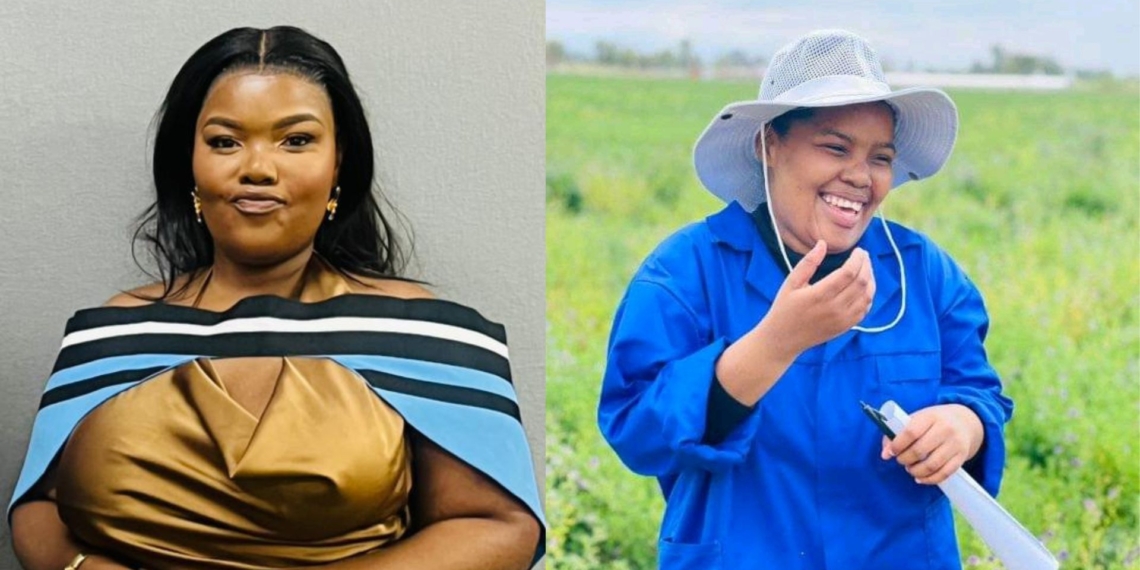
For crop scientist Anele Danisa, agriculture was a reality long before university. Growing up in KwaDukuza, KwaZulu-Natal, she watched her parents run their farm, supplying local shops and the Durban market.
By the time she matriculated from North Coast Agricultural College, she already understood farming through the lens of business, science, and food security.
In 2020, she enrolled at the Tshwane University of Technology, where she ultimately earned her postgraduate diploma in crop sciences.
Danisa tells Food For Mzansi that her first classroom wasn’t a lab, but a garden. As a member of her primary school’s Soul Buddies Club, tending to that small school patch quickly became her favourite part of the day.
“The fascination grew at home too, watching my parents supply fresh vegetables from the Durban market to local shops. For me, farming wasn’t just a business; it was magic.”
Finding the magic in agricultural science
Soon, agriculture stopped being just about growing food and became the science of life. “Watching a seed become a full plant, understanding the processes, and seeing potential turn into a harvest. That’s when I knew this wasn’t just a subject. It was my career.
“My high school was a well-equipped agricultural school with its own farm, so we had full access to practicals.”
Attending the Royal Agricultural Shows further opened her eyes to the full spectrum of the industry. So, Danisa enrolled at TUT for a diploma in crop production, drawn by its 10-month in-service training component.
“That practical experience mattered to me. I also wanted to move far from home and experience life in a different city.”
However, the transition wasn’t without its challenges. “The biggest challenge was the academic intensity. I didn’t realise how much science and mathematics agriculture was involved.”
Having studied mathematical literacy in high school, university-level maths was a completely different story. “But with resilience and hard work, I pushed through and passed in record time.”
Related stories
- Baloyi’s mission: Designing ‘perfect plant babies’ for SA’s farmers
- Agri economist Vuyisani planted a seed and changed his future
- Eastern Cape scientist is breeding a better future for farmers
- How Dr Sokombela grew from top learner to agricultural scientist
Discovering the science behind the food system
Her final year took her to Sakata Seed Southern Africa for her in-service training, a move that changed everything. Exposure to their breeding programmes and plant pathology department introduced her to a deeper, research-level of agriculture.
“I started out as a ‘farming person’, but my time at Sakata shifted my focus. I became fascinated by plant pathology, which is the study of plant diseases and how to manage them.”
In 2023, she moved on to an internship with Earn International through their subsidiary, African Greenpreneurs. This role built her professional confidence, giving her hands-on experience in supply chain, procurement, packhouse administration, and running agripreneurship training. It also introduced her to aquaponics, hydroponics, and the commercial side of the sector.
“I learned how to maximise profit and how to take knowledge that seems ‘invisible’ and turn it into value, like invoicing for my brain and ideas,” Danisa says.
“I even learned how to take something like chicken waste and turn it into a useful resource. That was a powerful lesson in agribusiness.”
Driven by her growing interest in plant diseases, she left to return to TUT for an advanced diploma in crop sciences.
She graduated in 2025 and immediately stepped into a postgraduate diploma in crop sciences, specialising in postharvest technology and crop protection, specifically plant pathology.
Connecting to farmers
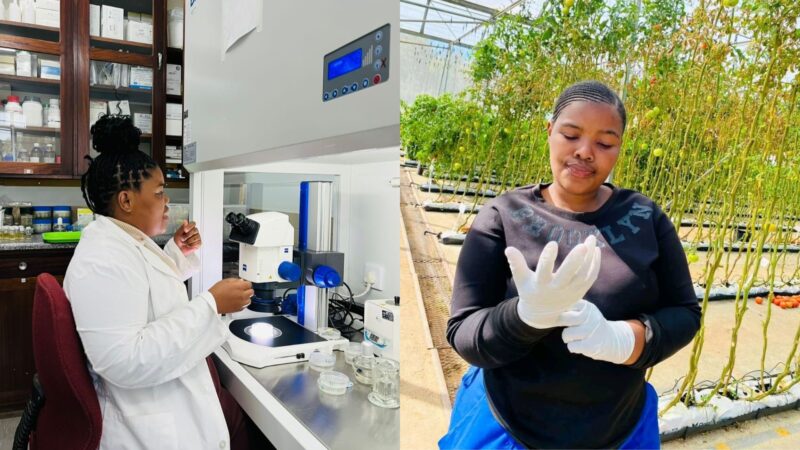
Right now, Danisa is finalising her contract with the Insika Foundation in Centurion, Tshwane, where she has been employed as a crop sciences graduate. At Insika, she saw agriculture from a different angle, looking at it through the lens of tourism.
“I also mentor a group of students on learnership programmes, which keeps me connected to the next generation.”
Based on her experience and research, Danisa notes that the biggest gap in Mzansi’s food system is communication. “Farmers face real challenges in their fields that researchers don’t always see.”
Often, the results found in labs never make it back to the farmer in a way they can actually use. “There’s still a battle in translating research into practical solutions.”
To combat this, she attends farmers’ days and industry engagements, listening carefully to their challenges to guide her own work. “My goal is to bridge the gap between the lab and the land.”
For those unsure of what exactly they like within agricultural studies, she emphasises the sheer variety in the industry, from science and business to technology and problem-solving.
“If you can dream it and you’re willing to work for it, there’s a place for you in this sector.”
READ NEXT: Wild at heart: Shane Ngwenya swapped fear of snakes for science