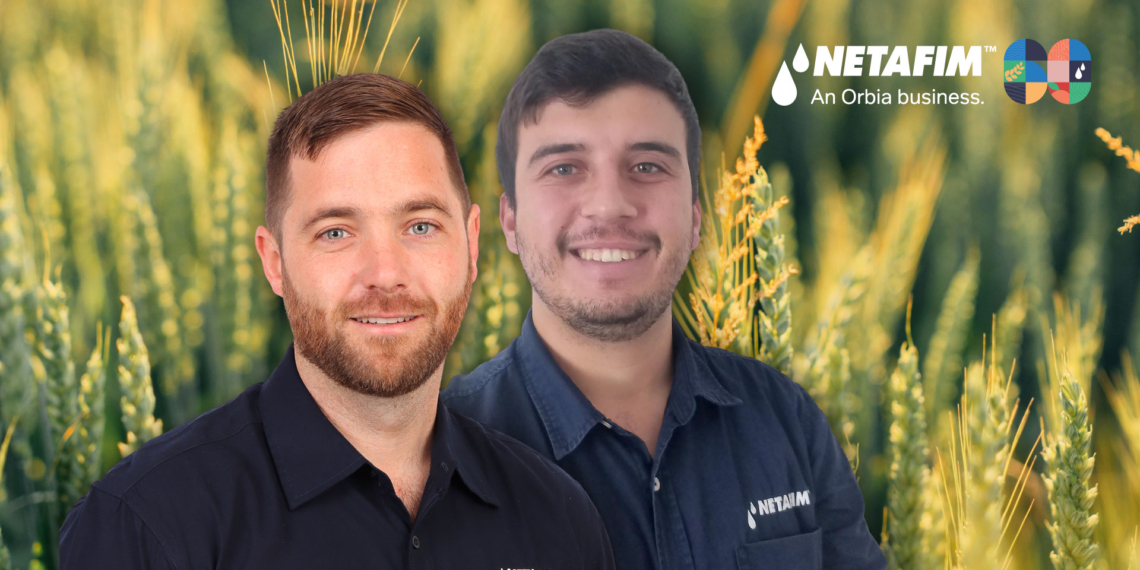
As input costs rise, more seasonal crop farmers are turning to precision drip irrigation to boost water and fertiliser efficiency. Netafim’s Dexter Neethling and Byron La Trobe explain how drip irrigation can help growers maximise efficiency.
Drip irrigation is increasingly becoming an important tool for seasonal crop farmers looking to improve water and fertiliser efficiency while managing costs.
According to Dexter Neethling, product manager at Netafim Southern and East Africa, drip irrigation works by delivering water and nutrients directly to the crop root zone.
“Drip irrigation allows you to irrigate your crops with precision, meaning it allows you to give your crop the water and fertiliser it needs at the root of the crop. If we compare drip irrigation with sprinkler irrigation, drip irrigation uses much less water because you are not irrigating the land between the crop rows, allowing efficient use of water and fertiliser,” Neethling says.
According to Byron La Trobe, technical sales advisor at Netafim Southern and East Africa, drip irrigation is no longer regarded as a new technology but has become an established practice worldwide, particularly among producers adapting to increasingly challenging climatic conditions, growing water scarcity and the need to improve fertiliser-use efficiency.
La Trobe said drip irrigation is fundamentally about maximising efficiency. While every irrigation method has limitations, drip systems offer the advantage of delivering water and nutrients directly to the active root zone, ensuring resources are applied precisely where the crop can use them most effectively. This targeted approach helps reduce wastage, improve input efficiency and support more sustainable crop production.
“There are many benefits to drip irrigation, like reduced evaporation and minimal disturbance to uniformity caused by the wind, but one of the advantages often forgotten advantages is the effect that it has on bees. By applying water directly at the ‘foot’ of the crop, we don’t disturb the hard-working bees to guarantee successful pollination,” he says.
Related stories
- How irrigation automation benefits farms of all sizes
- Netafim’s precision irrigation helps farmers grow more with less
- Netafim precision irrigation: Transforming farming in Kenya
Selecting the right system
Seasonal crop drip irrigation systems differ from those used in permanent crops. These systems generally use smaller drippers embedded in thinner-walled driplines suited to shorter production cycles.
“Manufacturers or suppliers of driplines will also indicate which dripline will suit seasonal crops,” Neethling says.
He notes that choosing the right system requires balancing cost, crop needs and operating conditions.
The goal is to balance dripper cost and performance by considering both the crop’s requirements and the practical limitations or opportunities presented by the farming conditions.
The biggest technical differences between seasonal and permanent crop systems lie in dripline durability and dripper design.
“The main technical differences between the two are the wall thickness of the dripline and the capabilities of the dripper itself,” Neethling says.
Seasonal crop driplines use thinner walls because they are not required to remain in the field for long periods. Permanent crop systems, by comparison, use larger drippers with greater filtration capacity, improved clogging resistance and, in many cases, pressure compensation for longer-term performance.
Why system protection matters
Several supporting components are essential to maintaining a reliable drip system. Neethling highlights water meters, control valves and filters as key elements for seasonal crops.
Important system components for seasonal crop irrigation include a water meter to monitor water use and a control valve to manage irrigation to individual blocks. Control valves and/ or pressure regulators are especially important in seasonal systems because thinner driplines operate at lower pressures and need protection from pressure fluctuations.
Filtration, however, remains one of the most critical investments.
“Filtration is a very important part of any irrigation system, even if it is used on seasonal crop irrigation. The filter is your only protection against particles that can potentially clog your drippers, so I see it as an essential investment for any irrigation system,” Neethling says.
Despite this, some growers still underestimate its importance in short-term production systems.
Many farmers using drip irrigation on seasonal crops fail to prioritise filtration, assuming it is less important in short-term systems. However, inadequate or absent filtration can reduce system efficiency, increase the risk of clogged drippers and ultimately jeopardise the irrigation investment and the crop yield.
Designing for affordability and durability
Cost-efficiency is a major factor in making drip irrigation accessible for seasonal crop production.
La Trobe advises, “An important aspect of making drip irrigation a suitable option for seasonal crop irrigation is ensuring that the cost of products is in line with seasonal use and short-term crop ROI.”
He says locally manufactured driplines in varying wall thicknesses help ensure solutions for different crops, farm sizes and production conditions. Using a thicker pipe with small seasonal drippers offers little value and only increases cost.
At the same time, durability remains a practical concern in the field.
“Regular users of thin-wall driplines would, however, know that in-field dripline damage becomes a significant challenge when moving towards thinner-wall driplines. Farmers do not have the time to treat driplines with kid gloves. In the field, you need irrigation equipment that does the job and survives the often tough conditions,” La Trobe notes.
To address this, Netafim’s Streamline X dripline incorporates reinforcement features designed to improve durability under demanding farming conditions.
For seasonal crop farmers, effective drip irrigation comes down to combining precision water delivery with the right system design, proper filtration and equipment suited to the realities of commercial production.
READ NEXT: Netafim’s precision irrigation helps farmers grow more with less