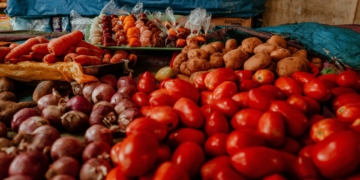
Following a recent Food For Mzansi article on tomato prices, Joburg Market responds to price concerns, explaining the mechanics of price discovery and announcing new cold storage investments to support farmers and food security.
The challenges facing South African farmers are real. Rising fuel and electricity costs, climate volatility, pests such as Tuta absoluta, logistics disruptions, and unpredictable production cycles continue to place significant pressure on producers across the agricultural value chain.
However, it is important to clarify that the Joburg Market does not arbitrarily create prices. The market operates on an open market system where the price discovery system is transparent and where prices are determined daily by supply, demand, product quality, packaging, seasonality, weather conditions, and buyer activity.
As South Africa’s largest fresh produce trading hub, Joburg Market naturally serves as the country’s leading price reference point. This reflects market scale, liquidity, and efficiency, not market manipulation. Price movement in Joburg Market may or may not influence other regions, as South Africa’s fresh-produce economy is highly integrated through national trade and logistics networks.
Fresh produce markets differ from contract-based industries because products such as tomatoes are highly perishable. Prices can shift daily, and sometimes hourly, depending on available volumes and market demand. This is a global characteristic of fresh produce trading, not unique to South Africa.
Related stories
- Tomato farmers squeezed as Joburg Market leads price shocks
- Joburg Market shines with three consecutive clean audits
- The farmer’s guide to supplying fresh produce to markets
- Farmers demand fairer fresh produce markets
To strengthen market resilience and improve product preservation, the Joburg Market has recently completed the construction of new cold storage facilities with a capacity of 1 230 pallets.
This strategic investment will:
- reduce spoilage and post-harvest losses
- extend product shelf life
- improve supply management during peak periods
- support price stability by easing oversupply pressure
- and strengthen national food security outcomes
Improved cold-chain infrastructure is a critical long-term solution to reducing volatility in highly perishable commodities such as tomatoes.

What drives price volatility
The market also remains one of the most accessible and inclusive trading platforms for farmers, particularly emerging producers, by providing:
- immediate access to thousands of buyers
- transparent daily pricing
- rapid product movement
- and structured payment systems
The current conversation should focus not on blaming markets for reflecting volatility, but on strengthening the agricultural value chain through:
- improved logistics
- expanded cold-chain infrastructure
- better production planning
- enhanced market intelligence
- and stronger coordination between supply and demand
The Joburg Market remains committed to transparency, infrastructure modernisation, producer sustainability, and strengthening South Africa’s food security system.
Price volatility is a reality for both farmers and consumers. But price volatility is primarily driven by the open market system, climatic risk, perishability, rising input costs, and inconsistent supply.

Correlation, causation and market pricing: RSA Group responds
Meanwhile, debate over South Africa’s fresh produce pricing has intensified following Food For Mzansi’s recent coverage of tomato price dynamics and what they reveal about market structure and price discovery.
Responding to the discussion and findings from a Journal of Agribusiness and Rural Development study, RSA Group chief executive Jaco Oosthuizen urged caution in how the data is interpreted, warning against mixing up correlation with causation in complex food systems.
“Food For Mzansi’s article on tomato prices raises some fascinating points about the fresh produce industry’s structure and how price discovery functions – all worthy of debate. But, as always, we need to be careful of confusing correlation and causation,” Oosthuizen said.
He illustrated the risk of misinterpretation with a well-known analogy: “In the USA, ice cream sales and shark attacks are highly correlated, but that doesn’t mean buying an ice cream increases the chances of a shark attack.”
Oosthuizen suggested that similar reasoning may apply to South Africa’s fresh produce markets, where observed price movements can easily be misunderstood without context. He said Joburg Market plays a central role in national price formation.
One explanation, he said, is that the market functions as the country’s largest and fastest trade data processing hub, where supply and demand shocks are first reflected before rippling outwards.
“There’s a case to be made that Joburg Market will naturally lead national price discovery, with its on-market conditions a key reflection point of total supply and total demand in the country,” he said. “And when prices differ at other markets it’s generally going to be for logistical reasons involving the cost of getting to market.”
He added a final caution for interpretation: “Any interpretations of the ‘meaning’ of the paper should keep sharks and ice creams in mind.”
READ NEXT: Agriculture adds 960 000 jobs as strong harvests fuel growth