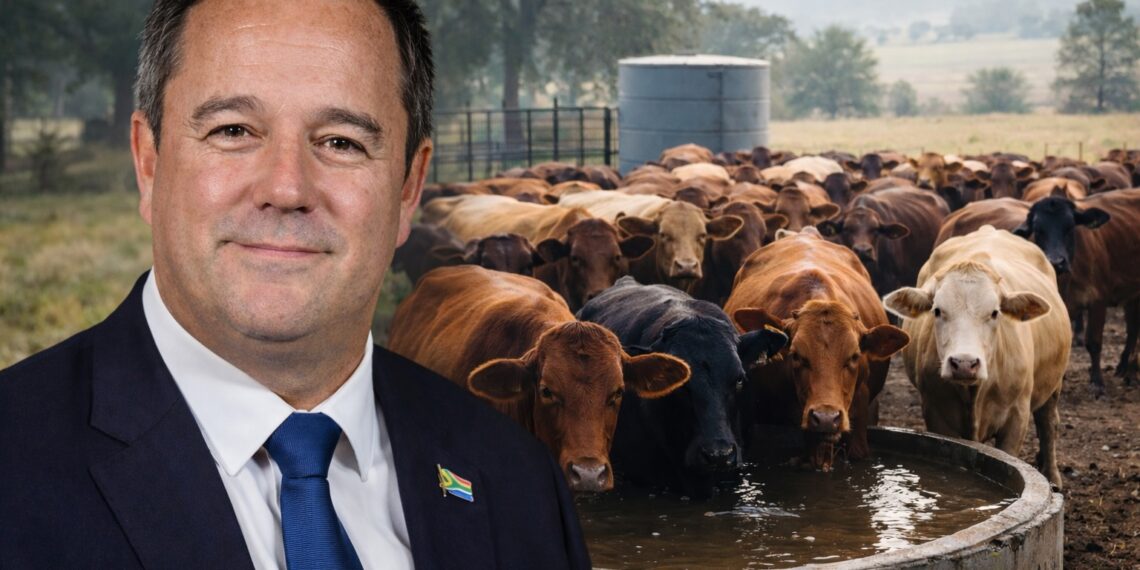
South Africa’s battle against foot-and-mouth disease has received another major boost with the arrival of an additional two million vaccine doses from Turkey, bringing the country closer to its ambitious national vaccination target.
Agriculture minister John Steenhuisen announced that the latest shipment of the Dollvet vaccine arrived on Tuesday morning as part of an accelerated procurement campaign led by the department of agriculture.
The new batch means South Africa has now imported eight million vaccine doses since late February.
“With an additional 5 million doses expected to arrive shortly, South Africa’s total imported vaccine volume will rise to 13 million doses. When combined with the 2 million BVI vaccine doses secured last year, the country will have landed 15 million doses by the end of May 2026,” said Steenhuisen.
“This sends a clear signal of our determination to protect the national interest, defend our livestock industry, and win the war against FMD.”
Outbreaks threaten livelihoods
The department of agriculture aims to vaccinate 80% of South Africa’s national cattle herd by the end of December 2026. The country’s herd is estimated at around 14 million cattle.
Government says the vaccination campaign forms part of a longer-term strategy to secure and maintain South Africa’s “FMD free with vaccination” status while limiting the economic damage caused by recurring outbreaks.
The outbreaks have placed severe pressure on livestock producers, particularly cattle farmers, while also threatening export markets and disrupting rural economies.
By securing vaccines at this scale, the department says it hopes to strengthen the resilience of the agricultural sector, protect food security and ensure compliance with international animal health standards.
Related stories
- No market access, no future: The heavy cost of FMD
- SA rolls out FMD vaccines as livestock industry fights back
- North West ramps up FMD vaccination drive in Marikana
- FMD crisis: Protecting SA’s livestock from viral disaster
Steenhuisen also used the announcement to highlight the importance of regional cooperation in controlling transboundary animal diseases.
On Monday, the minister joined Mandla Tshawuka and representatives from Mozambique in Hazyview, Mpumalanga, where 300 cattle were vaccinated in a symbolic demonstration of regional solidarity.
“One of the clearest lessons from South America is that you cannot defeat this disease in isolation. Cows do not carry passports,” Steenhuisen said.
“If one country acts alone, the risk remains for everyone. That is why we are working closely with our neighbours to build a truly regional response.”
Creating a strong SADC response to FMD
He said Southern Africa needed to move beyond reacting to outbreaks and instead establish stronger regional systems to respond rapidly when outbreaks occur.
“We must move beyond simply reacting to outbreaks and establish a SADC antigen bank so that Southern Africa can rapidly access vaccines when they are needed most, without relying on lengthy international procurement processes,” he said.
Regional discussions are expected to continue later this month when Steenhuisen chairs a meeting of Southern African Development Community agriculture ministers in Zimbabwe.
The talks will focus on livestock traceability, animal movement control and coordinated regional response systems for diseases such as Foot and Mouth Disease.
Steenhuisen also acknowledged the impact the outbreaks have had on farming communities across South Africa.
“We have seen the pain, the uncertainty and the economic damage this disease has inflicted on farming communities across our country,” he said.
“I have made a commitment that if we continue implementing this plan at scale and with urgency, this must be the last major foot-and-mouth disease outbreak to devastate our people. We are fighting this disease with everything we have, and we stand firmly with our farmers.”
READ NEXT: Unlocking the potential of fallow farmland in SA’s former homelands