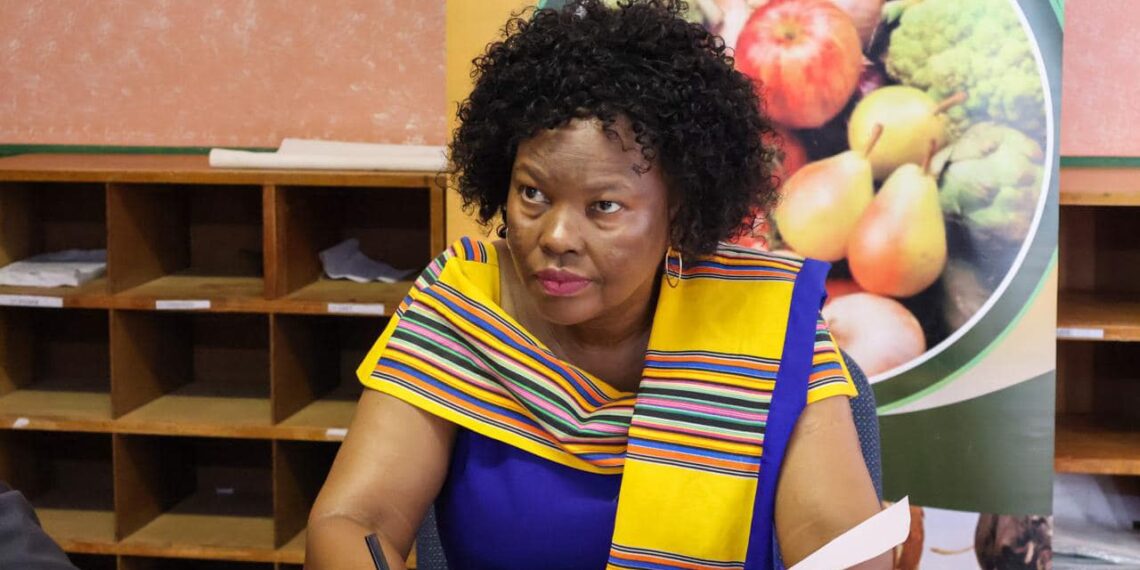
Limpopo department of agriculture and rural development’s MEC, Nakedi Kekana, reaffirmed the provincial government’s unwavering commitment to rural development and agricultural transformation in her recent budget speech.
Kekana said the department’s 2024/25 budget was aligned with the priorities set by President Cyril Ramaphosa for the seventh administration, focusing on tackling the high cost of living, poverty, inequality, and joblessness.
The MEC also unveiled the province’s new five-year strategic plan, designed to promote the meaningful participation of black farmers and expand opportunities for historically marginalised groups.
“The strategic plan aims to promote meaningful participation of black farmers, advance the inclusion of women, youth, persons with disabilities, and military veterans, and lastly, transforming the emerging farmers into fully commercial producers,” she said.
According to Kekana, agriculture remains one of Limpopo’s critical economic drivers in reducing poverty, creating jobs, and managing living costs. However, she warned that these goals are under threat due to climate change and global economic volatility.
Related stories
- Tech meets tradition: Limpopo fruit farmer Madima eyes exports
- Limpopo village proves farming can thrive in former homelands
- New plan to restore Limpopo’s once iconic Zebediela Citrus Farm
Climate change a growing threat
“Climate change is no longer an abstract global threat, it is a daily lived reality in Limpopo. Our emerging and commercial farmers alike continue to feel the pressure of erratic weather patterns, prolonged droughts, natural hazards like the recent black frost, army worms, and floods that compromise productivity and livelihoods, thus eroding our democratic gains,” she said.
She also pointed to rising global input costs, exacerbated by geopolitical tensions, as a key barrier for local farmers, driving up prices for fertiliser, seed, and mechanisation.
In response, Kekana detailed several key interventions:
- Investing in climate-smart agriculture and resilient farming systems,
- Scaling up (revitalisation of agriculture and agro-processing value chain) RAAVC infrastructure projects,
- Promoting sustainable land use practices, and
- Developing critical and future-focused agricultural skills.
Limpopo, an agricultural powerhouse
Limpopo continues to lead South Africa in food security, with 93.1% of households classified as food secure, according to the May 2024 general household survey.
Kekana confirmed the province’s strong agricultural standing and emphasised the need to close the gap for the remaining 6.9% of households still facing food insecurity.
“The province continues to be a national agricultural powerhouse, contributing 49% to South Africa’s citrus production, 32% to livestock, and 36% to grain. Most recently, Limpopo introduced canola as a new grain crop, marking a progressive shift in diversifying its agricultural portfolio,” she said.
However, Kekana raised concerns about the underdevelopment of Limpopo’s agro-industrial clusters, pointing out that the province’s dominance in primary production has yet to be matched by significant value addition in agro-processing.
To address this gap and drive inclusive economic growth, Kekana said the provincial government will prioritise strategic investments across key areas: infrastructure, research and innovation, skills development, unlocking the digital economy, industrialisation and beneficiation
Total budget and allocations for 2025/2026
For the 2025/2026 financial year, according to Kekana, the department has allocated a total budget of R1.909 billion. This investment is spread across eight key programme areas:
- Agriculture producer support and development: R811.9 million (42.51%) – the largest share of the budget.
- Administration: R381.3 million (19.97%)
- Veterinary services: R231.7 million (12.13%)
- Agricultural education and training: R160.9 million (8.43%)
- Sustainable resource use and management: R138.3 million (7.24%)
- Research and technology development services: R95.2 million (4.98%)
- Agricultural economics services: R83.9 million (4.98%)
- Rural development: R6.57 million (0.34%) – the smallest allocation.
The funding for the 2025/2026 financial year is sourced from two main streams. The largest portion, R1.563 billion, comes from the equitable share. In addition, the department receives conditional grants totalling R346 million, which include R242.9 million from the Comprehensive Agricultural Support Programme (Casp), R83.6 million from Letsema, R14.3 million from LandCare, and R5.3 million from the Expanded Public Works Programme (EPWP).
READ NEXT: Land reform is justice, not just policy, says Ngcukaitobi
Sign up for Mzansi Today: Your daily take on the news and happenings from the agriculture value chain.